This is the fourth part of a multi-part series.
Once upon a time, drawing comics in daily newspapers could be lucrative.
In the 1950s, Al Capp, the creator of “Li’l Abner,” was pulling in $500,000 a year — about $6 million today. He was a genuine celebrity, making guest appearances on talk shows and even hosting his own television programs.
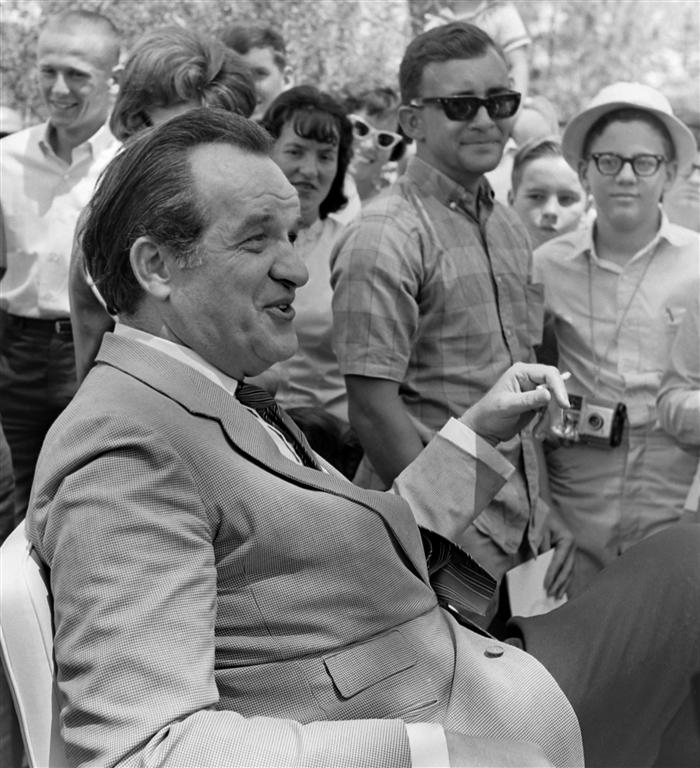
For decades, he and other creators of comic strips “made small fortunes at their craft,” as R.C. Harvey put it.
By 1989, the dynamics had changed, but it remained a great way to earn a living — if you could break into the industry — with U.S. cartoonists earning between $50,000 and $30 million per year, analysts reported.
Meanwhile, the online world was growing fast. More people getting modems, more sysops putting up bulletin board systems. The sky was the limit, some prognosticators promised.
So, if comics had made money in print, why not online, too?
Don Lokke seems to have been asking this question. He knew the print business, having worked for more than a decade as an advertiser, artist, and press operator.
When he discovered BBSes and the burgeoning online world, he saw a chance to bring his skills and experience to a new medium, and conceived the idea of selling ANSI comics and other content to sysops on a subscription basis.
After all, sysops already were paying for hardware, software, and phone bills. Maybe they’d pay for unique content, too. Something to set apart their BBSes from the competition.
I will profile Lokke and explore his unique ANSI comics in Part 5 of this series. But first, I’d like to pause and provide some context about the business of BBSing, and the growing tension between commerce and the common good.
We’ll see that Lokke wasn’t alone in trying to earn money from ANSI art.
Do you enjoy my retrocomputing histories on Break Into Chat? Please join my email list and stay in touch. 📬
From idealism to industry
When Ward Christensen and Randy Suess invented the world’s first bulletin board system, CBBS, on Feb. 16, 1978, they were keen to share it.
After all, both were members of the Chicago Area Computer Hobbyists’ Exchange, and sharing what you learned was part of the hacker ethos of those days.
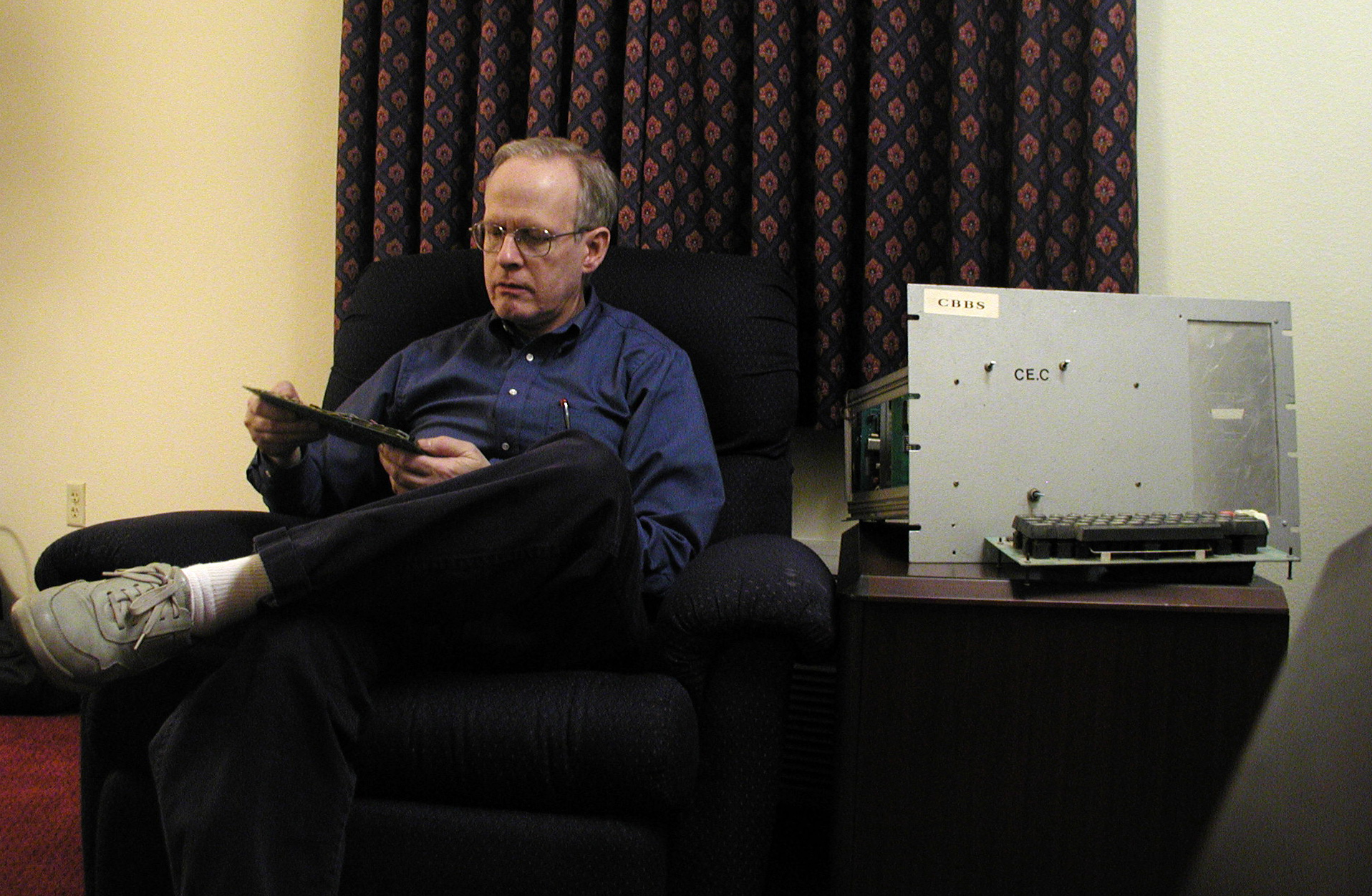
They demonstrated CBBS to the club and invited people to try calling it and leaving messages. Eventually, they published an article detailing their project in Byte Magazine.
“We would like to see other experimenters or clubs implement such a system,” they wrote, suggesting that together these boards could form a new communication network.
Tech tinkerers answered their call, and bulletin boards quickly proliferated. The novelty of swapping messages in this way, together with the spirit of openness and freedom, was hard to resist.
“There was something magic in it,” Jack Rickard, publisher of Boardwatch magazine, wrote later. “There was no money and no promotion.”
But the idealistic early days of this do-it-yourself hobby couldn’t last forever.
Running a BBS was expensive — sysops had to buy a modem and pay a monthly telephone bill at the very least. And you never knew when a computer or a drive might suddenly crash or die. On some free boards, users might chip in to fund upgrades or register software, but voluntary donations were unpredictable.
Charging a subscription must have tempted sysops as a reliable way to cover costs.
A few who took this path soon realized they didn’t have to settle for breaking even — a busy BBS might turn a profit. Users were willing to pay for amenities smaller boards couldn’t offer: real-time chat, thousands of message areas, hundreds of megabytes of files. Investing in expansion could yield a surge in users and subscription revenue.
One of the people beating this drum most loudly was Rickard, the publisher. In the early 1990s, he wrote repeatedly about the inevitability of a commercial bulletin board industry.
“We see subscription-based BBS as an emerging growth industry of unprecedented opportunity,” he wrote in September 1991. Running a BBS as a home-based business required little capital, he said, and faced “virtually no limits to success.”
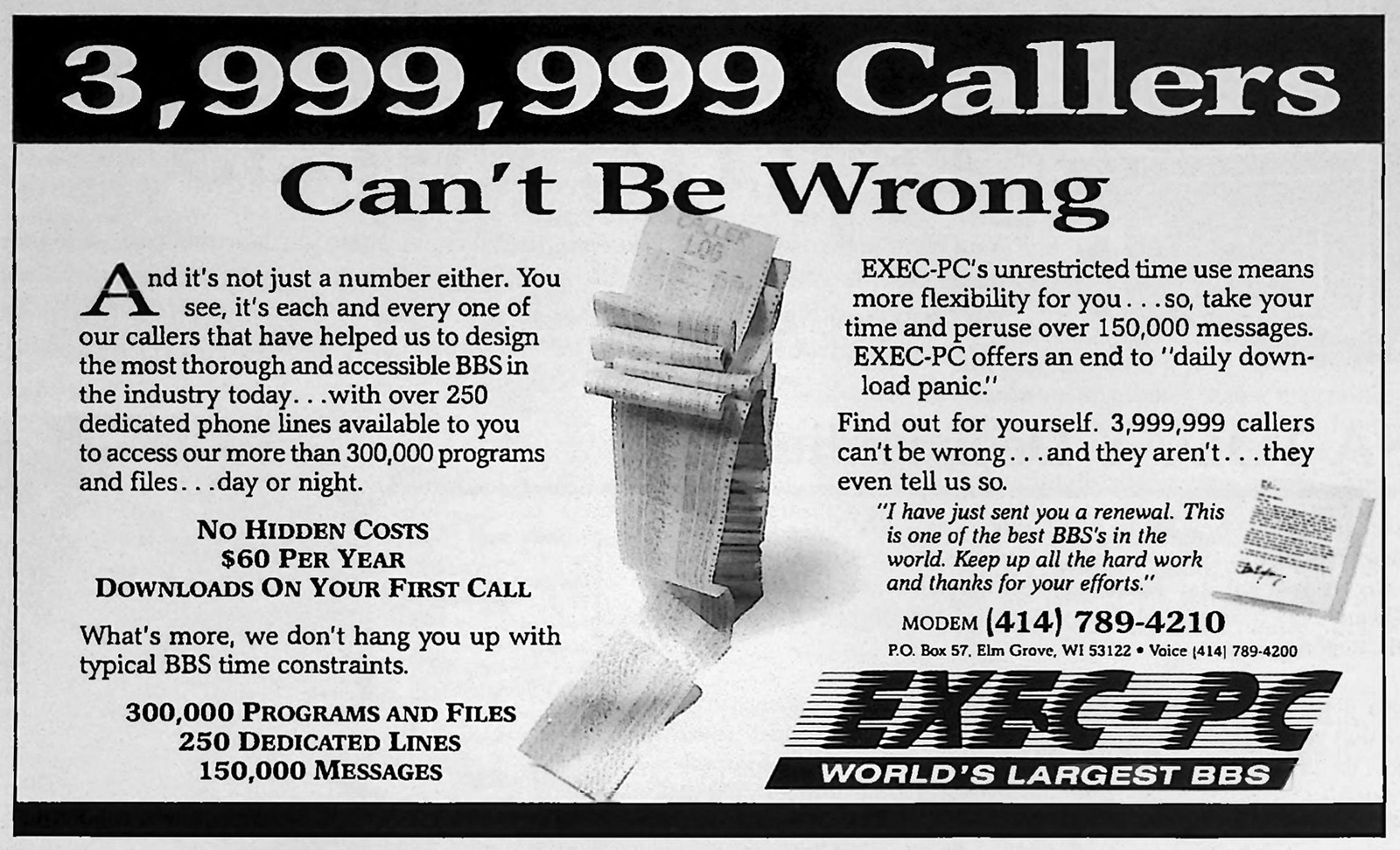
Milwaukee-based ExecPC BBS became an extreme example. Bob Mahoney set it up in his apartment as a single-line board in late 1983. Eight years later, the board had expanded to 250 phone lines and 10 gigabytes of files, and received more than 4 million total calls. Subscribers paid $60 a year for access.
Sysops weren’t the only ones chasing a profit motive.
These larger, more complex systems needed larger, more complex BBS software. And some developers found enough success to become full-blown commercial enterprises.
Phil Becker was one. By 1991, his company, eSoft, was commanding top dollar for its high-end TBBS (“The Bread Board System”) software. Prices started at $295, but large clients like Microsoft and the U.S. Environmental Protection Agency were willing to pay up to $1,995 for the 64-line version.
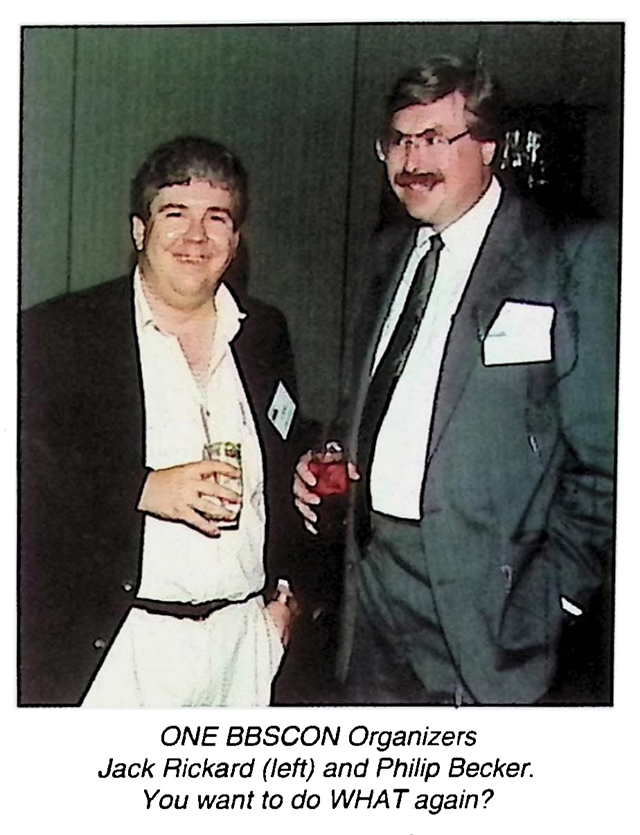
The BBSes-as-businesses buzz reached fever pitch at the inaugural “ONE BBSCON” trade show in August 1992. The brainchild of Boardwatch’s Rickard and eSoft’s Becker, the three-day conference attracted more than a thousand attendees and dozens of vendors to Denver, Colorado.
The conference’s premier track? Fifteen sessions on “How to Make Money with a BBS,” beginning with a joint presentation by Rickard and Becker titled “BBSing for Profit.”
The duo’s talk proved so popular that they reprised it several times. You can listen to the 1993 version here. Among the other sessions on the “money” track that year were “BBS Business Plans – The Venture Capitalist’s View” and “CyberFinance: How to Raise Capital for BBSes.”
It’s no wonder that within a year or two, authors were hawking how-to books with titles like “How to Successfully Run a BBS for Profit,” “Running a Perfect BBS,” or “The BBS Construction Kit: All the Software and Expert Advice You Need to Start Your Own BBS Today”?
Compelling content
The key to running a successful BBS business, Rickard often said, was choosing a strong theme.
A theme provided a vision, a focus for all the board’s content, from files to message areas to games to databases. Strong visuals could reinforce the theme, Rickard said, and help callers retain a clear “mental image” of the board they were visiting.
But where could a sysop find compelling content?
To an extent, it could be cultivated in-house: fostering discussions, encouraging users to upload files.
But some of it had to come from outside, from talented game developers, writers, and artists. And folks with these skills were learning to capitalize on them.
Games were clearly the most lucrative.
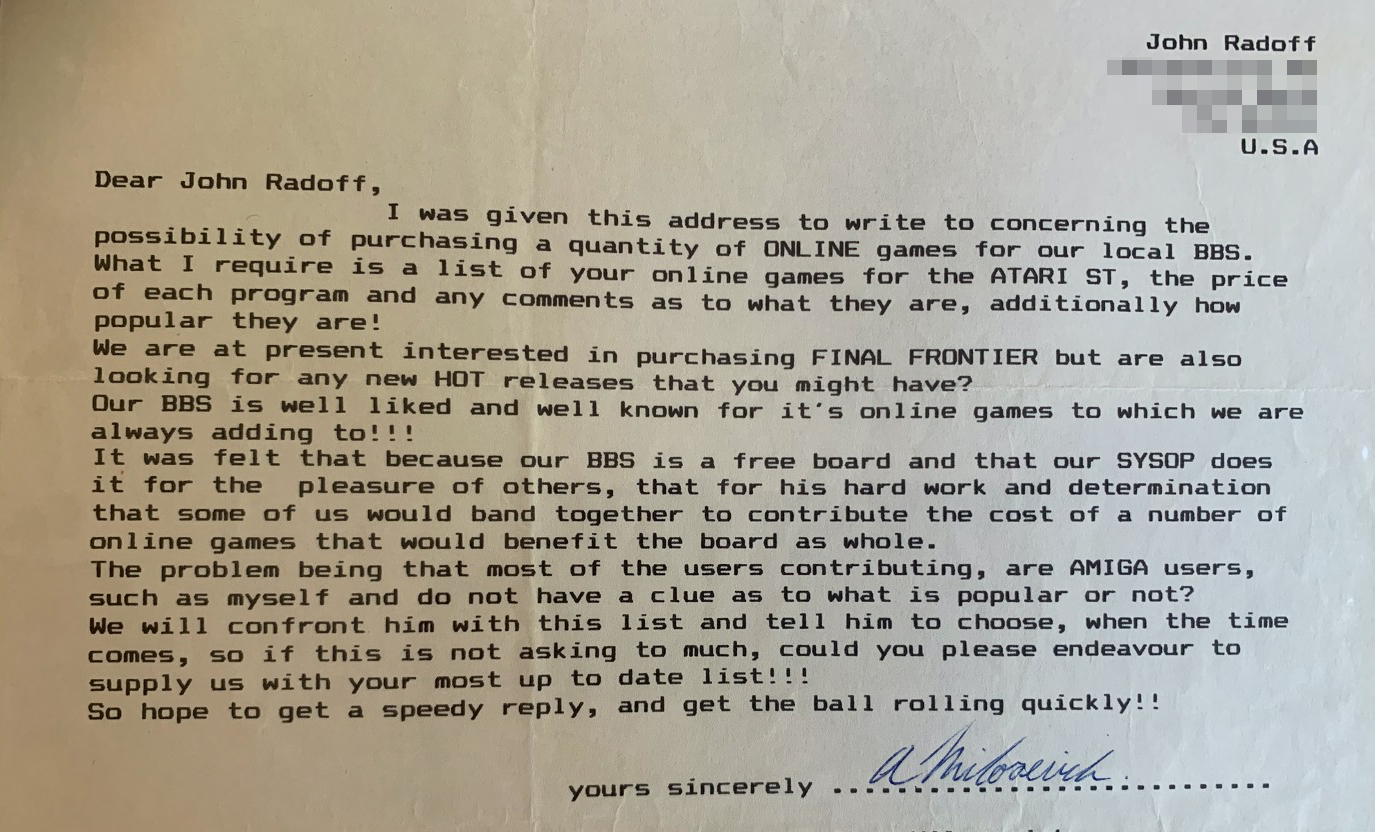
Programmer Jon Radoff, for example, struck gold in the late 1980s with his games Space Empire Elite and Final Frontier for Atari ST BBSes. He was able to earn “far more than any other conceivable employment” he might have had as a teenager, he said later.
Radoff’s success was just a prelude to even bigger hits in the early 1990s. Gary Martin’s TradeWars 2002 and Seth Robinson’s Legend of the Red Dragon were massively popular, selling tens of thousands of registered copies to sysops. Each game spawned its own cottage industry of add-on modules and helper programs developed by third-party programmers.
Most hobbyist game authors didn’t see such windfalls, but many managed to squeeze a small income from these side hustles.
But for writers and publishers, making money from BBSes remained mostly aspirational.
Dr. Ronald Albright, of Birmingham, Ala., was an early innovator. After self-publishing several print books on computer topics, he decided to try an experiment: He would convert one of his books to hypertext, then distribute it electronically using the shareware model.
He later claimed thousands of readers saw his work this way, though it’s not clear how much, if anything, he earned. Still, the experience convinced him that electronic publishing was the future.
“You will be billed for downloading,” Albright predicted. “The authors will get royalties based on electronic sales. You will get updates quickly and easily. Bookshelves will be replaced by disk cabinets.”
To help bring about this future, he founded the “Disktop Publishing Association” (DPA) in late 1991. The group hoped to achieve the same legitimacy as the traditional publishing industry.
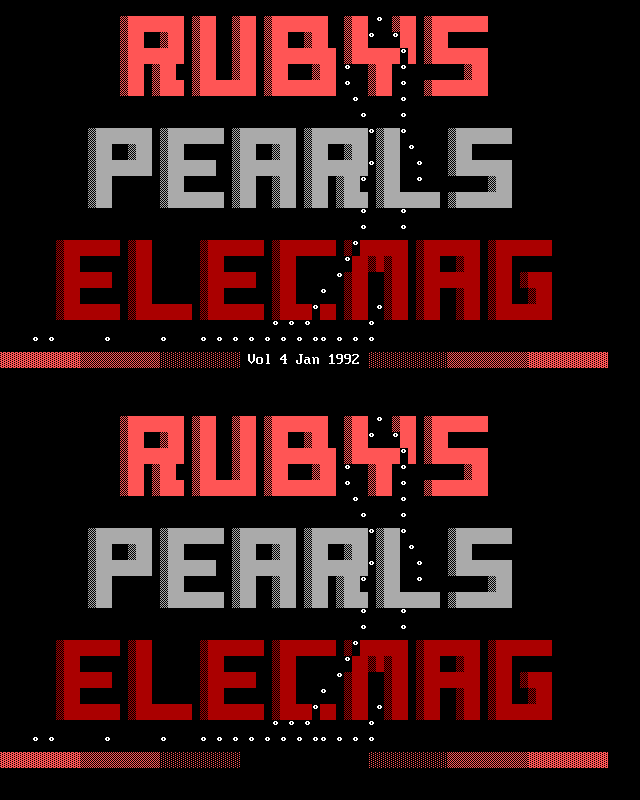
Within six months, the DPA’s membership had grown to 36 authors and e-magazine publishers such as David and Del Freeman, the brains behind the Ruby’s Pearls e-magazine and the hypertext novel Southern Discomfort.
Another early member? Don Lokke.
In 1992, Lokke was trying to build a business selling original ANSI art and other content on a subscription basis, targeting sysops who wanted to set their bulletin boards apart. The DPA must have seemed like a perfect networking opportunity, a chance to compare notes with likeminded folks.
Hoping to find a niche in the group, Lokke began curating a database of electronic publishers. He urged DPA members to call his “Online Mall BBS” and add themselves to the listings.
“If you are selling hypertext, animation, sound, software or services we want you in our databases!” he wrote.
Later that year, the Freemans tapped Lokke to design a cover for their first hard-copy anthology of “Ruby’s Pearls.” By April 1993, Lokke was serving as chairman of the DPA’s interim board of directors.
He had found his people.
But was there any real hope he could make money selling ANSI art to sysops?
Selling ANSI art
After the underground ANSI art scene took off, some of its biggest names advertised their willingness to work for commissions.
Eerie, an underground ANSI artist and the subject of Part 3 of this series, told me that some sysops were willing to pay for high-end screens and logos. He drew a few commissions himself, but such work was scarce.
It was far more common, he said, for artists to trade: I’ll draw an ad for your BBS, you draw one for mine.
But that was several years later. Were there any precedents for selling mainstream ANSI art in the earlier years?
Yes: the “Make a Kid Smile” project, and “Ansi Shoppe.”
Selling art in some ways ran counter to the community culture that still prevailed across the public domain (PD) ANSI art scene. The message areas where these artists met were “a place to call home,” a place where they “could feel creative,” as ANSI artist Lora Ruffner once described it. She and her fellow artists shared their work and their feedback freely.
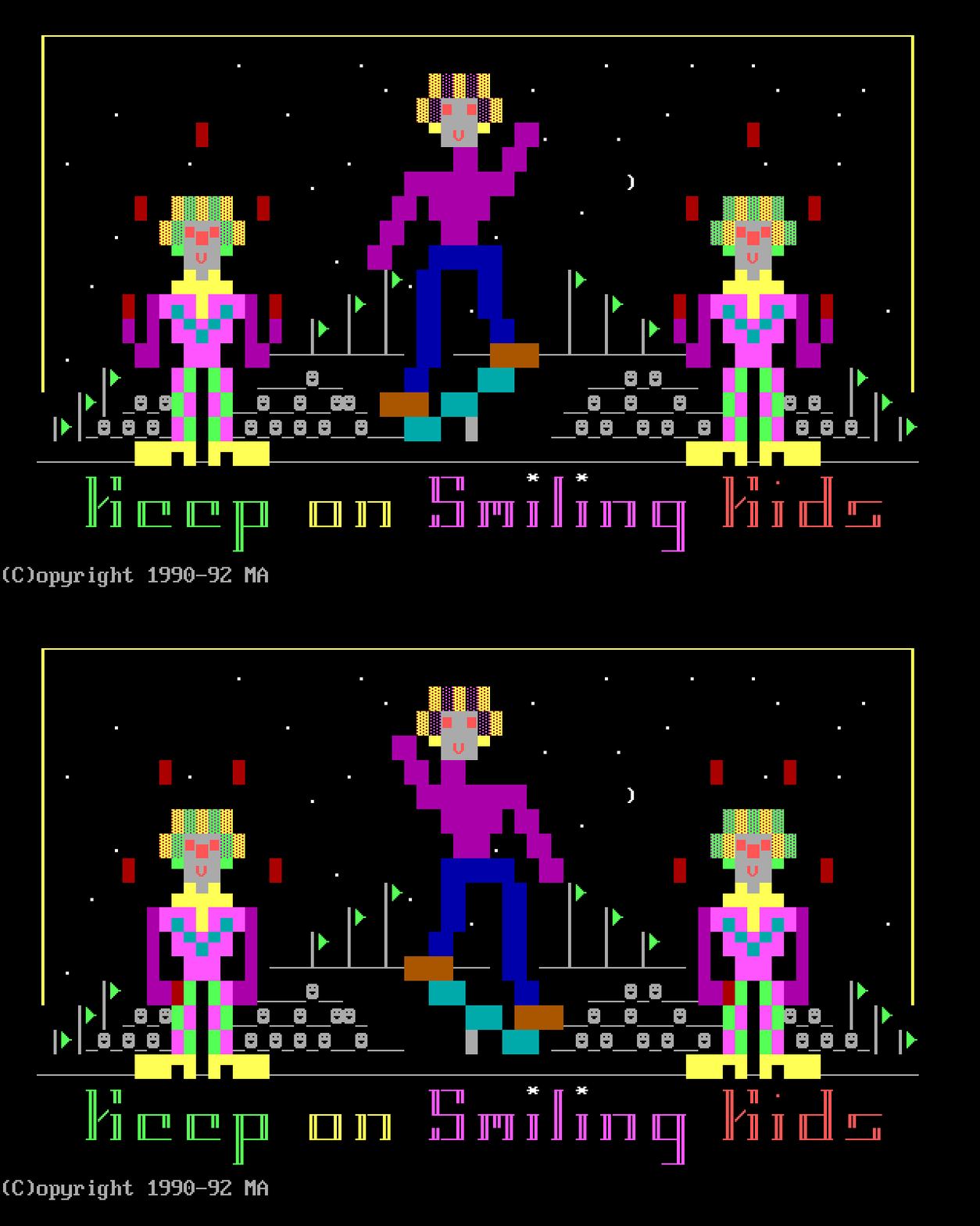
Perhaps it’s not surprising, then, that one of the early attempts to sell ANSI art was charitable endeavor, a fundraiser that exemplified the very best of the hobbyist BBS community.
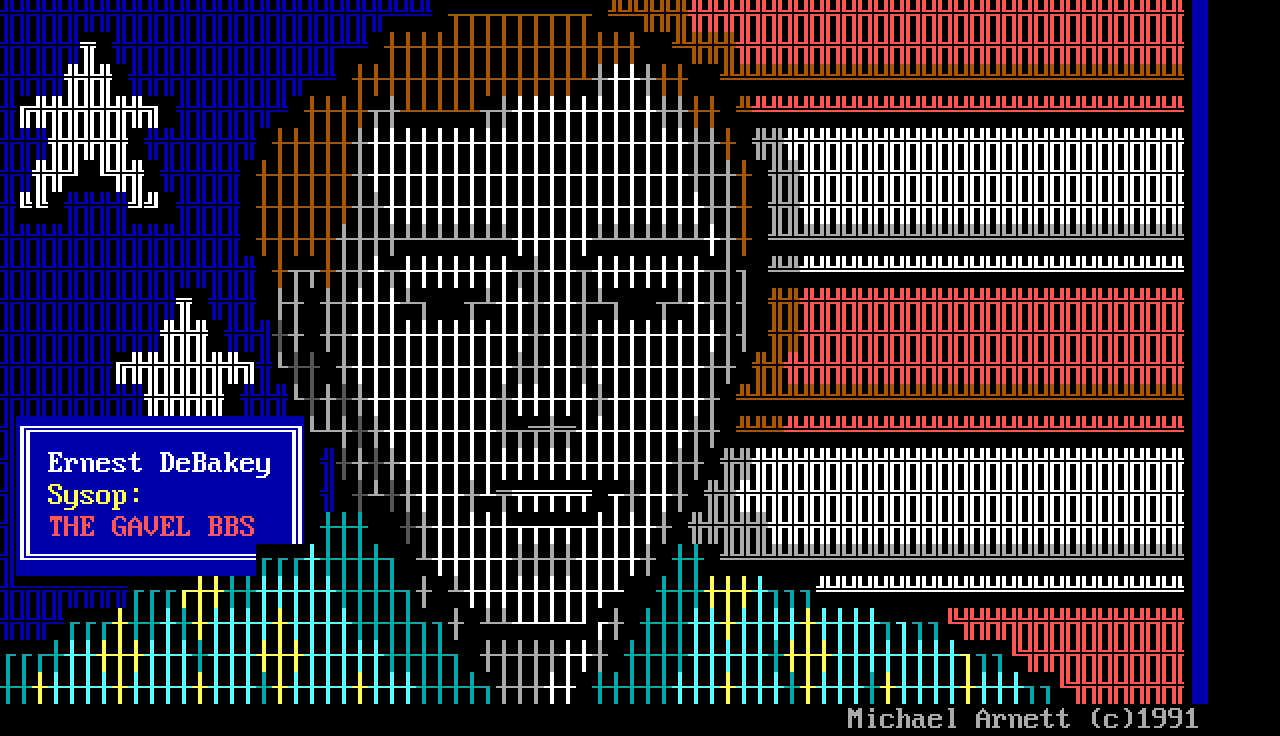
In 1989, ANSI artist Michael Arnett and attorney Ernest DeBakey, sysop of “The Gavel BBS” in Houston, Texas, launched a nonprofit called “Make a Kid Smile, Inc.” Their vision was to donate “Smile Machines” — menu-driven computers loaded with games, drawing programs, and ANSI art — to children’s hospitals for patients to enjoy.
To raise money, Arnett and DeBakey sold a $20 package to sysops that included the “SMILE” ANSI art viewer program, bundled with a collection of 500 ANSI screens.
They raised enough to donate their first system in 1991, and the effort was successful enough they continued one system per year through 1995.
“Make a Kid Smile” proved that some sysops would pay for art and support a good cause.
Around the same time, Lora Ruffner decided to see if she could turn her artistic talent into a business.
Ruffner, better known as Ebony Eyes, ran the “Third Stage BBS” in St. Louis with her husband Richard. She was a strong presence in the WWIV community, and one of the most gifted and prolific PD ANSI artists. No one was better positioned to try building an ANSI art business than her.
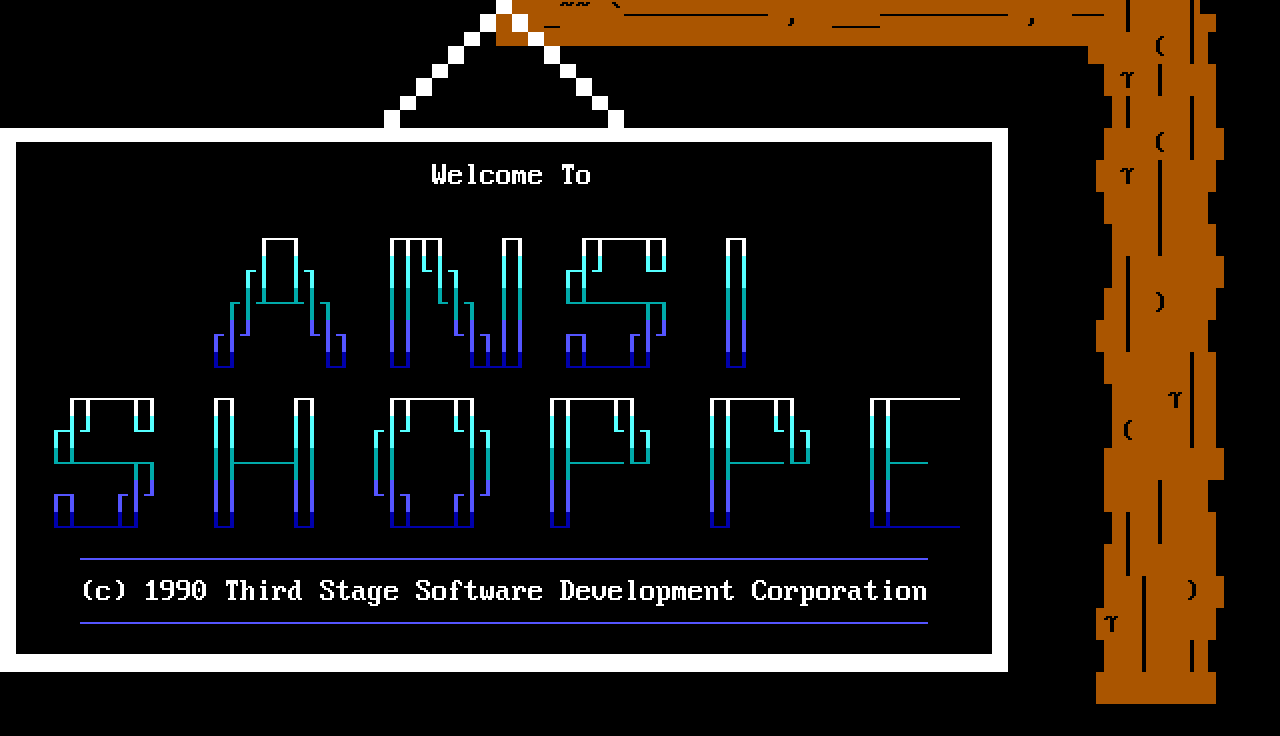
So, in 1990 she launched “Ansi Shoppe.”
She adopted a business model similar to “shareware” software distribution: she gave sysops a sample of her art in hopes they would decide to buy more.
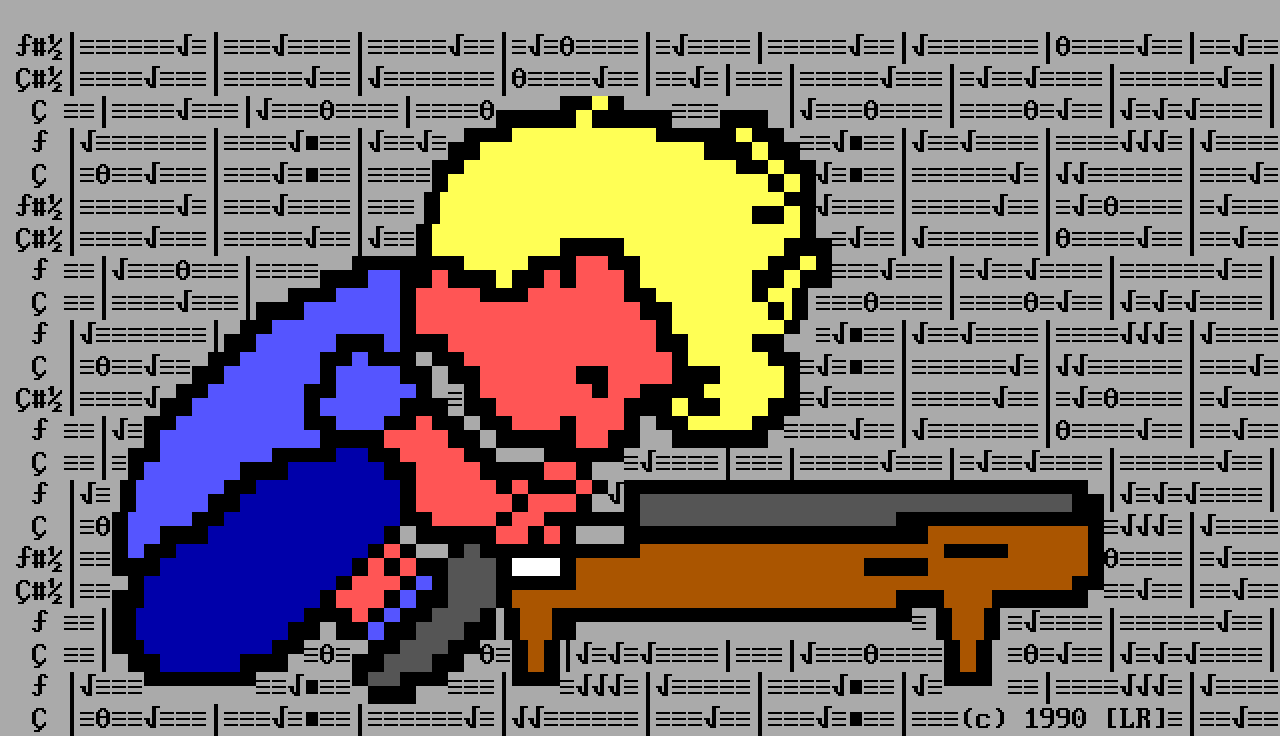
Ruffner’s free variety pack featured 24 ANSI screens, most of them portraits of well-known characters, from Captain Crunch to Donald Duck to to Mario.
This was just a small selection of her “current stock of over 600 screens.” Her back catalog ran the gamut from holidays, to fantasy, to Star Trek, to adult themes. She also offered a custom artwork service for sysops, starting at $10 per screen.
Ruffner began advertising “Ansi Shoppe” in April 1990.
Then, six months later, life intruded.
She abruptly closed her BBS and left the BBS scene. A fellow St. Louis BBSer explained she had “suffered an illness in her family.”
It’s not clear whether “Ansi Shoppe” had found any success before its end. (Ruffner died in 2023.)
Still, if Lokke knew about either of these two projects, perhaps they gave him hope.
“Make a Kid Smile” proved people would pay for art. And “Ansi Shoppe” provided a pattern, a business model he could adapt.
But Lokke faced a significant disadvantage: unlike Arnett and Ruffner, he didn’t have years’ worth of digital drawings to sell. He needed a niche — something no one else was drawing.
Amid the presidential race of 1992, he found one — an idea drawn from newspaper comics traditions.
The political cartoon.
Up next — Part 5: Don Lokke and “Mack the Mouse”
Share your thoughts!