Whether you call it “ripping” or “remixing”, the BBS scene had a long tradition of adapting and reusing earlier ANSI art.
Fire Escape was one of many sysops around the world who often repurposed older so-called “public domain” ANSI art to enliven her bulletin board.
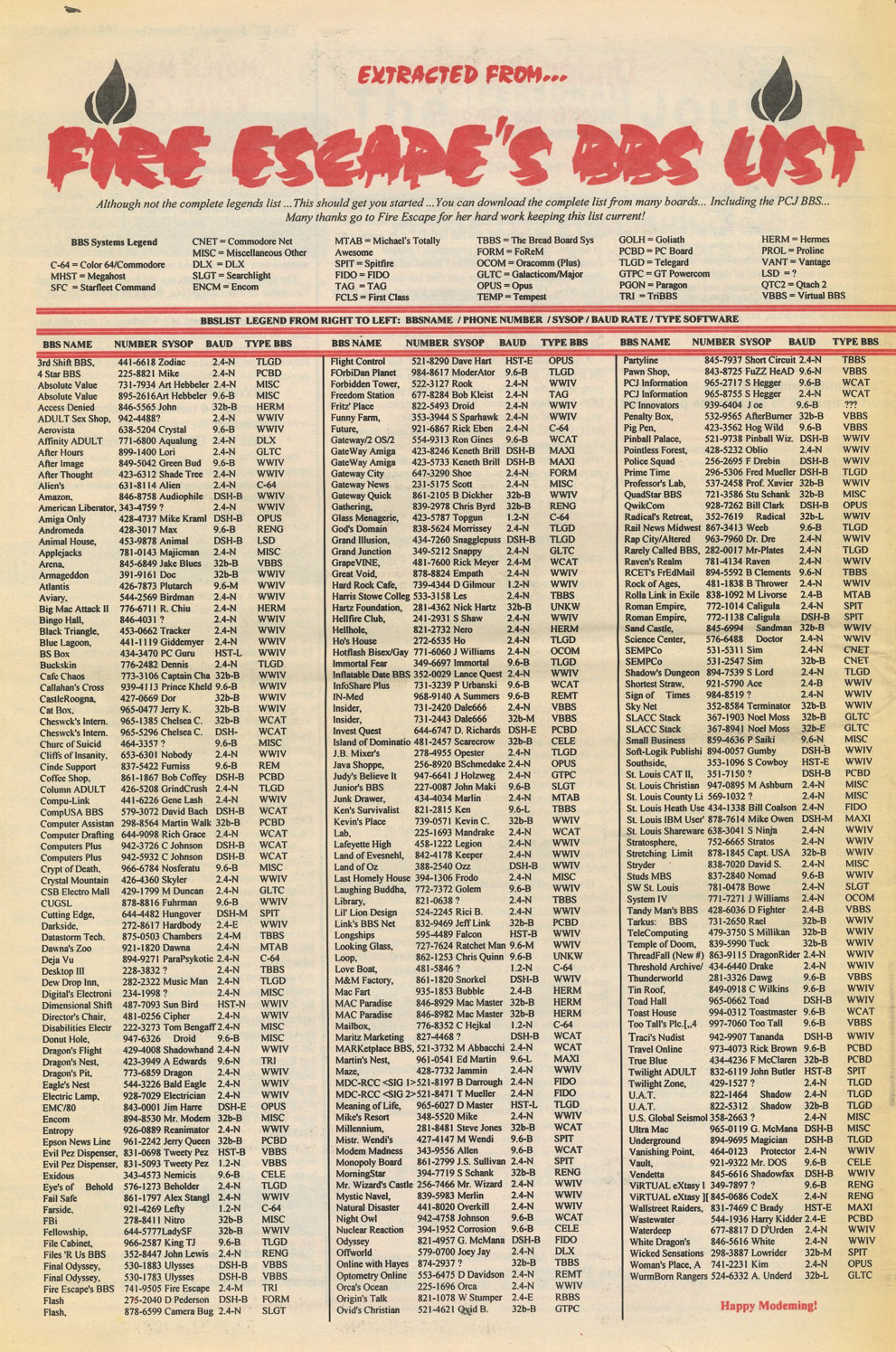
She was famous in St. Louis, Missouri, for her meticulous work as curator of “Fire Escape’s St. Louis BBS Directory,” the authoritative monthly list of bulletin boards in the 314 area code. Even Boardwatch Magazine recognized Fire Escape’s directory as “one of the most accurate and detailed bulletin board lists in the world.”
In late 1992, she set up her own BBS — “Fire Escape’s BBS Directory HQ” or “FEHQ” — with the help of her then-husband and it quickly became one of the most popular boards in town.
In my last blog post, I tracked down the source of a mysterious custom title screen for the game Solar Realms Elite that I first encountered on FEHQ in the 1990s. In that post, I showed that Fire Escape had adapted an older piece of ANSI art, GALACTIC.ANS, drawn by the artist Tom Bradford for an entirely different game. And she wasn’t the only one — at least two other people reused this same screen for other game projects.
In this blog post, I’m going to continue exploring this phenomenon by tracing the origins of several other pieces of art from Fire Escape’s BBS. We’ll see that adapting old ANSI art was a widespread practice. And it wasn’t limited to sysops or programmers — even ANSI artists sometimes reused their own work.
Reinforcing a mental image
Jack Rickard, the publisher of Boardwatch, repeatedly counseled new sysops to choose a strong theme when setting up a BBS, to give it vision and focus.
Themes helped callers develop a clear “mental image” of the BBS they were calling, Rickard said, which increased the chance they would keep calling back. If you were a gardener, he said, you might choose “lawn care” as a theme, and name your board “The Green Thumb BBS.”
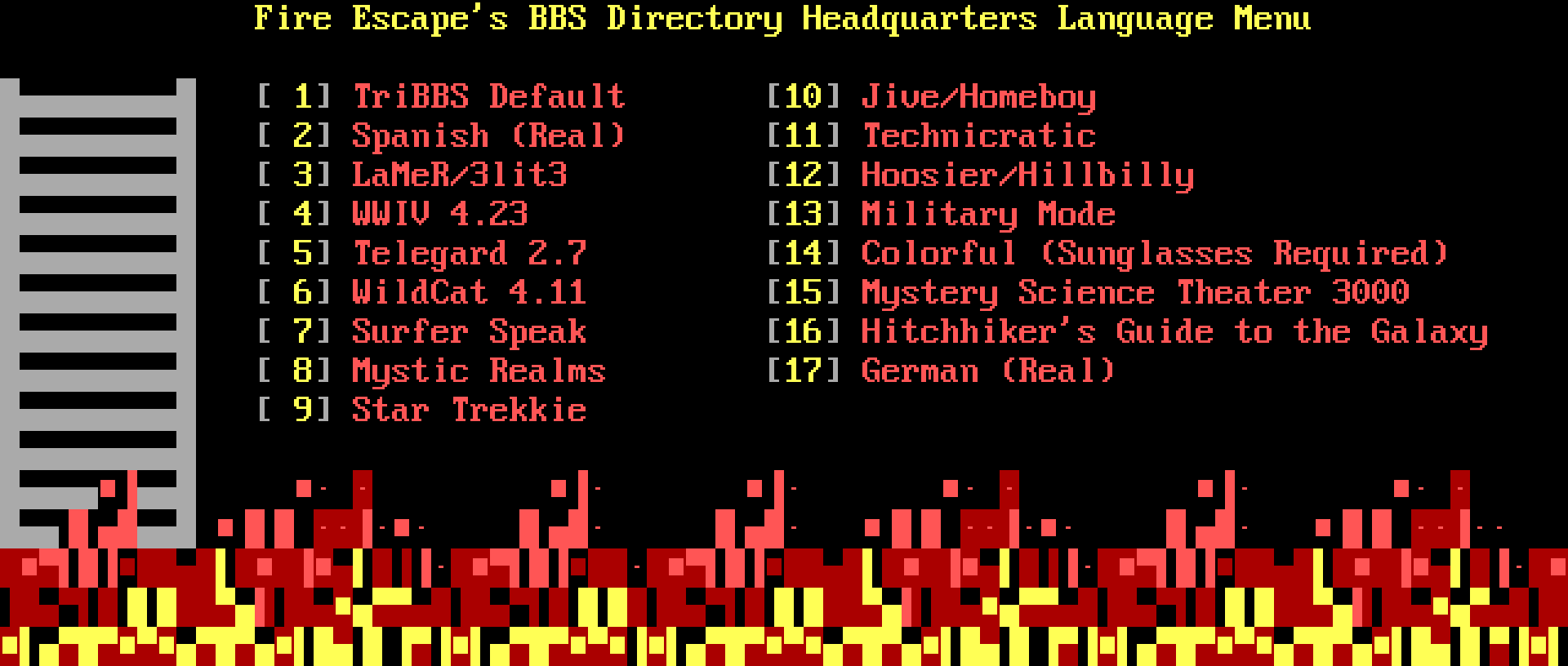
And if you ran a BBS called “Fire Escape’s”, you might adorn your BBS with images of flames and mushroom clouds, and make liberal use of red and yellow.
Which is exactly what Fire Escape did.
But she also believed in variety.
Any time a caller connected, the BBS would display one of 18 (!) different welcome screens, chosen at random. While many of these fit her theme (see gallery above), others were more whimsical (see gallery below): Snoopy as “Joe Cool,” a pet store, a computer room.
I called Fire Escape’s BBS so frequently for so long (I was No. 9 on her leaderboard for users with most calls) that each of these logon screens was burned into my memory. In the mid-2000s, when I was one of very few people still interested, she sent me an archive of every ANSI screen she used on her BBS — dozens of them — a treasure trove I still have today.
But where did she get all this art?
It’s not a question I would have thought to ask as a teenager in those days. Many years later, though, I stumbled across the answer while researching for Part 2 of my ANSI art and webcomics series.
Some, maybe even most, of Fire Escape’s logon screens had actually been adapted from old school “public domain” ANSI art drawn in the late 1980s and early 1990s by folks such as Tom Bradford, Lora Ruffner (aka “Ebony Eyes”) and Violet Stymacks.
In the rest of this blog post, we’ll compare several of Fire Escape’s welcome screens with the original versions, as well as variations made by other people. Some of these will get surprisingly surreal.
Comparisons
THE SNOOPYS
Fire Escape’s versions of these public-domain images were usually altered in various ways. The most common was cropping: Terminal screens ranged from 23-25 rows tall, but Fire Escape cropped each of her logon images much tighter, restricting them to 16-17 lines max. One side effect of cropping is that artist signatures or attribution were often removed.
We can see this clearly when we trace the origins of two FEHQ logon screens featuring the beloved Peanuts character “Snoopy”:
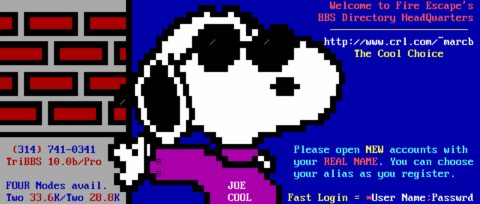
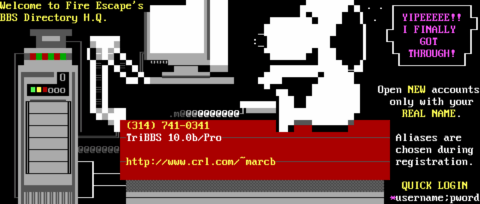
The first of these two, LOGON1C.ANS, features Snoopy as “Joe Cool”, leaning against the corner of a brick building. The original version of this image was drawn in 1990 by Lora Ruffner, also known as “Ebony Eyes,” perhaps one of the most prominent of the public-domain ANSI artists.
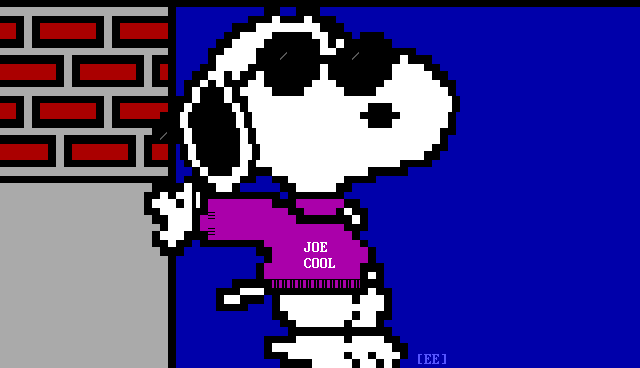
Ruffner’s original was deeper than Fire Escape’s version — Snoopy had legs! — and was almost entirely devoid of any text other than Ruffner’s artist signature: “[EE]”. Images like this were probably attractive to sysops because they could fill the empty space with their board’s details, as Fire Escape did.
The second of these two FEHQ Snoopy images, LOGON1I.ANS, shows him sitting atop his dog house — but instead of flying a Sopwith Camel, he’s using a computer, maybe to call a BBS. The original version of this image was drawn in 1990 by Michael C. Ling, who signed his images as “MCL”.
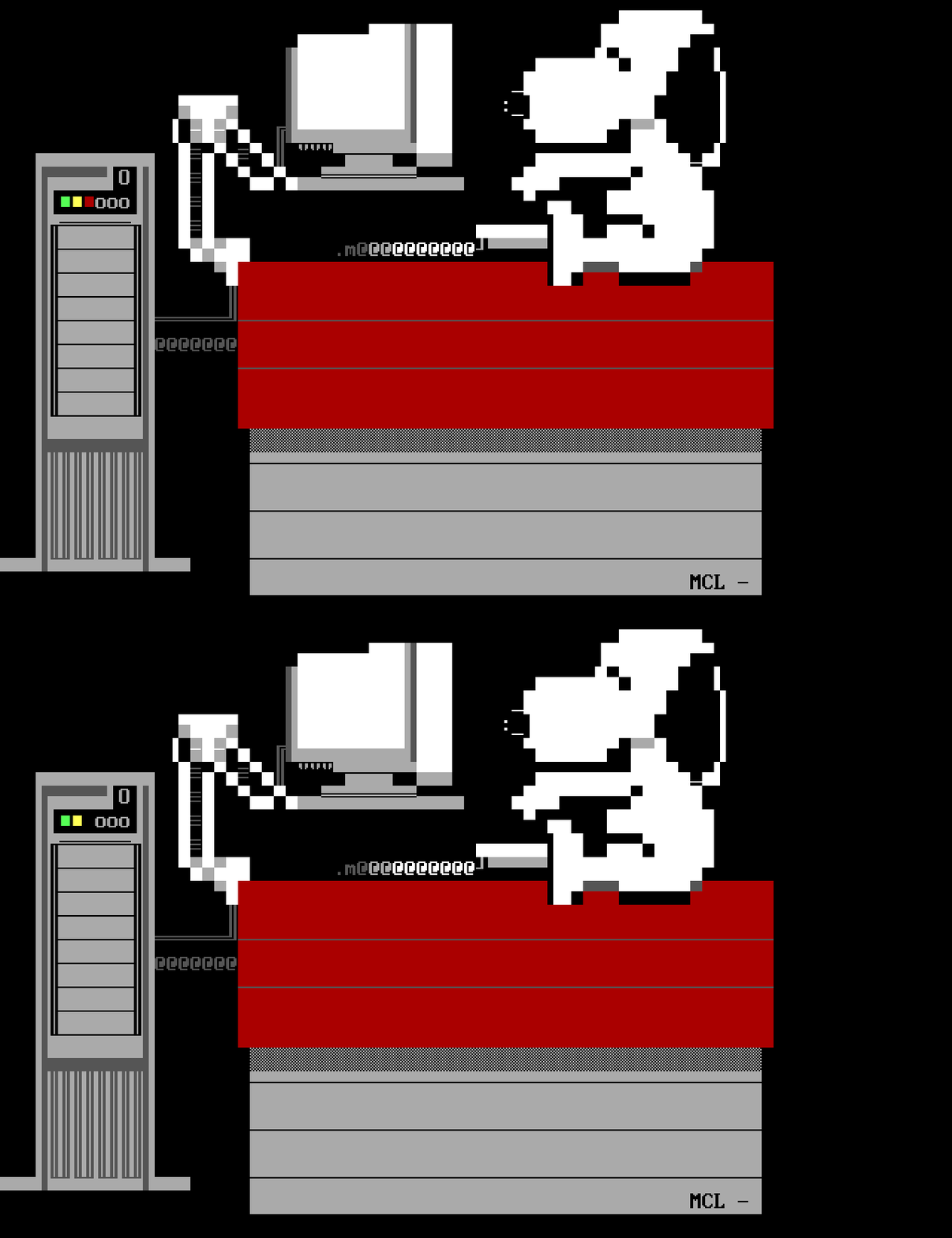
As before, Ling’s original is deeper than the version on Fire Escape’s BBS, his signature has been cropped out, and Fire Escape has filled in the empty space with her board’s details. But Fire Escape’s version of this Snoopy image was altered more than the other one: Her version has added a device atop the computer tower, added many more wires, and — most interesting of all — added a thought balloon for Snoopy, saying “Yipeeeee!! I finally got through!”
THE MUSHROOM CLOUD
The most striking of all Fire Escape’s logon screens in my opinion is LOGON1B.ANS, a visceral, yet extremely compact, depiction of a nuclear holocaust (seen below). A gray mushroom cloud rises from a bright yellow fireball, in front of a skyline of broken red buildings against a black background.
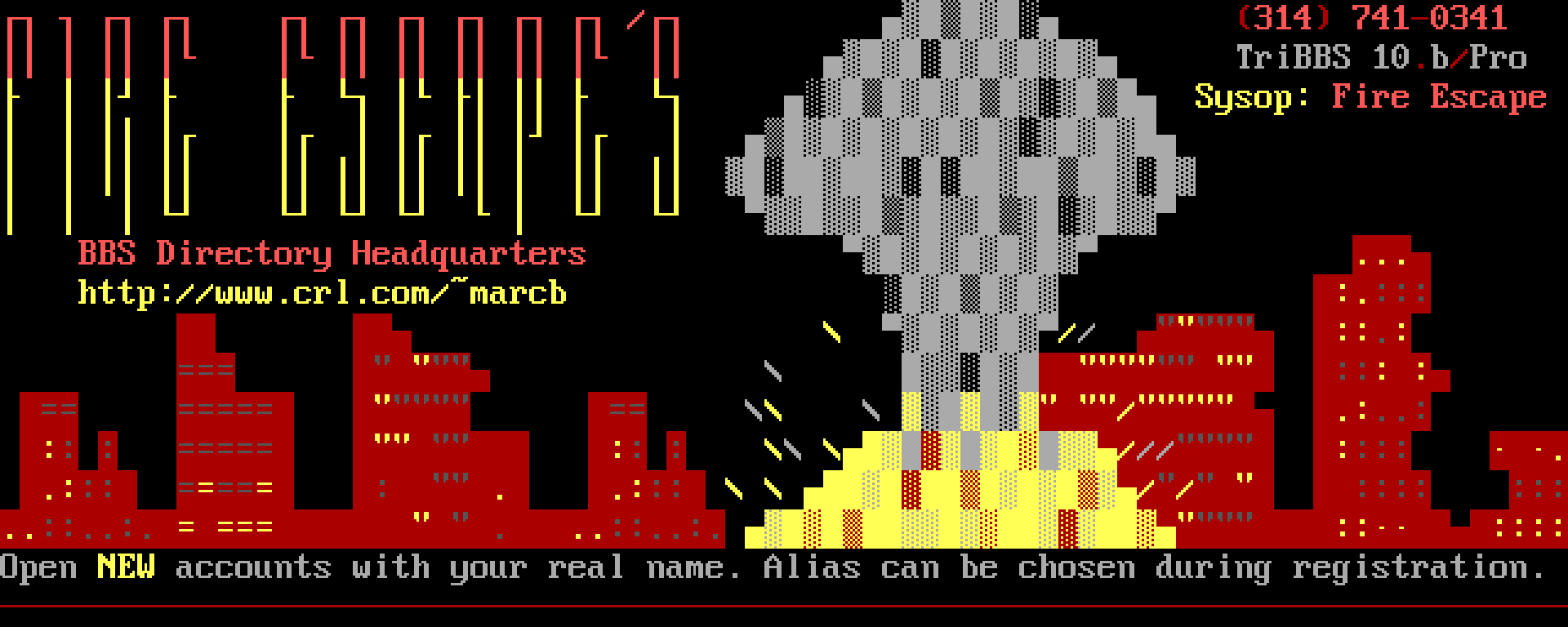
It turns out that the oldest extant version of this image, called ESCAPE.ANS, predates Fire Escape’s BBS by five years. It was drawn by an artist using the signature “TS” (stylized as “┬s”) in 1987. (I have been able to locate only one other piece signed by the same artist. I suspect both ESCAPE.ANS and this other piece may have been meant as intro screens for very early BBS games.)
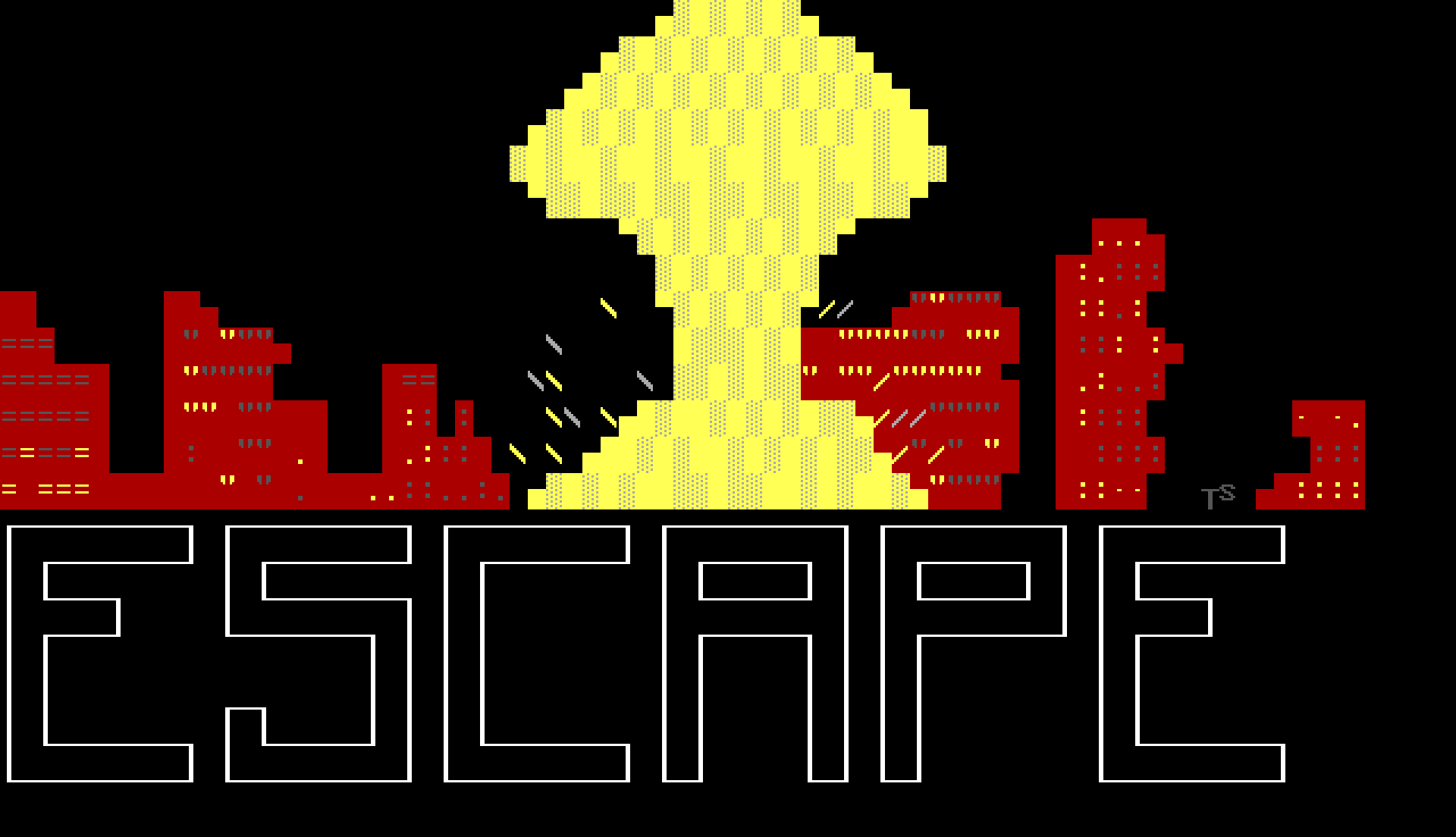
The original ESCAPE.ANS is simpler than Fire Escape’s adaptation: the explosion and the mushroom cloud are just a single shade of yellow. The dark sky is empty, and the word “ESCAPE” is drawn underneath in a large blocky ANSI font.
In 1990, three years later, an unknown artist adapted TS’s ESCAPE.ANS to a new context: the Persian Gulf War. This artist rearranged the buildings in the skyline in order to shift the mushroom cloud to the right and make room for text on the left: “Greetings Saddam Hussein! (pronounced who sane?) Welcome to Bagdad after dark!” More importantly, the artist took what had been a static image and animated it: the buildings are drawn first, followed by the explosion (from the ground up).

Then, in 1995, someone using the handle “Kung Fu Tzu” made a noteworthy adaptation of ESCAPE.ANS. Kung Fu Tzu kept the drawing exactly the same, but replaced the large word “ESCAPE” with “STOP,” transforming the piece into more of an anti-nuclear protest.
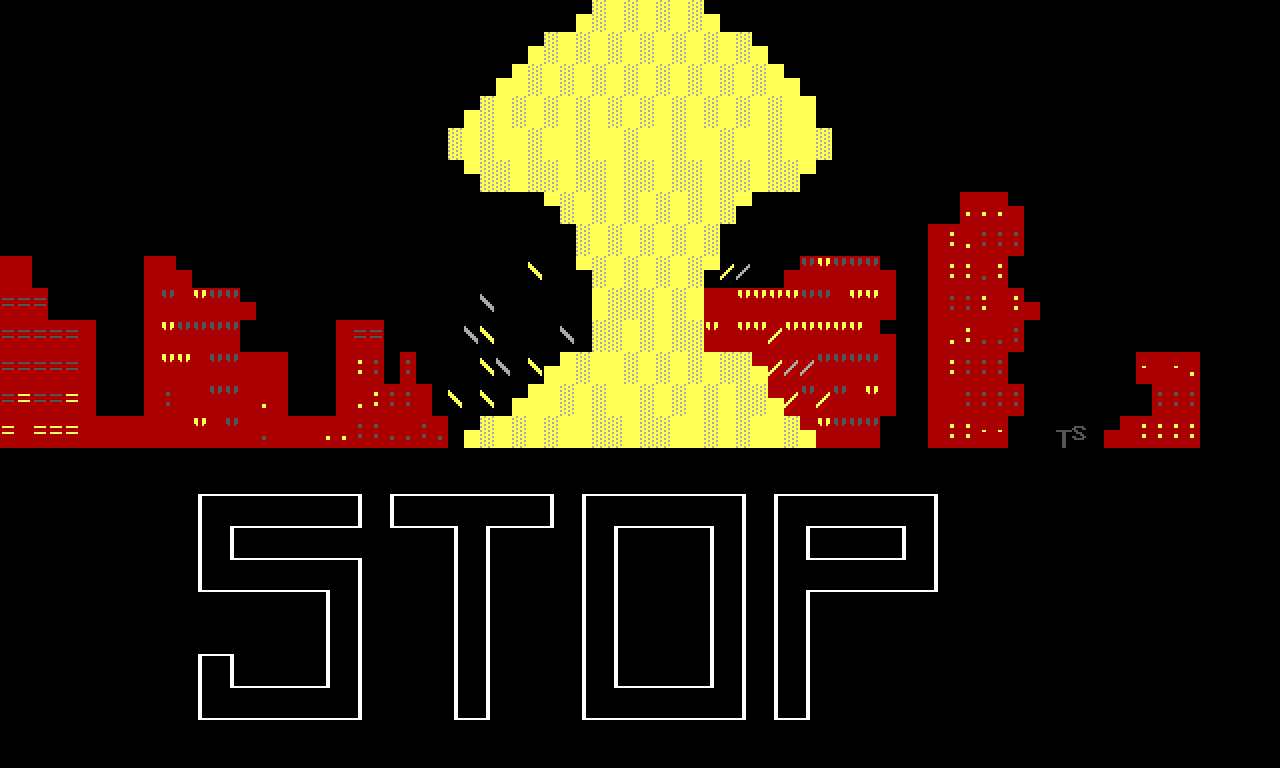
[Quick digression: This was just one of hundreds of pieces of public domain ANSI art that Kung Fu Tzu altered — actually “defaced” might be more accurate — as part of a bizarre project released in 1995, called CHRISLAM. It’s chock-full of rambling manifestos and nonsensical screeds written in a syntax/language called “SIMPLE”. I won’t say any more about it, except to note that CHRISLAM also includes alternate versions of each of the next two images I’ll discuss in this blog post.]
I find the Fire Escape version to be superior visually to the earlier variations. It’s not clear who made the improvements — whether Fire Escape, her then-husband, or some other person. But that person gave the mushroom cloud and the explosion more definition with better use of shaded blocks and color. Making the mushroom cloud entirely gray separated it visually from the explosion. There’s also great ANSI typography — the long thin font used for the phrase “Fire Escape’s” looks much cooler than the blocky “ESCAPE”.
THE COMPUTER ROOM
In contrast to the previous case study, Fire Escape’s LOGON1A.ANS screen — a computer room — might seem mundane. But, trust me, this will go in a surreal direction.
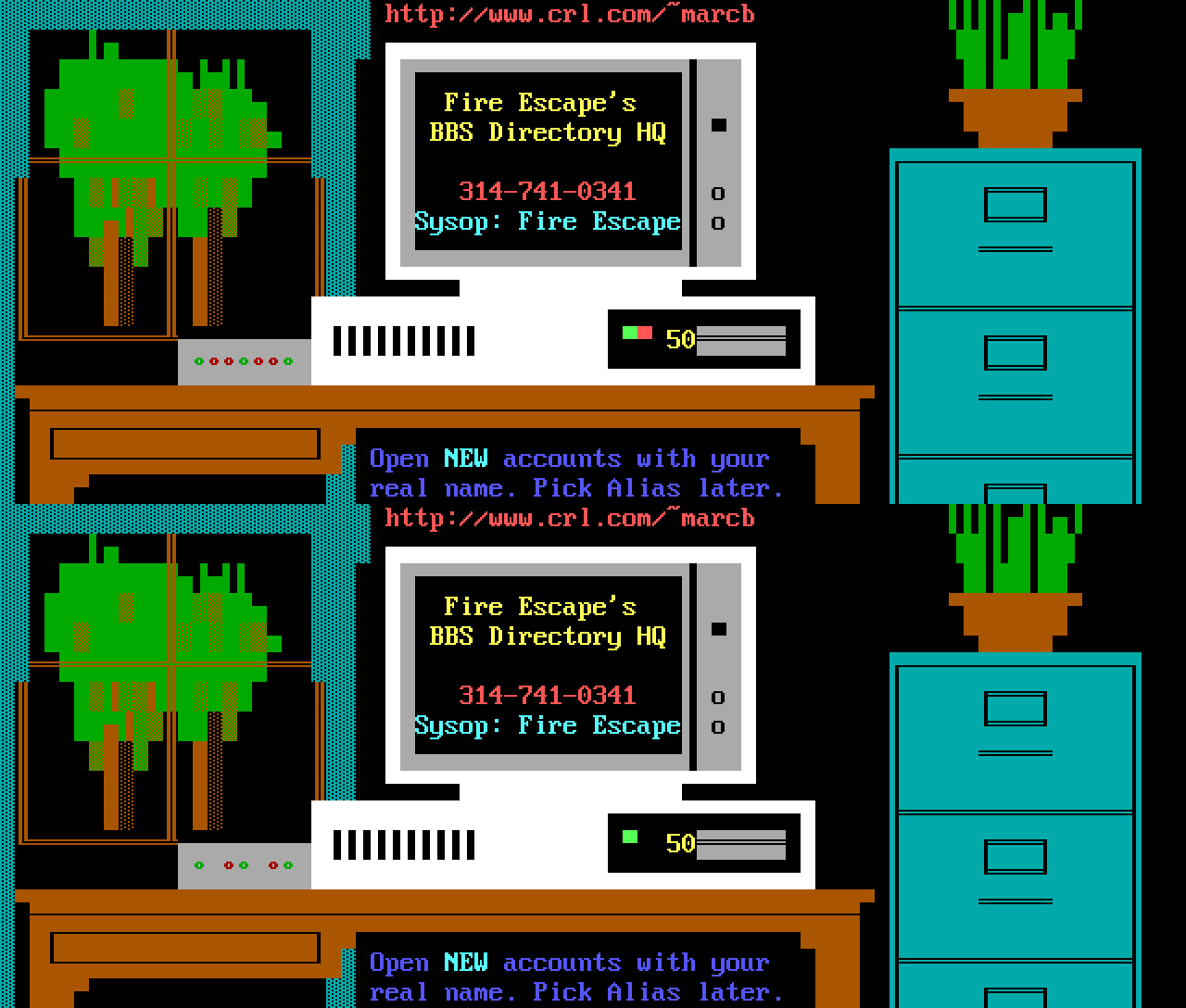
Desktop computers were a popular subject to draw from the earliest days of ANSI art. Case in point: here’s a BBS welcome screen from 1985, featuring a large PC with a 5.25 floppy drive. This screen was included with the ANSIDRAW v3.0 release as an example of the program’s capabilities.
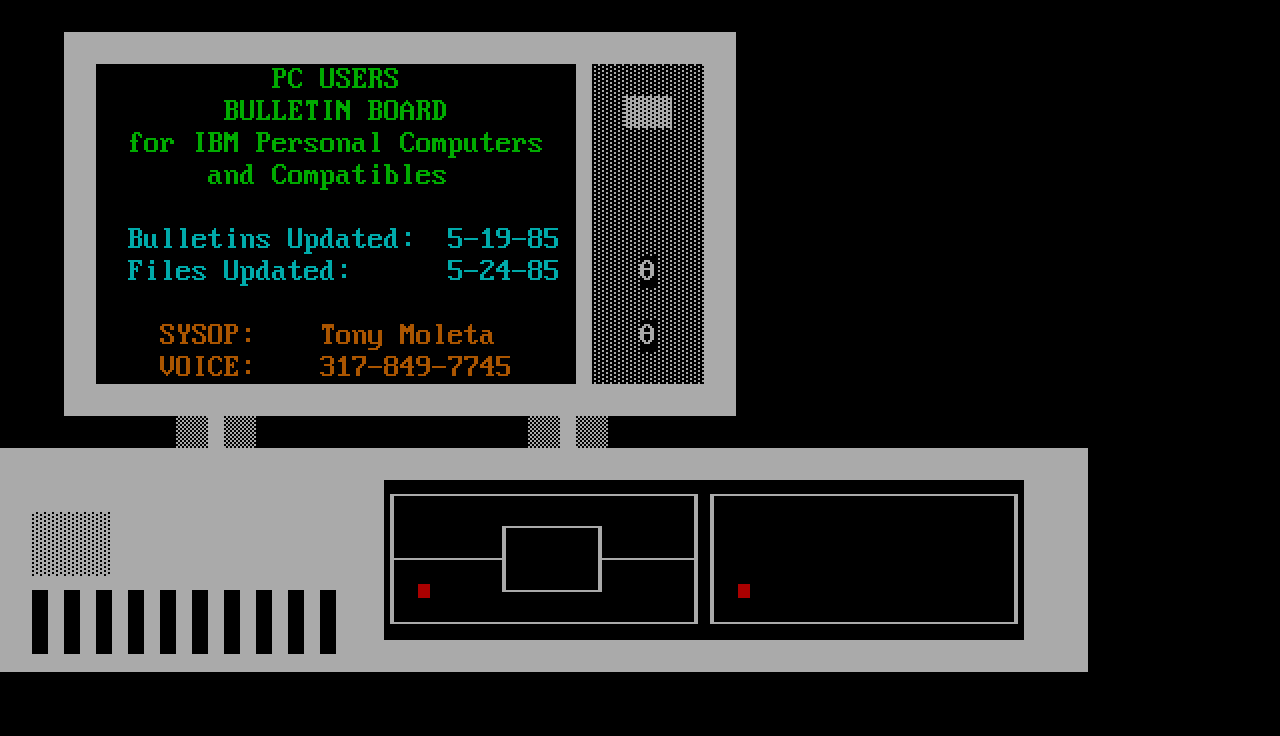
The image we see in Fire Escape’s LOGON1A.ANS has a broader scope than the typical ANSI computer trope. The artist has zoomed out to depict an entire room: around the wooden desk where the PC and modem sit, we see a filing cabinet with a potted plant, and a window showing trees outside.
The oldest version of this scene I could find is LION02.ANS, an advertisement for the Lion’s Den BBS in Atlanta, drawn by an unknown artist in 1988 — years before FEHQ went online.
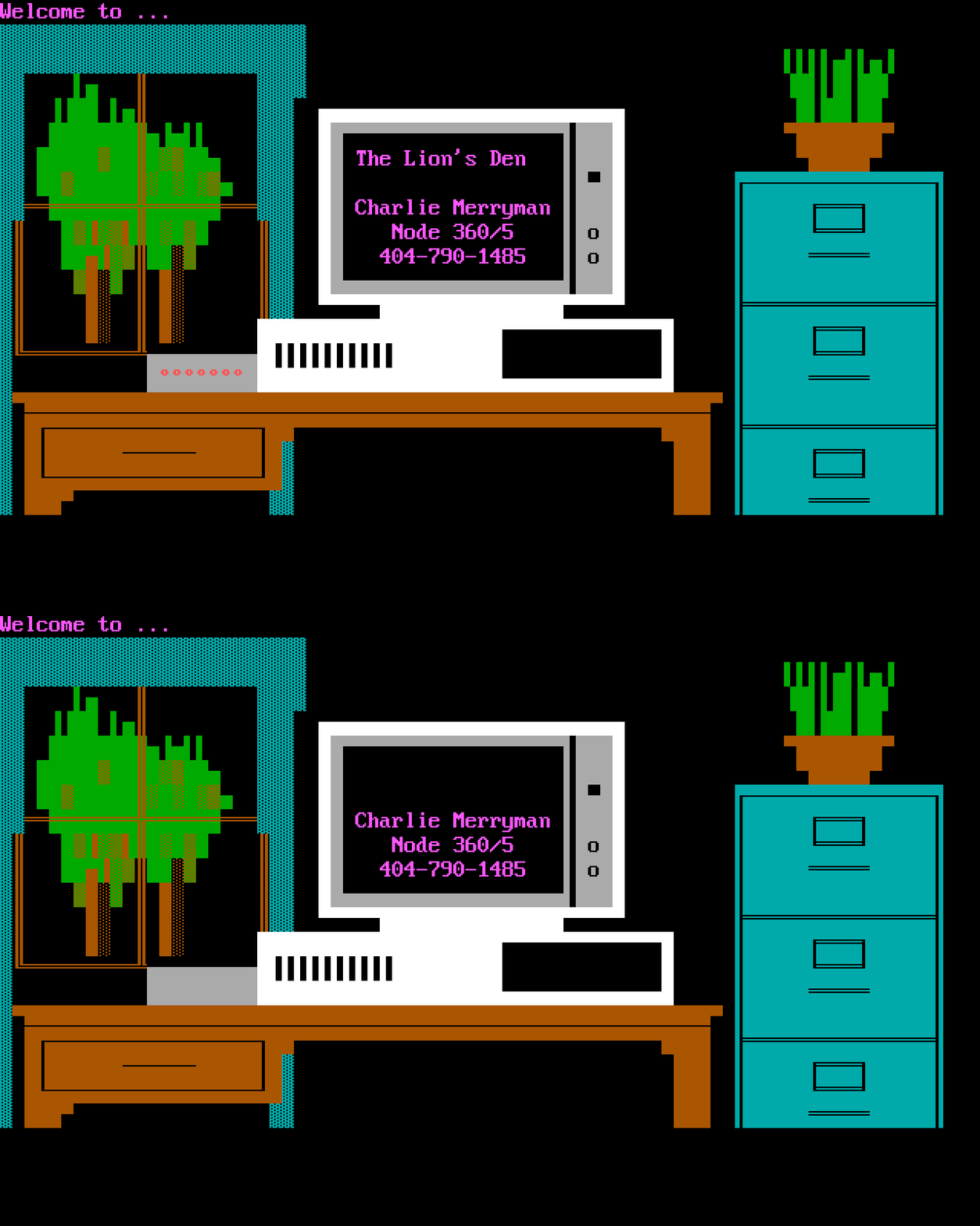
I suspect that sysops loved adapting ANSI drawings of computers because they were so easy to re-brand. All you had to do was rewrite the text on the computer monitor and — boom! — you’ve got your own personalized BBS logon screen or advertisement. Fire Escape wasn’t the only sysop who did that to this particular image.
Jacob Linder, for example, adapted this screen to use as an advertisement for “Salem’s Music Source BBS” in 1993 by simply replacing the words “Welcome to …” with “This file was brought to you by …” and putting his board’s information on the computer monitor. He distributed the ad as an executable, SMS.COM.
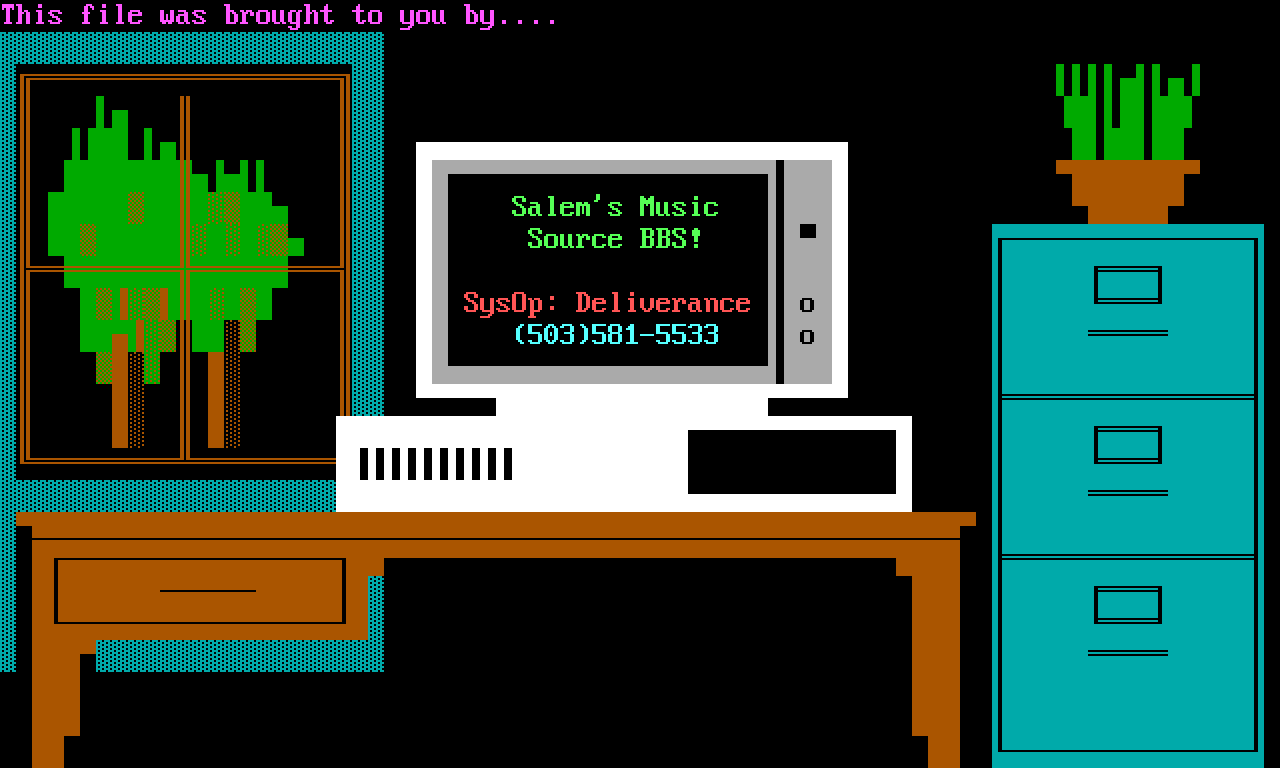
Because the earlier LION02.ANS was shorter and narrower than a typical ANSI screen, Linder apparently decided to fill out his version by lengthening the file cabinet and the legs of the desk, and by widening the computer and the desk top. He also cleaned up the sash and casing of the window.
But where Linder extended the LION02.ANS image to make SMS.COM, Fire Escape went the opposite direction — cropping it even tighter, to just 17 lines, to make LOGON1A.ANS. Her version included extra details on the computer, and blinking modem lights.
But, at the end of the day, both the Linder and Fire Escape versions of this image hewed pretty close to LION02.ANS.
The same cannot be said of POOTER1.ANS, POOTER2.ANS, and POOTER3.ANS, a series of far more interesting adaptations of this scene, created in 1994 by an unknown artist.
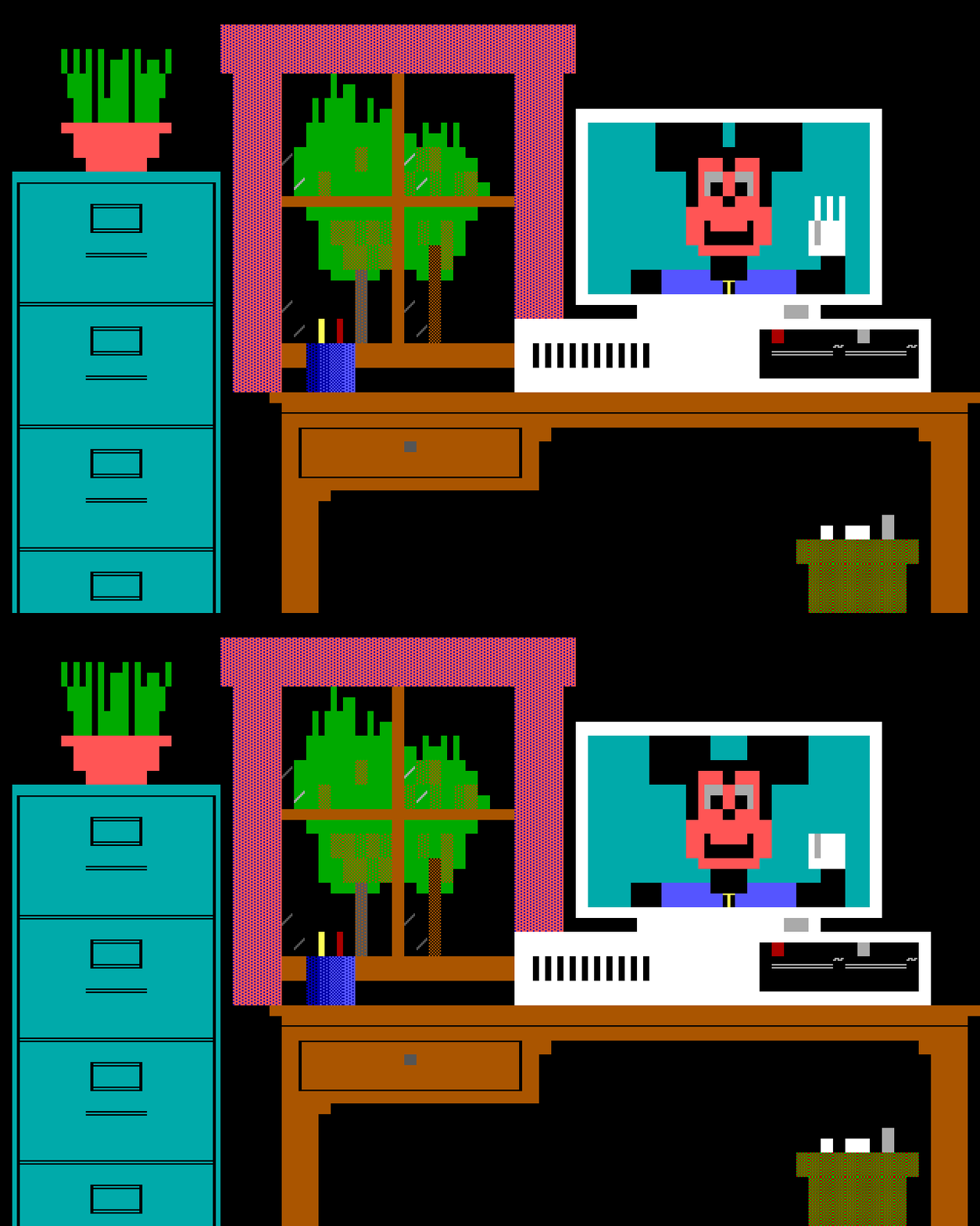
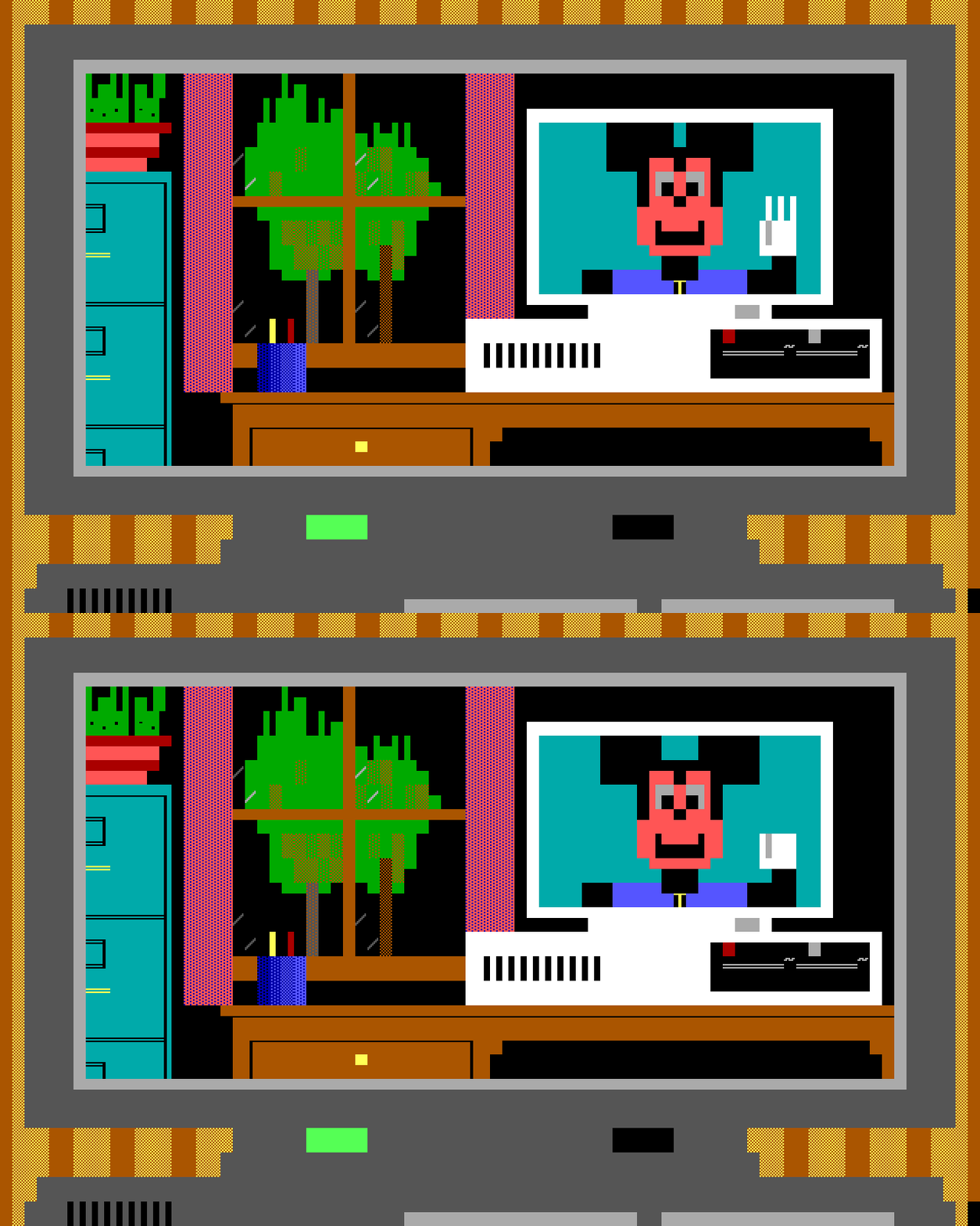
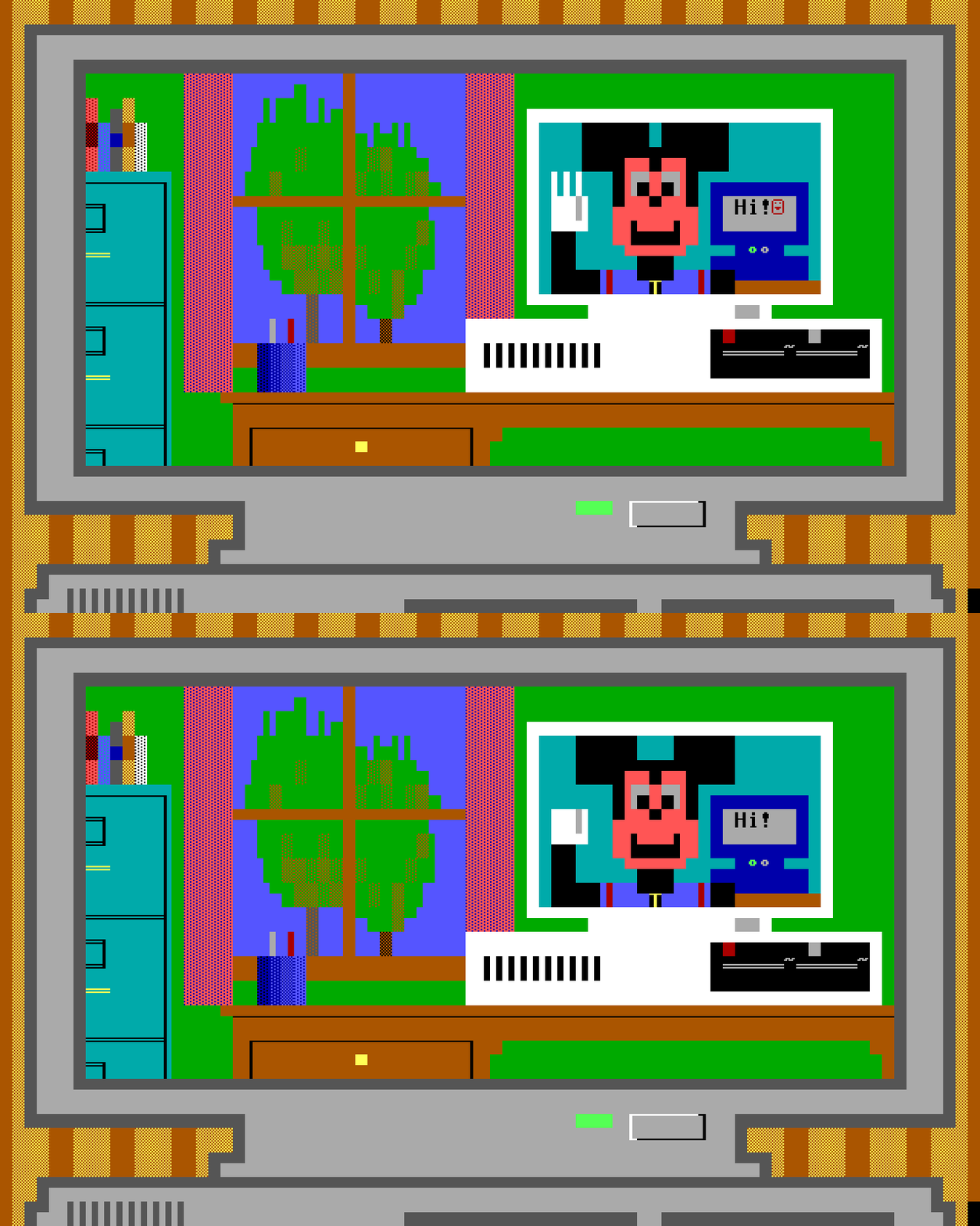
These are not BBS welcome screens or advertisements. Rather, they are a weird experiment in creating the Droste effect or mise en abyme in ANSI art, which the artist thought might make good electronic greeting cards.
The first image is a rearranged version of the original LION02.ANS computer room plus new elements, such as Mickey Mouse waving on the computer screen. Each subsequent image zooms out, showing the scene nested within another monitor. The final image depicts a computer screen on a computer screen on a computer screen. And, of course, anyone looking at the image is displaying it on yet another computer (a real one).
Viewing this sequence of images feels like the ANSI equivalent of opening a set of Russian Matryoshka dolls.
THE PET SHOP
The last of Fire Escape’s logon screens that we’ll examine is LOGON1D.ANS, which depicts a pet shop. The windows are full of winged creatures, plus some containers I think are aquariums containing fish or other creatures. (At this small scale, a single glyph has to represent an animal.)
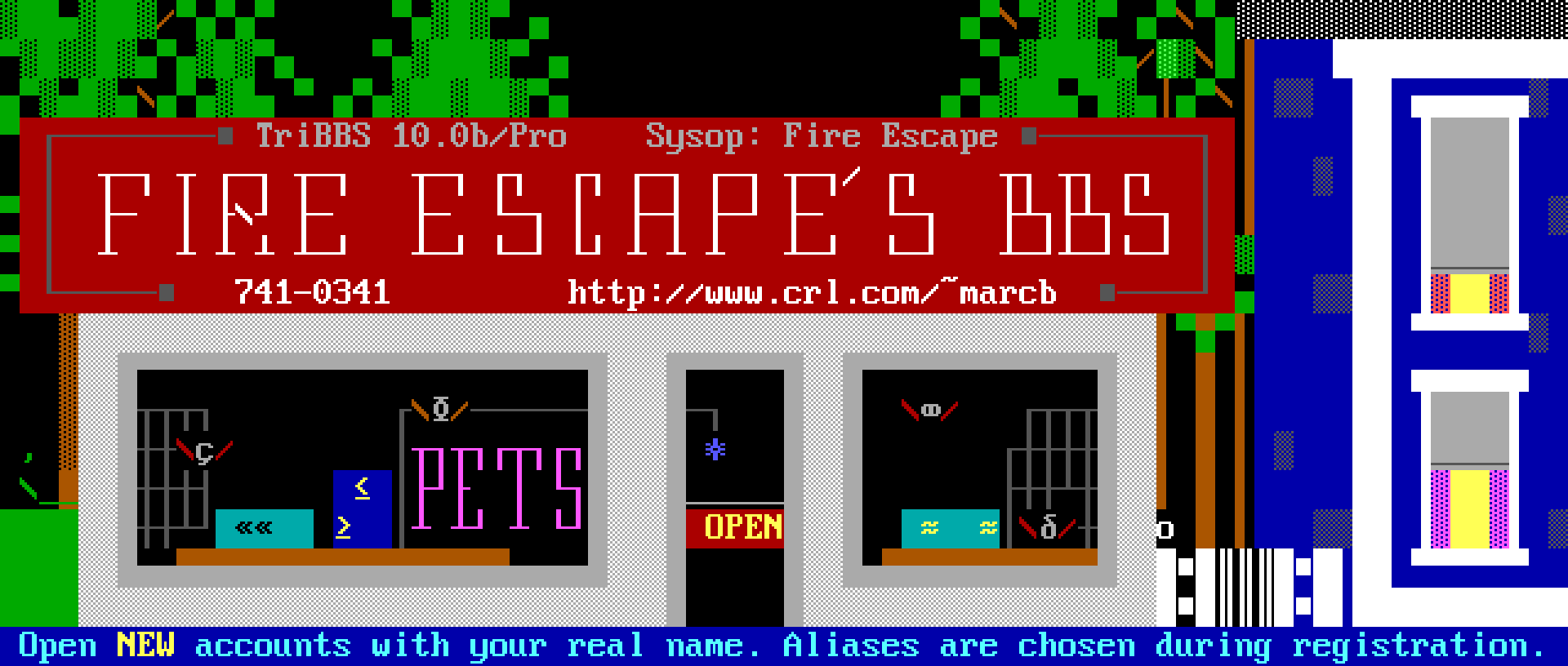
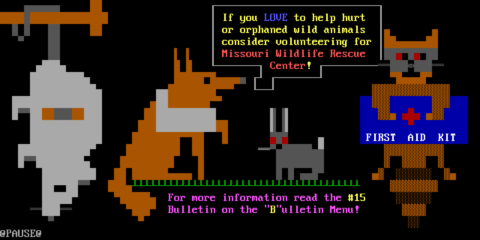
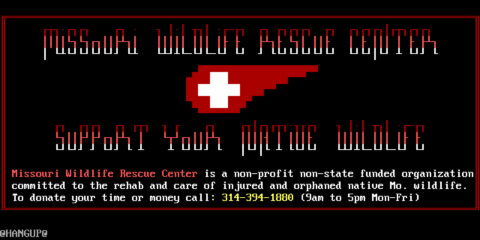
This screen probably had extra resonance for Fire Escape, an animal lover who owned many pets over the years, including pygmy opossums and Egyptian spiny mice, to name just two. She also worked as an animal care volunteer at the Missouri Wildlife Rescue Center in Ballwin, Missouri, a suburb of St. Louis. She promoted the center’s work with ANSI ads on her BBS, like the ones below, and later on her website.
The original version of Fire Escape’s pet shop logon image was DESKTOP.ANS, drawn in 1991 by Violet Stymacks, a prolific ANSI and ASCII artist based in Eugene, Oregon, and later Emeryville, California, who signed her work as “VS.”
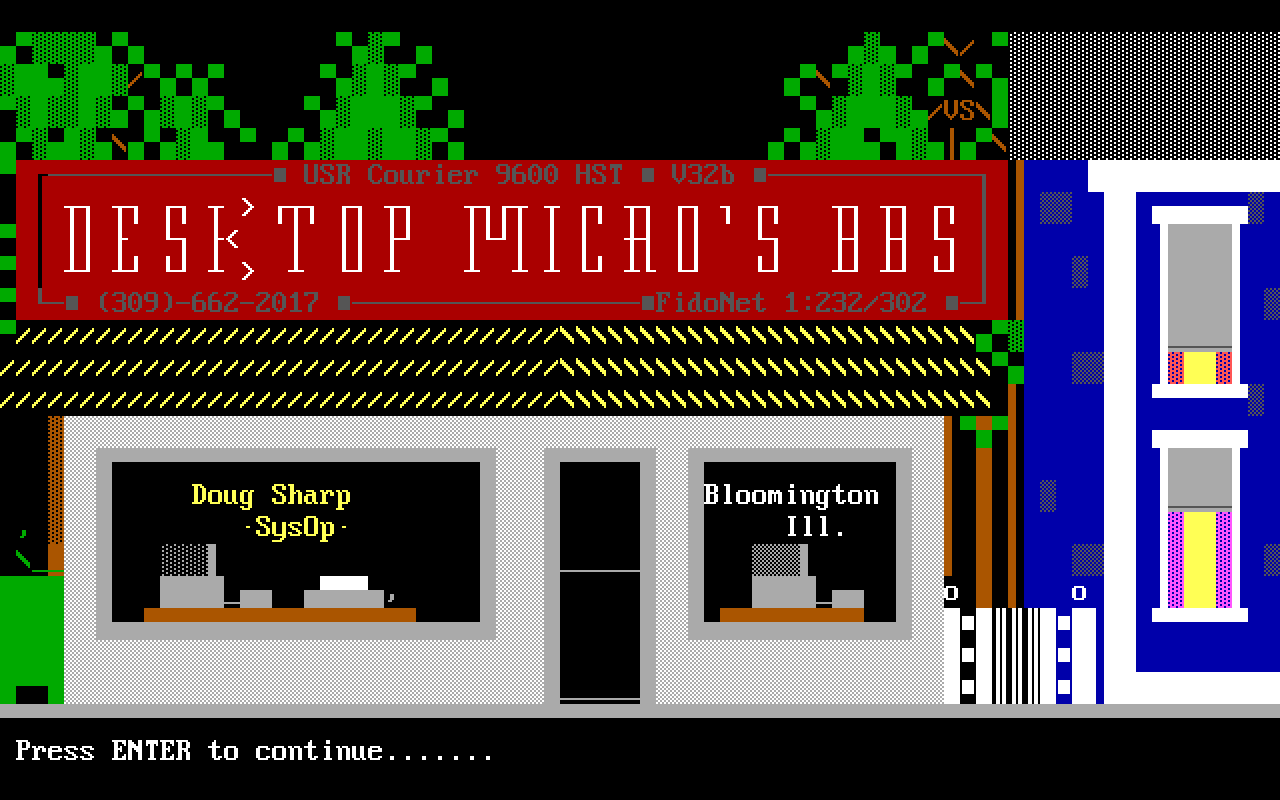
But notice that Stymacks’ original depicts a computer store, not a pet shop. And that makes sense. An image of a computer store would perfectly fit the theme of the board that Stymacks was drawing this screen for: “Desktop Micro’s” in Bloomington, Illinois.
So who changed it to a pet store? My first assumption was that Fire Escape (or some other person) modified it later to fit her love of animals — after all, earlier this year, she told me she had “adapted existing art”. But this alteration was skillfully done, and Fire Escape also told me that she “was not that talented.”
There’s another possibility, a different form of adaptation than we have considered so far in this essay: self-plagiarism.
Violet Stymacks
Stymacks was unusually generous with her ANSI art. When she first began drawing, she combed through Fidonet node lists looking for bulletin boards with interesting or inspiring names. When she found one, she would draw an ANSI screen that fit the board’s theme, then send it to the sysop. Eventually, sysops began seeking her out, too.
By late 1990, she claimed that 500 bulletin boards were using her screens. Three years later, that total had tripled, according to Boardwatch Magazine. I believe it — I have located more than 1,100 of her pieces so far.
She was so prolific that it would be surprising if she hadn’t reused or remixed her own work over the years.
After all, if you end up drawing screens for different BBSes in different parts of the world that have nearly identical themes — say, “The Broken Rose,” “The Rose BBS,” “The Pink Rose BBS,” “Yorkshire Rose BBS,” “Sapphire Rose BBS,” “Rosebud BBS” and “The Purple Rose of Cairo BBS” — why wouldn’t you reuse the same basic design and just transform some colors and details?
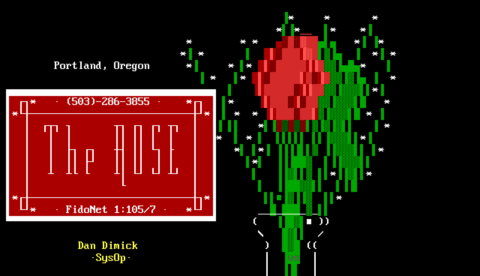
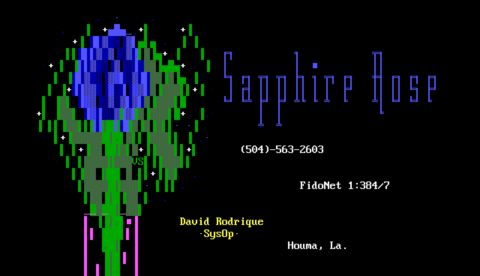
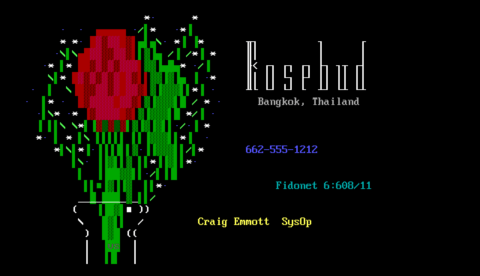
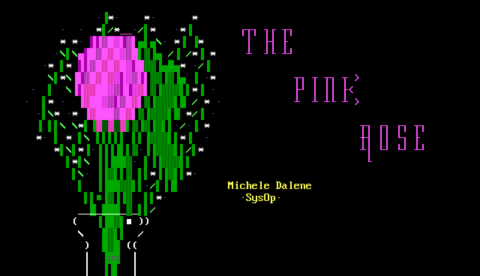
Stymacks seldom reused an entire scene or screen wholesale. More often she would use past work as a starting place and make more substantial changes.
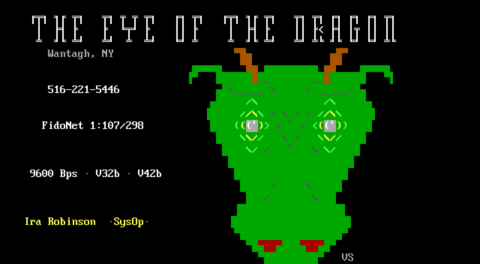
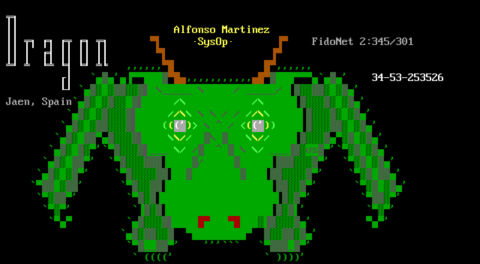
If she drew a large dragon head last time, she might tweak the head and add a body …
If she had drawn a motorcycle and rider in the past, she could modify the bike and add a sidecar to it …
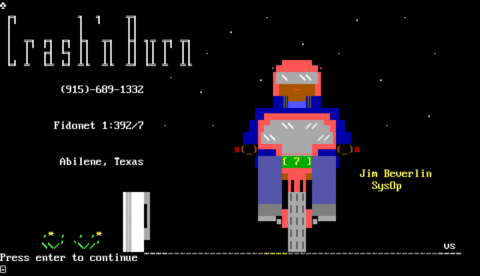
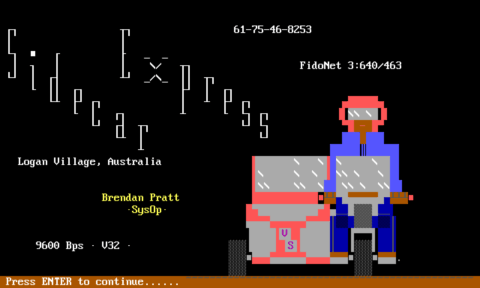
I’m still investigating, but it’s clear that a substantial portion of Stymacks’ oeuvre reuses at least some elements from prior pieces. It’s just the way she worked.
And so, if she could convert a “cookie shop” into a “file shop” by simply replacing some text, giving the building a new paint job, and tweaking the windows …
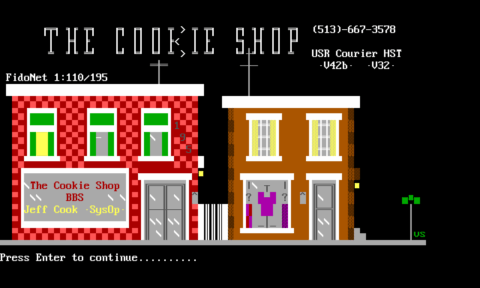
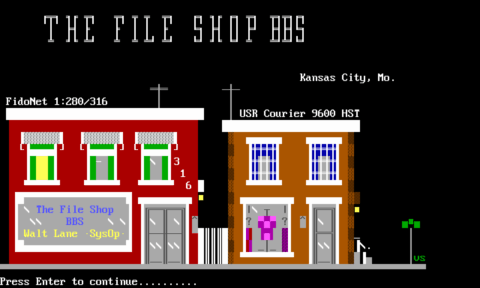
… it seems very possible she also could have converted her original DESKTOP.ANS computer store into a pet shop for another BBS — and that Fire Escape later adapted this hypothetical second image. I haven’t found such a pet shop image. But then again I have only obtained 66 of at least 79 art collections that Stymacks released.
Conclusion
The “public domain” ANSI artists of the late 1980s and very early 1990s — people like Violet Stymacks, Lora Ruffner, Michael Arnett, Michael C. Ling, Tom Bradford, Dave Hartmann, Noel Gamboa, Joey Crum, and George Ramos — certainly intended their work to be seen. They shared it publicly on messageboards carried by national or international networks.
We’ve seen that some artists, like Violet Stymacks, did reuse and remix their own art. But did they intend for other people to do so? Or would they have considered such borrowing or adapting as “ripping” or just plain “stealing”?
These questions have dogged the BBS, ASCII art, and ANSI art scenes from the beginning.
A freelance writer named Patrick Grote grappled with this ethical dilemma in 1990. He had begun to publish archives of ANSI art that he had collected from various public messageboards and networks. But what were people allowed to do with the ANSI screens in these collections? Was it okay to modify them? “Tough call,” Grote said.
“I know some people copyright their screens by inserting a little ‘(C)’ on it,” Grote wrote in a README file included in these collections. “Is this ‘true’ copyrighting? I would say yes, but then again, I don’t feel like having any legal action taken against me for using an ANSI screen.”
“In my opinion, I would say leave the ones that say ‘(C)’ alone, but make every effort to contact the artist and ask for permission.”
But many people saw no issues with it.
“You might want to look at the existing collections of ansi art, and modify them to suit your needs,” Darryl Perry suggested to a fellow sysop who was trying to find an ANSI artist to make menus for his BBS in 2001.
When I corresponded with Fire Escape this year, she admitted her memory wasn’t what it used to be, but felt certain that she had not asked any artists for permission because she didn’t know who they were or how to reach them.
“I figured if anyone had an issue, I’d just remove the screen,” she said.
“But no one ever said anything about it.”
Other citation formats
@online{renaud2026recycling,
  author       = {Josh Renaud},
  title        = {Recycling ANSI art: Tracing the origins of Fire Escape’s logon screens},
  year         = {2026},
  month        = oct,
  organization = {Break Into Chat},
  url          = {https://breakintochat.com/blog/2026/10/25/recycling-ansi-art/},
  urldate      = {}
}{{cite web |last=Renaud |first=Josh |title=Recycling ANSI art: Tracing the origins of Fire Escape’s logon screens |website=Break Into Chat |url=https://breakintochat.com/blog/2026/10/25/recycling-ansi-art/ |date=2026-10-25 |access-date=}}
Share your thoughts!