
This is the first part of a multi-part series.
Does ANSI art have a place in the history of webcomics?

One of the first chroniclers of webcomics history thought so.
In the first chapter of his 2006 book, “A History of Webcomics,” T Campbell tackled the “prehistory” of webcomics by discussing ARPAnet, ASCII art, and emoticons.
Then he made an eyebrow-raising claim: that ANSI artist Eerie had created “the first known comic on the Internet, Inspector Dangerfuck.”
That’s … a provocative title. And a tantalizing factoid. But was it true?
Even to someone unfamiliar with ANSI art history, there should be some red flags, starting with Campbell’s use of a fraught superlative like “the first” without any dates or further details.
More importantly, Campbell gave no sources for his statement. “Very little is readily available about the strip,” he admitted in a footnote.
Unfortunately, this lack of detail and sourcing did not deter others from repeating some version of this assertion in books, theses, Wikipedia articles, blog posts, and YouTube videos about webcomics history.
None of them introduced new details about Eerie or Inspector Dangerfuck, except to give a date.
In his 2009 master’s thesis about webcomics, Olaf Moriarty Solstrand noted Campbell’s assertion, but said the only examples of Inspector Dangerfuck he had found online were all dated 1994. Still, it took until 2017 for anyone to edit Wikipedia’s “History of webcomics” article with this update.

Campbell must have assumed Eerie’s work was older. But given that year, anyone familiar with pre-Web telecommunications would wonder about earlier alternatives. Surely artists were uploading comics to Usenet newsgroups or online services like CompuServe or GEnie long before 1994?
Yes. There definitely were earlier online comics. Campbell even mentions one of them in his book on the very next page: Where the Buffalo Roam, a comic by Hans Bjordahl, first posted to alt.comics.buffalo-roam earlier in the 1990s.
So that’s one answer, at least: Inspector Dangerfuck could not have been the “first known comic on the internet.”
Do you enjoy my retrocomputing histories on Break Into Chat? Please join my email list and stay in touch. 📬
But there remain many unresolved questions! Who was Eerie? What was the story behind this inspector? Was it the earliest ANSI comic? Were there other ANSI comics? Could any of them be considered precursors of webcomics?
Various mea culpas have been offered over the years for the dearth of details about Inspector Dangerfuck. The editors of the 2011 book “Everyday Information” parroted Campbell’s footnote: “Very little information is available about this strip in printed or Web literature,” they wrote.
“Unfortunately, I couldn’t find much,” wrote Nicha Meyer in a 2016 post on Retro Activity, her webcomics history blog. “Lots of information about ANSI things, but not so much love for ‘Inspector Dangerfuck.’”
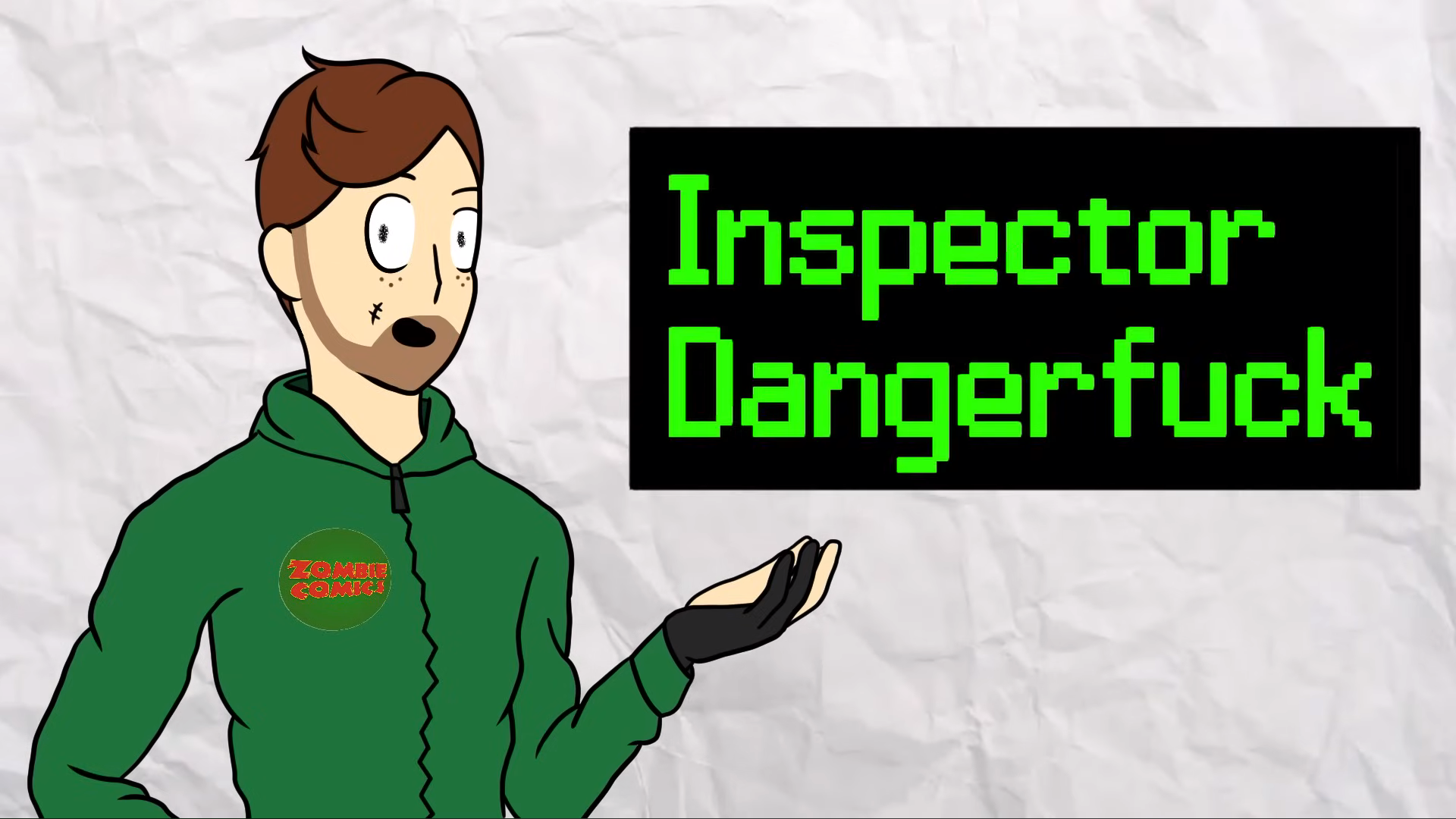
“Information regarding Inspector is scarce and unreliable at best,” said Andrew Addessi in a 2023 video on his Zombie Comics Aura channel. “If just basic information is next-to-impossible to dig up about Inspector, I wouldn’t get my hopes up that it could ever be recovered,” he added.
The good news is that Inspector Dangerfuck doesn’t need to be recovered — because it was never lost.
Information about it has long been hard to find, sure. But that’s where I come in.
Let’s fill in some blanks.
And hopefully we’ll get a better idea where ANSI art might fit alongside the history of webcomics.
About this series
This will be a five-part series.
I have delved deeply into Discmaster, spelunked in 16colors, interrogated Eerie himself, and recorded reams of research, to bring you a more detailed history of Inspector Dangerfuck and the intersection of ANSI and comics.
I also have a curveball. I will introduce another little-known ANSI cartoon — two years older than the Inspector, and far more extensive, with more than 100 installments.
- Part 1: Filling in the blanks
- Part 2: BBSes and the artscene
- Part 3: Eerie and “Inspector Dangerfuck”
- Part 4: The business of BBSes
- Part 5: Don Lokke and “Mack the Mouse”
A quick note about me: I am a journalist and a computer history researcher, but I am not an expert on the ANSI artscene, nor on webcomics. My purpose here is to plug some gaps in this specific history, in hopes of spurring further research and discussion from critics and experts on those topics.
This series is based on my own correspondence with Eerie, Rowan Lipkovits, T Campbell and Amber Greenlee; a 1998 interview with Eerie preserved on acheron.org; ANSI artwork preserved on 16colors; contemporary public messages, documentation, and text files preserved in Discmaster and other archives; print magazines including Byte, Boardwatch, and Stormtrack; newspapers and blogs including the Los Angeles Times, Houston Chronicle, The Guardian and The Comics Journal; online magazines such as Phrack, Northern Phun Co, ACE, UnderGrown, Doomed to Obscurity, GEnie Lamp, Electronic Review, A Chat, Ruby’s Pearls, Pasco BBS, DFW Online, and OP News; the book “Paperless Publishing”; the personal websites of Eerie and Don Lokke; the numerous websites produced by Lokke Advertising; Lipkovits’ history of the 604 area code artscene for York University Computer Museum; original uncut interviews from Jason Scott’s “BBS Documentary”; theses by Olaf Moriarty Solstrand and Michael A. Hargadon; and numerous files included in various releases of Remote Editorial, NewsRun, Smile, and Blue Instant Graphics.
I have taken the liberty of silently correcting capitalization, spelling, and grammar in material I quote.
‘Single biggest regret’
So how did Campbell come to include Inspector Dangerfuck in his book?
It all started with a well-regarded series of blog posts about the history of webcomics, that Campbell researched and wrote from 2003 to 2005. They were originally published on Comixpedia, but can be read today on Comix Talk. These posts don’t mention ANSI art or BBSes at all.
Later, buoyed by the community’s positive reception, Campbell decided to expand this material and publish a full-length book.
But the reaction to Campbell’s “A History of Webcomics” upon its release in 2006 was markedly different. In contrast to the success of his blog posts, the book attracted strong criticism.
“This book is nothing more than another self-masturbatory project of the new webcomics cognoscenti crowd,” wrote Scott Kurtz, the creator of “PvP” in a 2006 article.
“Overall, A History of Webcomics is an unnecessary work,” Jason Sigler wrote for Digital Strips. “It’s a must-not-have.”
Campbell would later describe “A History” as the “most amibitious project” of his creative career, and also his “single biggest regret.”
His own reassessment of the book, five years after its publication: “It really is still that bad.”
Still, not everyone was quite so savage. Fleen’s Gary Tyrrell took a more measured approach in his 2006 review.
“The most telling thing about T AHOW is probably on the upper-right corner of the cover: the book is described as ‘v1.0’,” he wrote. “As even the most casual consumer of software can tell you, Version 1.0 usually has lots of room for improvement.”
Personally, I like the idea of “versioning” historical work. I know from my own research how my understanding changes over time as I make new discoveries or talk to new people while digging into something.
And it turns out Campbell’s inclusion of Inspector Dangerfuck in the “History” book was a last-minute addition prompted by a new discovery.
“As publication loomed, I sought out some members of the webcomics community to get their feedback about the book,” Campbell told me. Many weren’t helpful, but some were, including artist and writer Amber Greenlee, who offered suggestions on things that were missing from the draft, including ASCII and ANSI art.
Greenlee had firsthand experience. “I knew there were comics on BBS boards because I had made some when I was 13,” she told me, “and I knew others had too back in the 1990s.”
She searched Google for examples to send to Campbell, but the best she found was Inspector Dangerfuck. She sent Campbell a hyperlink to an everything2.com article as evidence; unfortunately, that page is a victim of linkrot, apparently never archived, so we can’t see it today.
This series, then, will be my attempt to create the missing documentation of Inspector Dangerfuck and some other ANSI art history that might have been helpful to Campbell if it had existed in 2006. And, as I said above, I hope it will spur further research and discussion from experts.
Up next — Part 2: BBSes and the artscene

Share your thoughts!