This is the third part of a multi-part series.
“I’ve always been kind of restless,” says Eerie, the ANSI artist who created the character “Inspector Dangerfuck” in 1994.
Today, Eerie is a musician and author, with a deep knowledge of cartoons and comics. But back then, he was a teenager in Quebec trying to make a name for himself in the fast-growing underground ANSI art scene.
“It was a period where I was in quite a lonely place,” he says. “I had far too much free time, living at my parents’, in a limbo of sorts.”
He looks back at the ANSI art scene as a “fun secret underworld to be in for a while,” where he witnessed “awesome displays of creativity” interspersed with “ridiculous boasts” and “absurd beefs.”
That underworld would later attract an outsized claim.

In his 2006 book “A History of Webcomics“, author T Campbell asserted that Eerie’s “Inspector Dangerfuck” — was “the first known comic on the Internet.”
Campbell offered no dates, no details, and no sources. To be clear, the assertion was wrong, as discussed in Part 1 of this series. Even so, it didn’t deter later editors, bloggers, and content creators from repeating versions of this statement, without unearthing anything new.
Eerie agreed to answer my questions about that “godawful ANSI” — “Inspector Dangerfuck” — but asked that I not use his real name in this story.
“I find it hilarious that it’s referenced in some books and evidently nobody has bothered to seek it out,” Eerie says.
So, since nobody else “bothered to seek it out,” I did.
Eerie’s story is worth telling, and it’s worth considering where his ANSI art might fit in the history of webcomics.
Do you enjoy my retrocomputing histories on Break Into Chat? Please join my email list and stay in touch. 📬
Imagination, talent, and skill
For Eerie, as for many teenagers then, calling bulletin board systems began as a novelty, and quickly became a social balm.
When Eerie was in high school, his father, a computer analyst, had brought home a terminal and a 300-baud modem. It was cumbersome, slow, and soon replaced by a proper PC — but it gave Eerie a portal out of the loneliness of his parents’ basement into a fantastic online world.
“The idea of a computer calling another computer sounded wild,” Eerie says.
Soon it was second nature. Armed with a list of BBS phone numbers given by a friend, Eerie began calling and connecting. He became a regular presence on the primarily French-speaking boards of Quebec’s 418 area code.

Online, he found community and collaboration. He spent months developing a BBS utility for creating blog-like news publications in 1992. Dozens of people helped him, from Pascal programmers on Fidonet to beta-testers. Best of all, a few sysops liked it enough to pay the $10 shareware registration fee.
Later that year he and friends tried to launch an e-magazine called “Ctrl-Break” aimed at the underground scene, but it was slow to come together. They were beat to the punch by a local hacker group who began publishing their own e-mag in November.
The hacker group’s magazine was full of the bluster that characterized so much of the computer underground. In the third issue, for example, the magazine’s editor published a 1,000-line takedown of an “old geezer” named Mephisto, mocking him for campaigning against the group’s “subversiveness.”
Overshadowed, Eerie decided to lampoon his competition. He and a group of collaborators spent two weeks assembling a 2,200-line parody of the hackers’ magazine. They released their satire issue in February 1993. To their surprise, instead of taking offense, their targets were flattered.
“I couldn’t possibly be angry with someone who offers their ‘dissent’ with such brilliant humor!” the magazine’s editor wrote in the next issue. The editor applauded Eerie’s “imagination and creativity,” describing him as a “one-man band with many talents, including undeniable programming skills.”
Eerie was indeed a man of many talents, and the local underground scene was taking notice.
He continued to develop software, write articles, and start new e-magazines at a prodigious rate. But now his restlessness was driving him to yet another creative outlet: ANSI art.
A cartoony style
As a French speaker in Quebec, Eerie had grown up in a cultural context different from his English-speaking American counterparts in the underground ANSI art scene.
Like many of them, he had drawn cartoons on paper from an early age. But where they were immersed in serious superhero comics, Eerie had grown up reading funny French and Belgian comics known as bandes dessinées — hardcover books featuring characters like “Tintin,” “Spirou,” or “Léonard.”
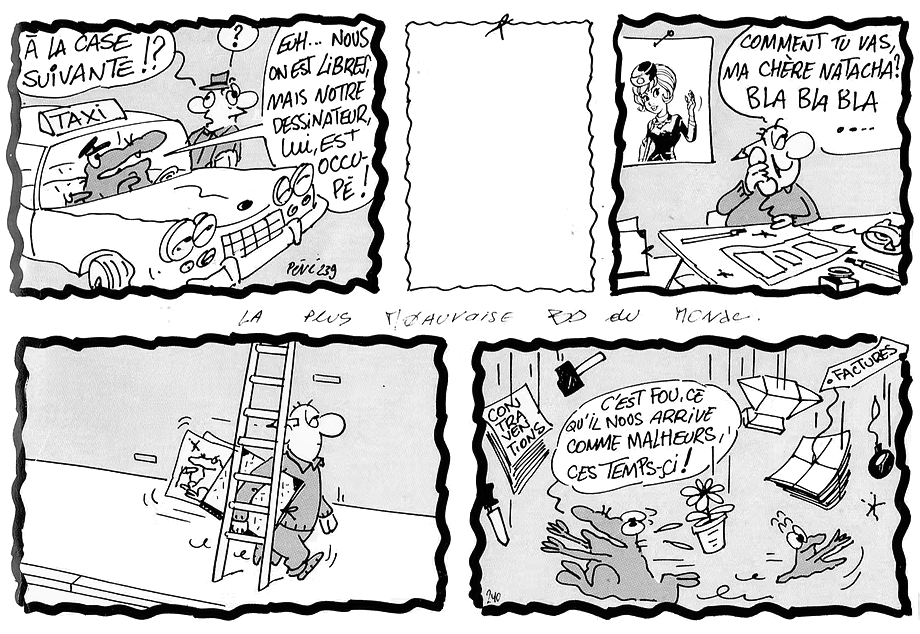
At the same time he was working so hard to build a unique online identity, he was also drawing his own bande dessinée. Modeled on the “The Worst Comic in the World,” a series by the Belgian artist Pévé, Eerie created dozens of intentionally haphazard, hastily drawn, sometimes nonsensical pages, which he called “absolutely unpublishable.” In fact, he sold or gave away a dozen photocopies after he finished it in 1993.
When he first began drawing ANSI art, he brought to it a personal style — loose, elastic, cartoony — strongly influenced by these sources.
You can see it in these pieces from 1993. The first depicts the “Disciple” character from “Léonard,” while the second was drawn to promote his new BBS, “Sarcastic Toaster,” serving the 418 area code.
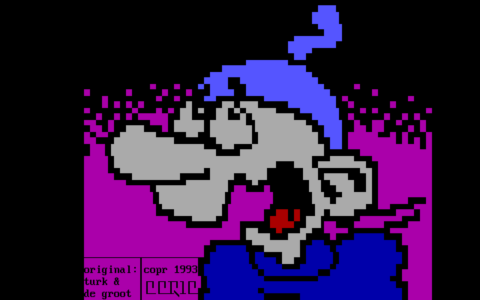
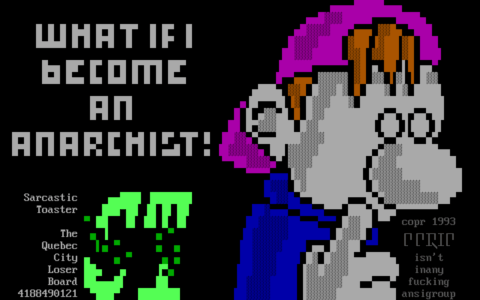
Another early hallmark: his human characters have gray skin. Other ANSI artists defaulted to bright red and brown.
These pieces might have fit in well among the very best “public domain” (or “PD”) art. Nor are they very far from the early work of underground ANSI titans who also drew in a “toony” style, such as Jed of ACiD or Toon Goon of iCE.
But in many ways, these pieces were out of step with the shifting stylistic sensibilities of the underground ANSI art scene.
As discussed in Part 2 of this series, many artists like Tempus Thales of the iCE artgroup now were drawing tightly cropped, extremely vertical ANSIs with lots of shading. Taking inspiration from the pages of Image Comics, these pieces often featured dynamic action, dramatic shadows, intense facial expressions, and greatly exaggerated musculature.
So perhaps it’s not surprising that Eerie says the scene’s reactions to his early work “was often pretty negative.”
Initially, Eerie did not realize just how much the underground scene was into Image Comics — particularly its Spawn character. But later, after he did, “I adapted my style accordingly, even though it was very foreign from my point of view.”
‘All over the place’
One hallmark of the underground ANSI art scene was the constantly changing local landscape. Smaller groups were frequently forming, merging, splintering, and fizzling out as personalities clashed, or talented artists were lured away.
Indeed, upward mobility was an important aspect of the scene. Smaller local groups often served as “farm teams,” scene historian Rowan Lipkovits once wrote, “perpetually at risk of having their top talent poached by larger international crews” — groups such as ACiD, iCE and CiA.
Eerie lived this as he moved through a succession of local groups (a trajectory that would eventually land him in ACiD in 1995).
He got his start drawing ANSI art for Astek (“ANSI Staff To Eternal Kreations”) in the summer of 1993, including an eye-catching toony advertisement for “Wave of Weirdness” BBS.
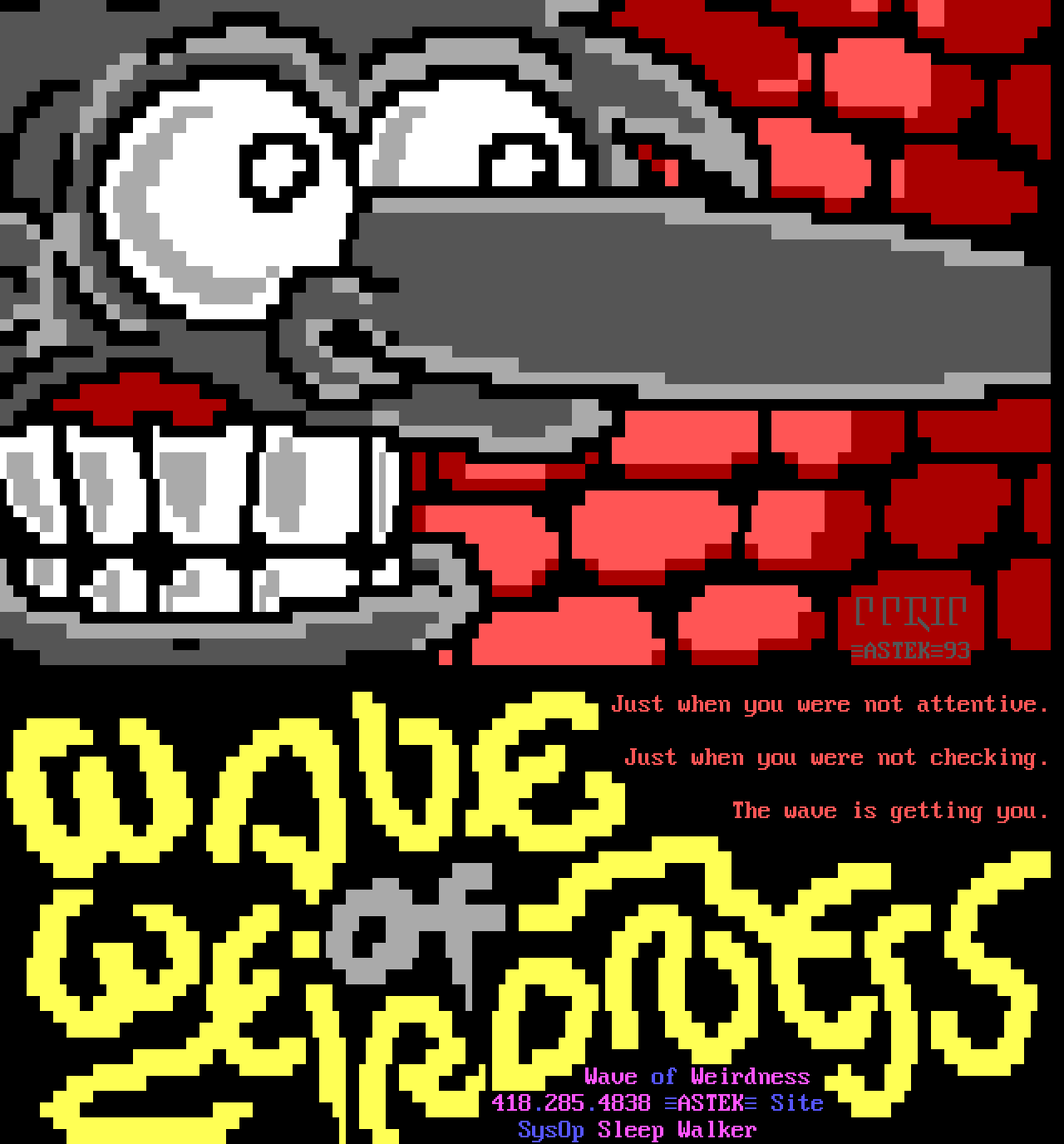
But Astek didn’t last long. By January 1994, Eerie and others had left, hoping to form a new group, Rx. But it fizzled, too.
Then, a shakeup in April 1994 gave Eerie a chance to join a brand-new, cross-country Canadian art group.
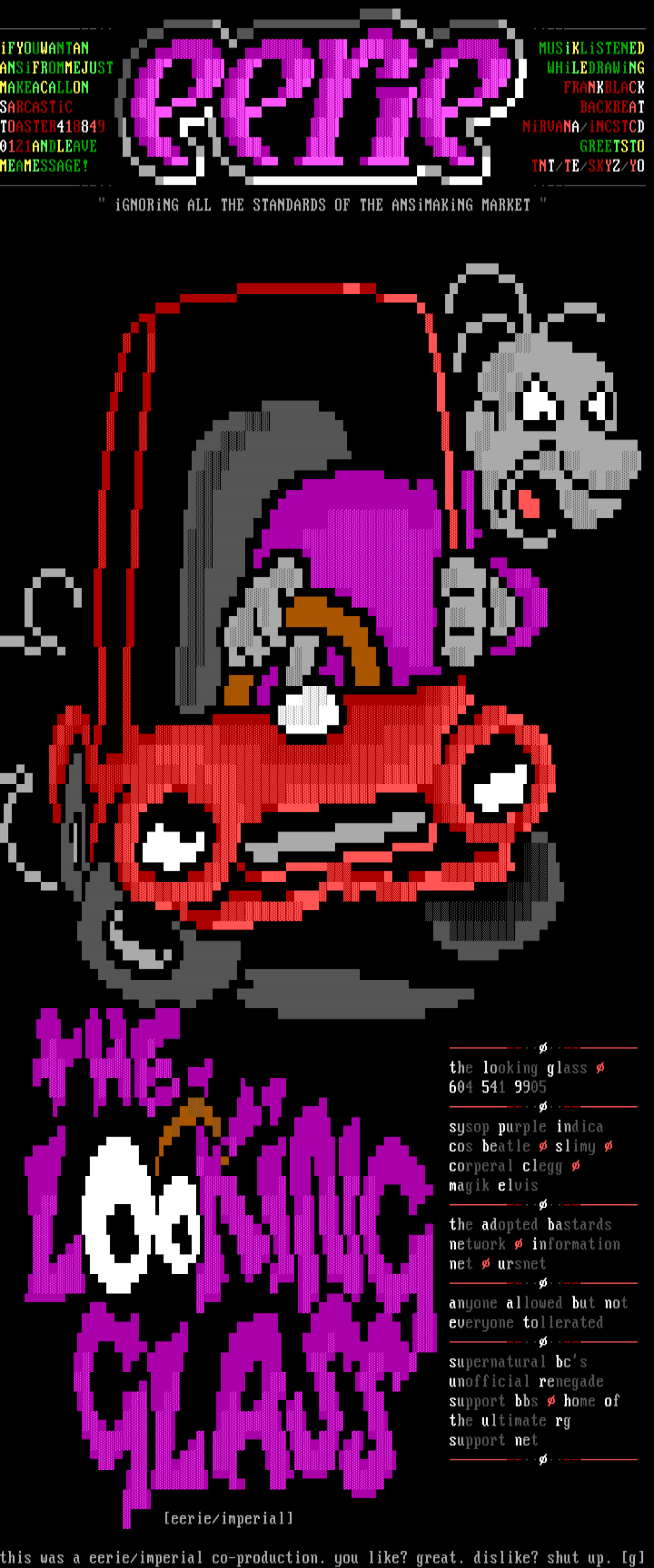
NWA (New Wave Artists), based in British Columbia, decided to team up with GRiP (Graphic Revolution in Progress) from Quebec. Together they became Imperial.
Imperial existed only five months — “the two scenes were never truly integrated,” wrote Lipkovits, who was a member — but that was long enough for Eerie to join and make a splash, as we’ll see.
After Imperial disintegrated, he bounced through a few more groups before year’s end — Relic, Mistigris, Katharsis. And he kept producing ANSI and ASCII art at a ridiculous rate.
“One month, he broke an all-time [record] by drawing and releasing over thirty screens,” Lipkovits told me. “But they would be all over the place in theme and style.”
If that wasn’t enough, he was still writing original stories, creating music, reviewing albums, and running e-magazines. One big success was “UnderGrown,” an e-mag focused on the art scene itself, interviewing artists and reviewing art released by lesser-known groups.
“I saw it as a way to help smaller groups get some of the spotlight,” Eerie told me, “and also to get some controversy going.”
He was throwing a lot at the wall, hoping some of it would stick. Hoping to find his place in the scene.
And one of the things he threw at the wall that summer was “Inspector Dangerfuck” — an original ANSI art character with a provocative name and a distinctive look.
Meet Inspector Dangerfuck
Inspector Dangerfuck burst onto the ANSI art scene with a bang, literally.
EE-LOF01.IMP, the first of two pieces in Imperial’s July 1994 artpack to feature the character, shows him walking with a gun in hand, as a bullet flies past. “God! This ain’t safe!” he exclaims.

Hover over this image to see it scroll. Click to open it in a new window.
Eerie no longer remembers the origin of the name. “Obviously it started as some kind of Inspector Gadget reference,” he says. “There probably wasn’t much thought involved, that’s for sure.”
To me, the inspector, with his bloodshot eyes, oversized round nose, gray skin, bright yellow hair, and blue coat, stands out in a pack otherwise full of depictions of comic-book superheroes like Venom, Magneto, and Apocalypse.
Around this portrait, Eerie arranged a series of dialog boxes written in the artist’s voice, talking about the character, rather than the character himself speaking. “Look at his eyes. Seems to be real stoned, uh?” reads one.
The second “ID” piece in the pack, EE-TCC02.IMP, used its verticality to great comic effect.
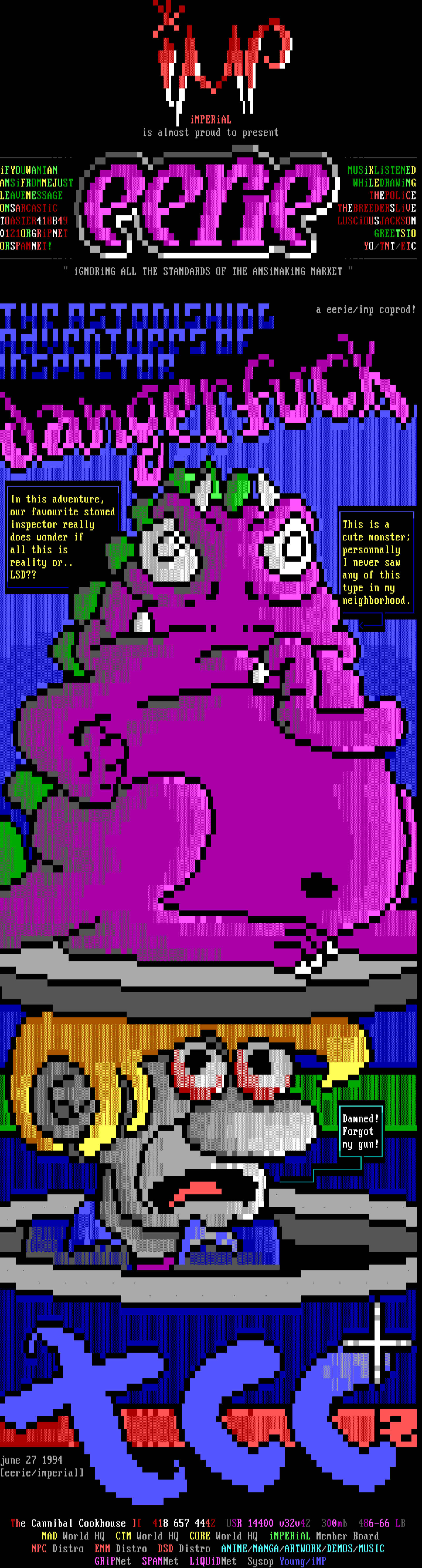
Hover over this image to see it scroll. Click to open it in a new window.
A viewer watching the image scroll up the screen would have first seen a prominent blue and purple headline declaring “The Astonishing Adventures of Inspector Dangerfuck,” followed by an enormous magenta monster flanked by narration boxes. As the image continued to scroll, it would become apparent that the monster is actually standing on a sewer lid, and then that the sewer lid is being pushed up by someone’s head: Inspector Dangerfuck. “Damned! Forgot my gun!” he exclaims.
It’s worth pausing here to ask the same question we asked in Part 2 about other early ANSI art original characters:
Can either of these first two pieces featuring Inspector Dangerfuck be considered comics?
Probably not. Both are essentially portraits without much (or any) plot. Scott McCloud’s widely accepted definition requires that comics have “juxtaposed pictorial and other images in deliberate sequence.” In his correspondence with me, Eerie concurred: these two are not comics.
But the case is altogether different with the next “ID” piece.
“Mega-eleeeeeeeeeeete adventures”
Released in Imperial’s August 1994 artpack, EE-NP1.IMP features six panels, real dialog balloons and multiple characters. There can be no doubt: it’s a comic, a vertical one extending more than 300 rows.

Hover over this image to see it scroll. Click to open it in a new window.
“The art is not very good but I thought I could compensate my crude skills by making the piece extra long,” Eerie says.
Making it so long took a lot of work. One of the most popular ANSI editors in the early days, “TheDraw,” was limited to 100 rows. Putting together a longer vertical piece, Eerie says, required drawing it in separate parts, then concatenating the pieces together in DOS.
As far as the art, I respectfully disagree. I love the look of the characters, and their expressive faces. For me, the letdown is the plot. Even though “The mega-eleeeeeeeeeeete adventures of Inspector Dangerfuck” has multiple panels, it doesn’t tell much of a story.
The inspector ducks into a dark alley to escape two nameless and faceless bad guys, only to stumble upon an “old friend,” Prof. Baldhead, who asks the inspector for help with “big deep troubles.” And that’s it.
Eerie even lists nine unanswered questions under the artwork, promising that “SOME OF THESE ANSWERS WiLL BE FOUND” in an upcoming piece titled “Inspector Dangerfuck vs Dr. Silly (and his secret weapon!)”
But this wasn’t all — the August artpack also included “The Adventures of Inspector Dangerfuck” (EE-WOWM1.EXE), a semi-animated demo which tells a somewhat more substantial story.
EE-WOWM1.EXE is an animated demo titled “The Adventures of Inspector Dangerfuck.”
It’s not quite on par with “Bart and the Feds,” where the characters moved and their faces were animated. Instead, Eerie’s demo is more like a slideshow of static screens, interspersed with narration, and a couple of scenes requiring user interaction. Eerie wrote the code himself with help from Coluche.
The story is straightforward but thin: “Dullcity,” a place with no crime, has just been hit by a bank robbery. The robber hides, the police get a report, and Inspector Dangerfuck tries to track the robber. The robber ends up at the inspector’s house and a car chase ensues, followed by an ambiguous crash. Then it stops.
Eerie pads out the movie by interrupting several times to make comments as the artist, and by adding places where the user can interact, such as the car chase. Though it was short, I appreciated that sequence; I’ve wrestled with making parallax ANSI animation myself (though with the advantage of modern tools).
Just like the EE-NP1.IMP comic, this “movie” ends abruptly before the story is resolved. And Eerie again dangles several questions that he promises will be resolved in the forthcoming “Inspector Dangerfuck vs. Dr. Silly.”
The inspector’s last hurrah
That August art pack marked the end of Imperial. But Eerie immediately jumped to the group Relic, where he managed to release two Inspector Dangerfuck pieces for them the very next month.
One of these was his much-mentioned, much-promised movie, “Inspector Dangerfuck vs. Dr. Silly, Part I” (33-DF6.EXE).
33-DF6.EXE is an animated demo titled “Inspector Dangerfuck vs. Dr. Silly, Part I.”
I’ll only briefly summarize the plot: an evil villain called Dr. Silly wants to rule the ANSI art scene and only one person stands in his way: “that damned Inspector Dangerfuck”. He kidnaps Professor Baldhead to force him to create ANSI-to-GIF converter software that will let him rule the scene and demands the inspector leave the country.
There’s a lot to like about this. First, it actually connects to plot threads from the previous comic and the previous animation: the narrator briefly mentions the “mad robber” had been defeated, while later Professor Baldhead becomes a key part of the plot.
I find it funnier than the previous inspector pieces, from the scene-specific jokes (HARD -> “Hot Ansi Rippers Dammit”) to the nonsensical visual gags (the sun hitting itself with a mallet, etc).
Finally, the story feels somewhat more substantial and satisfying than the earlier pieces — though it remains incomplete, ending abruptly like before.
Still, this was clearly made in a hurry, reusing the same template as the previous animation: the narration, Eerie’s advertising interruptions, the interactive moments (users make a choice, plus an animated car ride), and the artist’s questions at the end.
Eerie promised the story would be continued in the next Relic pack, but that didn’t happen. Eerie apologized (and made new promises) in the October and November packs, but he drew only a few small-scale portraits and cameos.
“I was definitely planning to follow it up but I didn’t because it was too much involvement,” Eerie says now. “Comics are a lot of work no matter what, but in ANSI, the effort-to-result ratio is kind of ridiculous.”
(Note: If you’d like to see the rest of the Inspector Dangerfuck pieces, Rowan Lipkovits just published a good roundup featuring all of them on his Pixel Pompeii blog. You can also browse the 16colors archive, but there are duplicates.)
Noise and grit
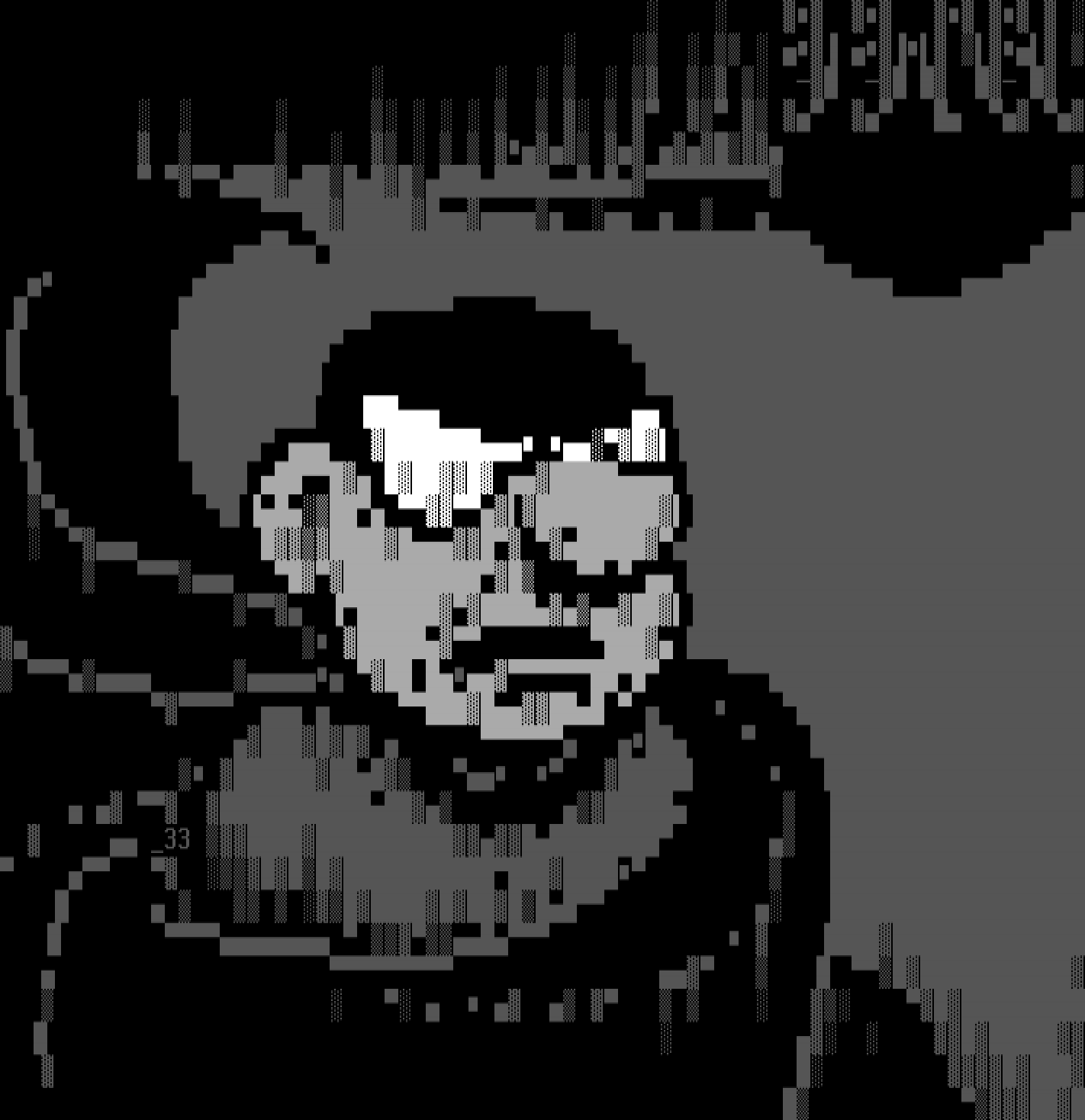
After joining Relic, Eerie quickly moved in a darker, grittier direction artistically. In September, he debuted a new original character: a superhero clad in a black hood and cape known as “Noise” (in 33-MS3.REL). This name reflected a new noisy technique Eerie was using in the shading and texturing of his Relic pieces, interrupting areas of solid color with thin gradient streaks or drips.
He worked with this technique the rest of the year, even using it to draw a small-scale portrait of the inspector in October.
“The Noise ANSIs are an example of my shift to something I considered more in line with the kind of art I found within the ‘elite’ ANSI scene,” Eerie says. “I had no real knowledge of the superhero books, so I made it up with original ‘superhero’ drawings hoping that it would be good enough!”
We won’t be diving deep into Noise, but Eerie made several portraits of him in the final months of 1994; more importantly for us, he also drew one true ANSI comic starring Noise: 33-N1.BIN.
Unlike the lone Inspector Dangerfuck comic, this one was laid out horizontally. It has a strong sense of style: noirish, with shadow and light, and a very limited use of color.
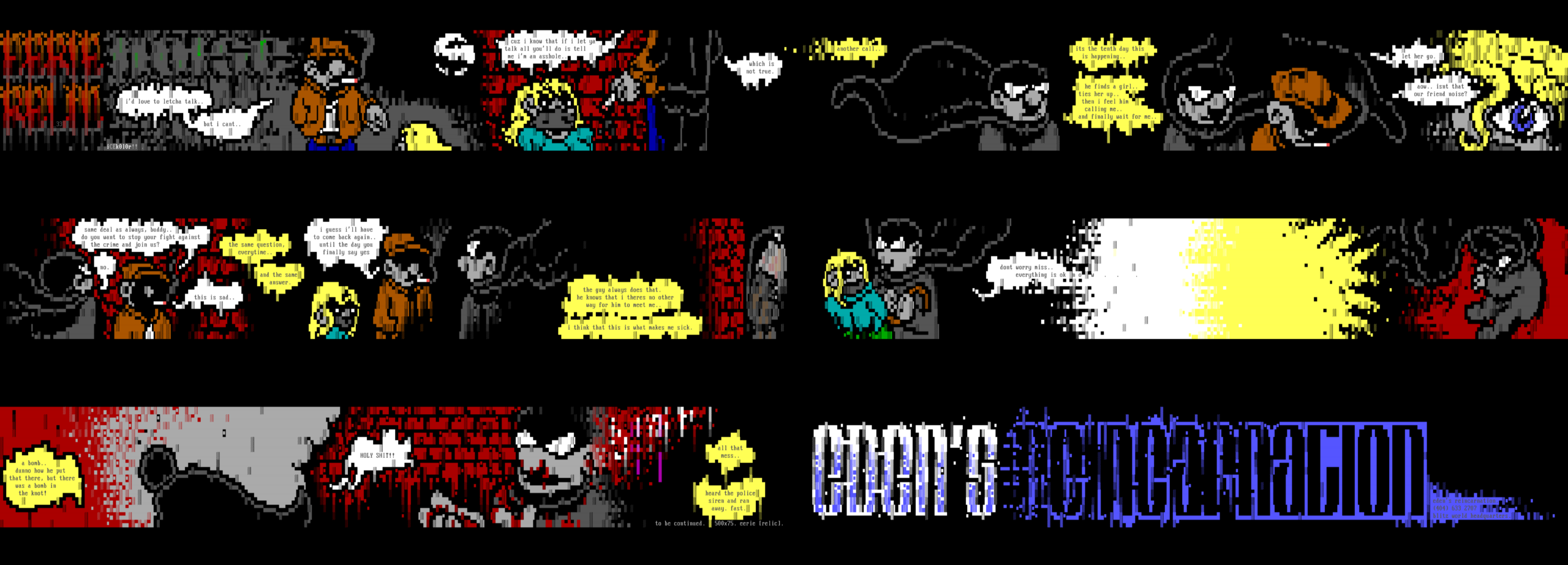
Altogether, Eerie drew around 20 pieces that definitely or likely included Inspector Dangerfuck or Noise in 1994 (see spreadsheet). It had been a year of experimentation and trying to “brute-force” his way into the upper echelons of the ANSI art scene.
He told me that he pursued two approaches simultaneously: using idiosyncratic techniques (“sometimes cranking up what everybody considered too weird or too wrong”), while also studying the ANSI greats and trying to learn by drawing traditional rips of comics characters like “Spawn.”
“Eventually both efforts gelled into a more recognizable ‘Eerie’ style,” he says.
In January 1995, he succeeded in reaching the big leagues: he became a member of ACiD.
He left the scene, and all of its “immature Calvin’s-treehouse energy,” after a couple years. “Growing out of it was a sensible thing to do,” he says.
He never revisited these two original characters.
“It’s not a webcomic”
It’s been a long journey. But we can say now authoritatively that Eerie drew two genuine ANSI comics featuring Inspector Dangerfuck and Noise; plus two semi-animated demos featuring the inspector.
Do these fit into the history of webcomics? Can they be considered precursors? I asked Eerie what he thought, and I think it’s worth quoting him at length:
I mean, sure, BBSes were online, so strictly speaking EE-NP1.IMP is an “early online comic.” It’s not a web comic, even if you want to stretch that notion to an extreme; but “online,” sure.
There’s another aspect to this. With web comics (like xkcd or Achewood), you typically have an artist running their own website, posting their comics on a regular basis, with an interface […] As a reader, you can move around and you can sense a logic behind the serialization.
Now, let’s pretend I produced a couple more Dangerfuck ANSI comics and there’s an actual series of them. The question is: how would that serialization play out? Remember: there’s no websites. The only two means of distribution are: (1) ANSI packs, which needed to be downloaded and unzipped individually; and (2) the actual BBS sponsoring the ANSI, provided it is displayed when the user logs in. […] The 90s art scene was not really a suitable structure for comics serialization and there was probably no future for a hypothetical “ANSI comics” scene under those particular circumstances.
Then there’s the question of what being an “early example” means or entails. If we’re just talking about precedence in time, sure: Dangerfuck probably preceded web comics. But more often than not, the phrase implies that the “early example” is, in some way, a precursor to what came after. I seriously doubt Dangerfuck was a precursor to anything outside the ANSI scene. The actual precursors to web comics were (likely self-published or college-published) print comics, not ANSI comics — not by a long shot. From that point of view it would be accurate to say EE-NP1.IMP was a dead end.
He makes some strong points. It’s not clear that any of the original ANSI comics characters we’ve considered in this series so far — from “Ansiman” to “The Wild Herd” to “Dive” to “Inspector Dangerfuck” to “Noise” — actually, directly influenced later web comics.
There’s weak evidence that some creators of web comics (such as Amber “Glych” Greenlee) were aware of ANSI comics or had made ANSI art themselves. But is that enough for them to be considered precursors? It feels like this is an area that deserves more research. I’d love to hear what you think in the comments.
However, we can push back a little bit about the serialization and distribution of ANSI comics. Eerie himself was involved in creating and distributing numerous e-magazines, often monthly. He wrote software for browsing back issues of those magazines, or for viewing ANSI artwork. Other people were doing that, too, whether offline or online.
In fact, a significant number of people on the “public domain” side of the BBS world were trying to build businesses syndicating content to sysops. They thought they were on the cusp of establishing an entire online publishing industry.
In the final installment of this series, we will meet one of these entrepreneurs, Don Lokke, who created and published more than 140 ANSI art “telecomics,” before Eerie had drawn a single portrait of Inspector Dangerfuck.
Up next — Part 4: The business of BBSes
Other citation formats
@online{renaud2025ansi,
  author       = {Josh Renaud},
  title        = {Eerie and “Inspector Dangerfuck”: ANSI art and webcomics, Part 3},
  year         = {2025},
  month        = dec,
  organization = {Break Into Chat},
  url          = {https://breakintochat.com/blog/2025/12/31/ansi-art-and-webcomics-part-3-eerie-and-inspector-dangerfuck/},
  urldate      = {}
}{{cite web |last=Renaud |first=Josh |title=Eerie and “Inspector Dangerfuck”: ANSI art and webcomics, Part 3 |website=Break Into Chat |url=https://breakintochat.com/blog/2025/12/31/ansi-art-and-webcomics-part-3-eerie-and-inspector-dangerfuck/ |date=2025-12-31 |access-date=}}
Share your thoughts!