
This is the final part of a multi-part series.
In an alternate universe somewhere, nobody has heard of “webcomics.” Instead, there are thousands of “telecomics.”
Thirty years ago, Don Lokke Jr. hoped to make that universe a reality. In 1992, he coined the term “telecomics” to describe his new digital comic strips, drawn primarily in the ANSI art format and distributed online through bulletin board systems and services like GEnie.

A serial entrepreneur, Lokke was one of many people at that time trying to build businesses syndicating content to sysops. He gave away his premier series, Mack the Mouse, for free, but sold other telecomics and ANSI content on a subscription basis from his “Online Mall BBS.” He and others hoped they were on the cusp of establishing an entire online publishing industry.
His star character was Mack, a cynical gray mouse with prominent ears and buck teeth, venting weekly about the politicians in Washington D.C. Mack wasn’t a stylized superhero from the pages of a comic book, but a political commentator, closer in spirit to “Mallard Fillmore” (which he predated) or the editorial cartoons seen in newspapers.
Lokke launched Mack at the height of the 1992 presidential campaign, a pivotal moment in American history. Lokke initially positioned Mack as an outside observer, but after Democrat Bill Clinton’s inauguration as president, Mack’s commentary grew more overtly conservative.
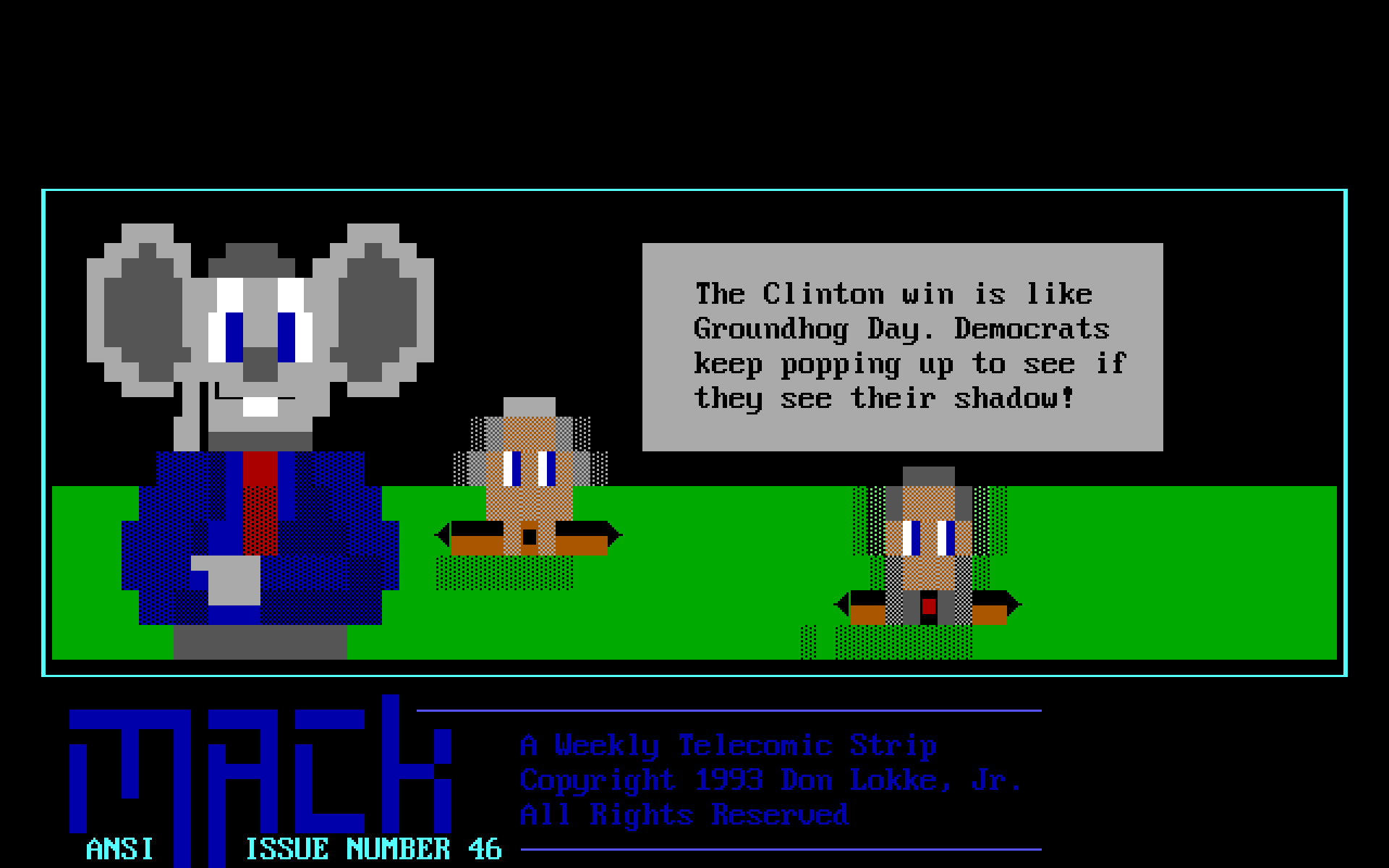
Over the next two-and-a-half years, Lokke produced at least 225 installments of Mack, plus dozens more of his other ANSI telecomics. He attracted a few subscribers, but probably not enough.
By 1995, the great migration from bulletin boards to the World Wide Web was well underway. Lokke jumped ship, too, and moved his businesses to the web. His ANSI telecomics were soon forgotten.
Decades later, I unearthed 145 of them, including a collection of more than 130 Mack the Mouse comics that now can be seen on 16colors, the ANSI art archive. But this is likely just half of Lokke’s ANSI output. The rest of his telecomics remain missing, perhaps lost to time.
We began this series by considering an old claim that the ANSI comic Inspector Dangerfuck, released in 1993, was “the first known comic on the Internet.” That claim was wrong.
And though Lokke’s telecomics predate Inspector Dangerfuck by a year, they also aren’t old enough to be considered “the first” online comics.
Still, they’re worth digging into today.
Beyond giving us a chance to see a very different type of ANSI comic, Lokke’s work will also allow us to consider the business side of BBSing, and to reflect on U.S. politics of the early 1990s.
Lokke died in 2017 in Richardson, Texas. I tried but was unable to contact his family, so this story draws extensively on contemporary textfiles, e-magazines and other records.
Dismayed and disillusioned
BBSers loved to argue about news and politics on messageboards. These discussions could get heated, becoming full-blown “flame wars.”
Yet the topic didn’t come up as often in ANSI art, which was far more likely to draw from pop culture or the theme of a particular bulletin board system.
That’s not to say politics never found expression in ANSI art.
Take the Persian Gulf War of 1990-91, for example. The quick success of this U.S.-led effort to liberate Kuwait from Iraqi occupation resulted in a profusion of war art, mostly patriotic or anti-Iraq in sentiment.
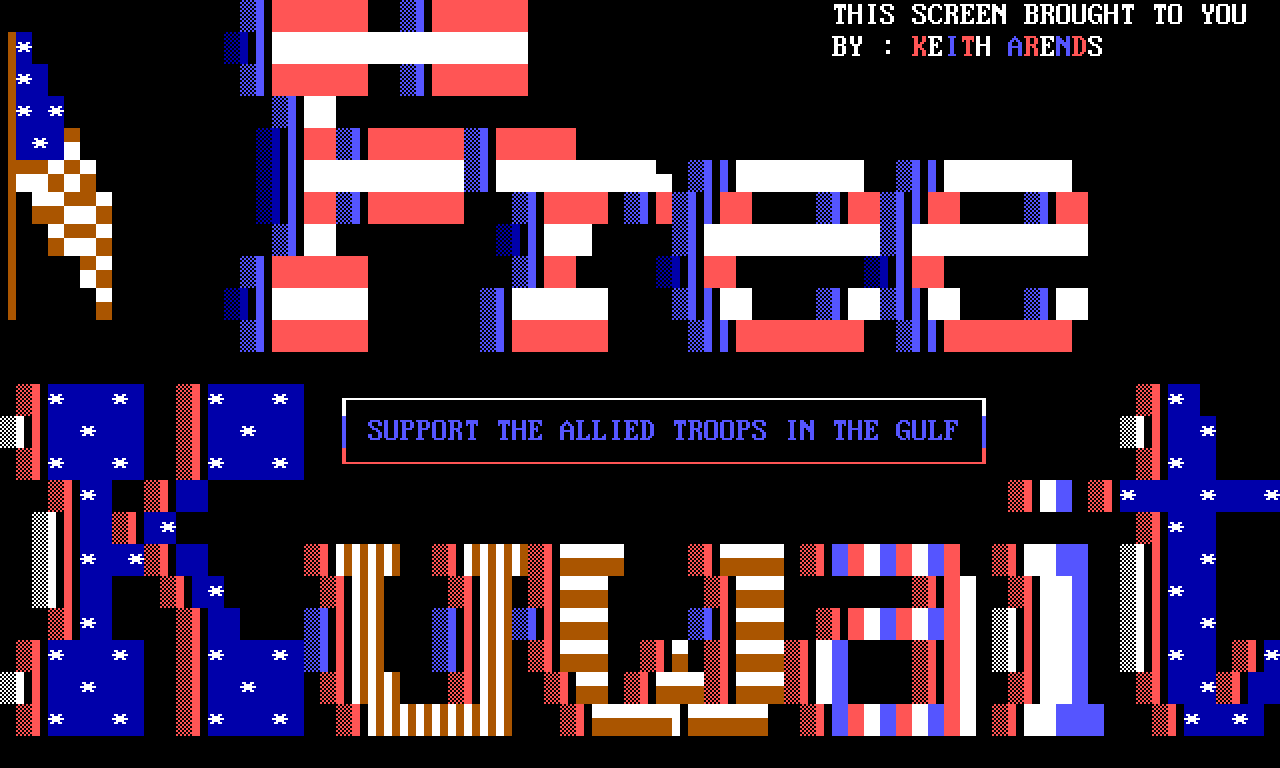
But as far as I can tell, nobody in the BBS world was producing anything quite like Lokke envisioned: weekly strips commenting on current events.
The topsy-turvy presidential election of 1992 was perhaps the perfect moment to try it.
Early on, President George H. W. Bush had seemed certain to be re-elected, bolstered by sky-high approval ratings after the Gulf War. But those ratings didn’t last, pulled down by anger over increasing taxes and fears about the worsening federal deficit. This created an opening for third-party candidate Ross Perot, a Texas billionaire who made a fortune in the tech industry.
Perot probably appealed to Lokke, a 36-year-old small-business owner, one of many Americans dismayed by the economy and disillusioned by politicians of both parties.
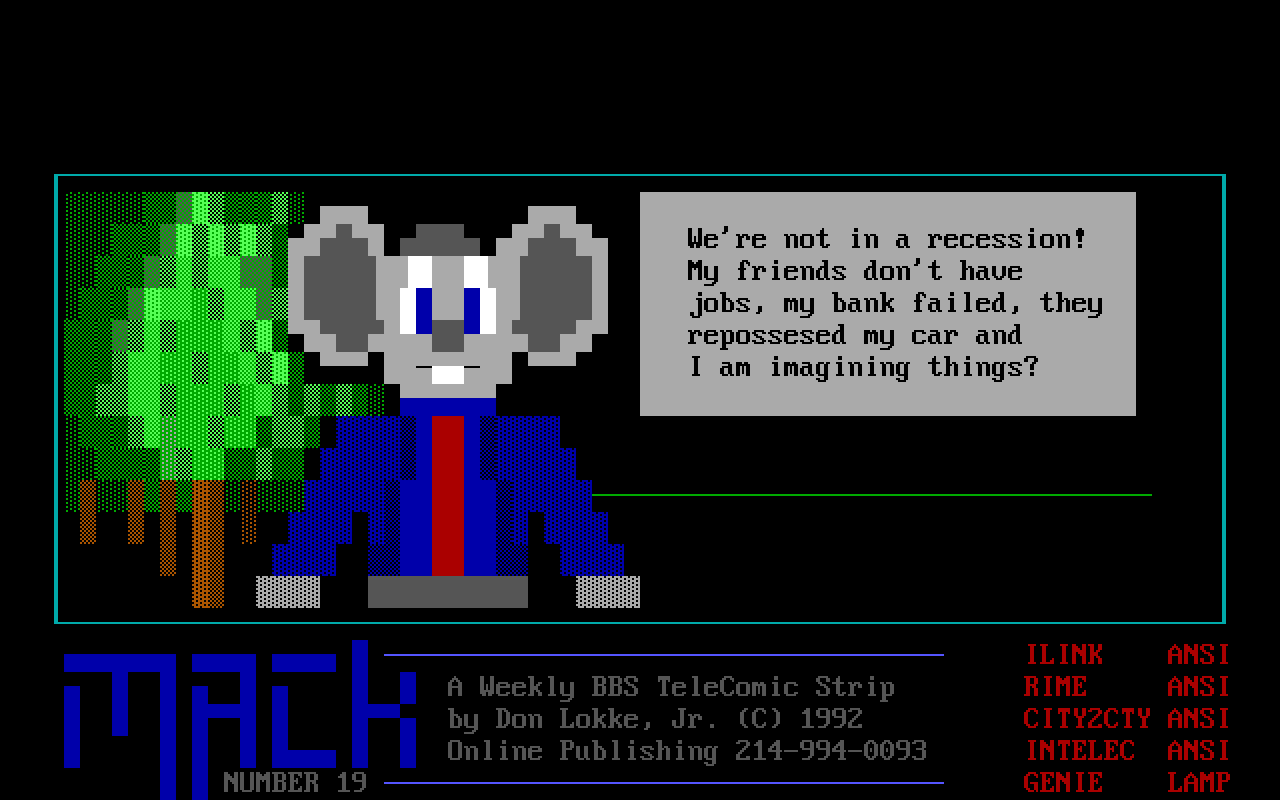
“We’re not in a recession!” Lokke’s “Mack” character would scoff in a later comic. “My friends don’t have jobs, my bank failed, they repossessed my car and I am imagining things?”
Lokke had been involved in advertising and publishing since 1978, when he graduated from Texas Tech University. He ran a full-service print shop in the garage of his home in Plano, Texas, where he helped produce publications for small clients, like “Stormtrack,” a bimonthly newsletter delivered to a few hundred storm chasers around the country.
He felt the economic pinch, and saving a buck could be almost as important as earning one. The electric bills for Lokke’s house and his shop could cost up to $700 per month in Texas’ summer heat. So he became an early adopter of renewable energy, installing a heat pump and smoke-tinting his windows.
With his background, Lokke could write convincingly in the voice of disaffected middle-class Americans.
His “Mack” character as an everyman and an outsider, a mouse protesting the outrageous behavior of the “rats” who were running Washington D.C.
A key political moment
Lokke had good reason to think Mack the Mouse and his other political telecomics might appeal broadly to sysops.
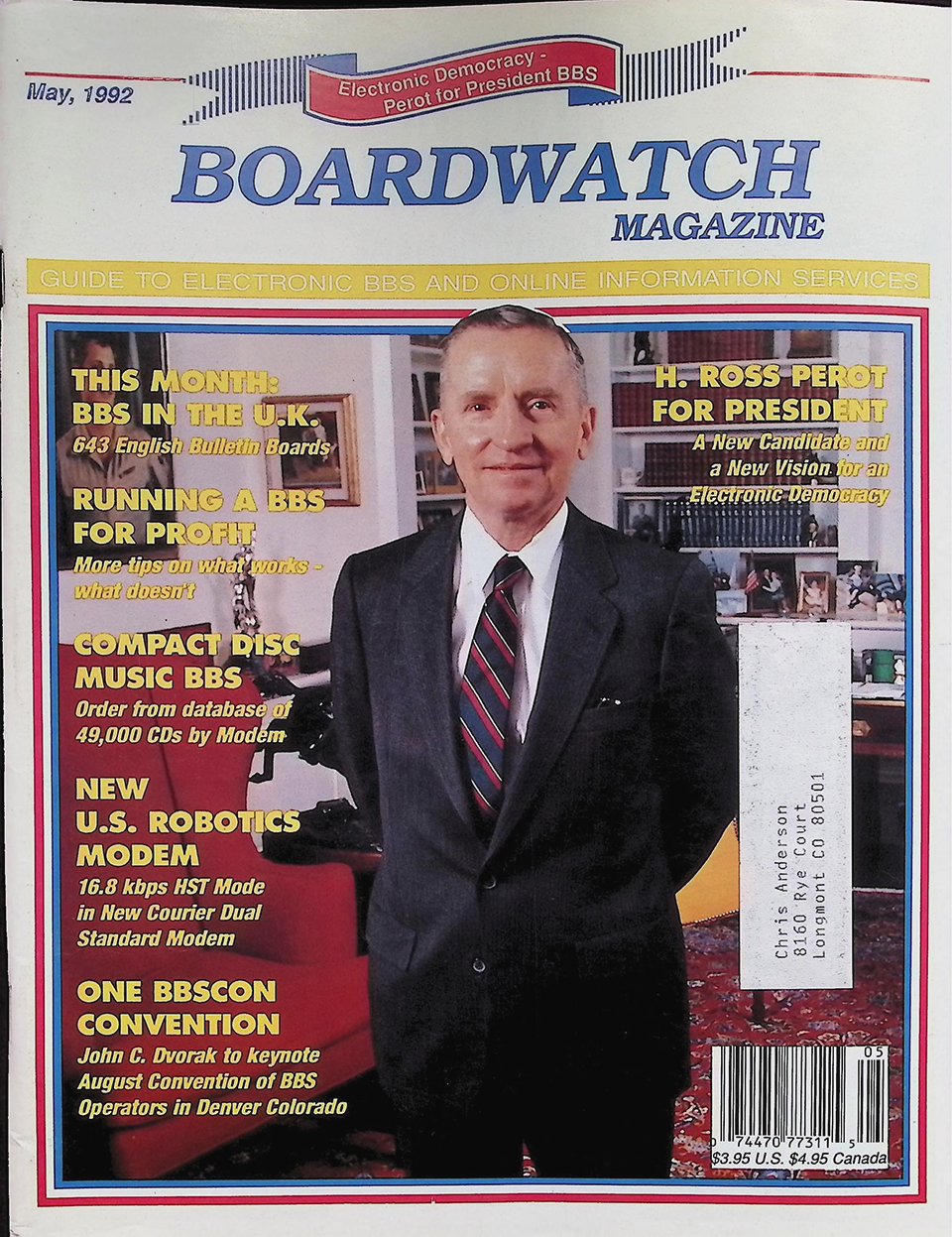
After all, the BBS world had a strong libertarian streak, perhaps best exemplified by Jack Rickard, the publisher of Boardwatch Magazine. Rickard was a staunch advocate of the transformation of BBSing from a hobby to an industry.
Like many online, Rickard greatly admired Perot, going so far as to put him on Boardwatch’s cover in May 1992. Rickard praised Perot for building a high-tech computer company, and lauded his vision of a future “electronic democracy” where millions of people would engage in massive town hall meetings by television and telephone.
Lokke had just begun to experiment with drawing political telecomics that summer, when the presidential race was upended.
In mid-July, facing an exodus of campaign advisers, Perot suddenly withdrew from the presidential race. Lokke, Rickard, and others must have been disappointed. Lokke seems not to have worked on his telecomics for several months.
St. Louis-based ANSI artist Dave Hartmann memorialized the event with a fun caricature featuring Perot’s face on a milk carton beside the headline “Have you seen this man?”
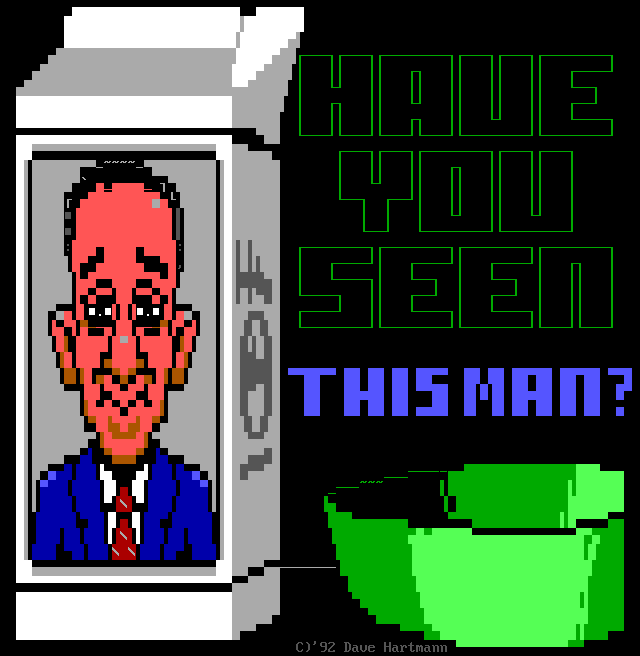
But at the last minute, Perot mounted a comeback, re-entering the race on Oct. 1, 1992.
A few weeks later, Lokke launched Mack the Mouse. He couldn’t have picked a more interesting political moment.
Building a library
Lokke was at a disadvantage when started his content syndication business. As discussed in Part 4 of this series, the top “public domain” ANSI artists had large back-catalogs of ANSI art they had drawn over several years. Lokke did not.
So, after the debut of Mack the Mouse in October 1992, Lokke drew at a frantic pace to build up his library, producing 40 installments in the first five weeks.
He wrote most of these early strips with generic political commentary. Keeping the strips vague gave them a longer shelf life.
He also went heavy on anthropomorphism, usually casting the general public as “mice,” and politicians and lobbyists as the “cats” or “rats” preying on or taking advantage of them.
Take Mack the Mouse No. 8, for example:
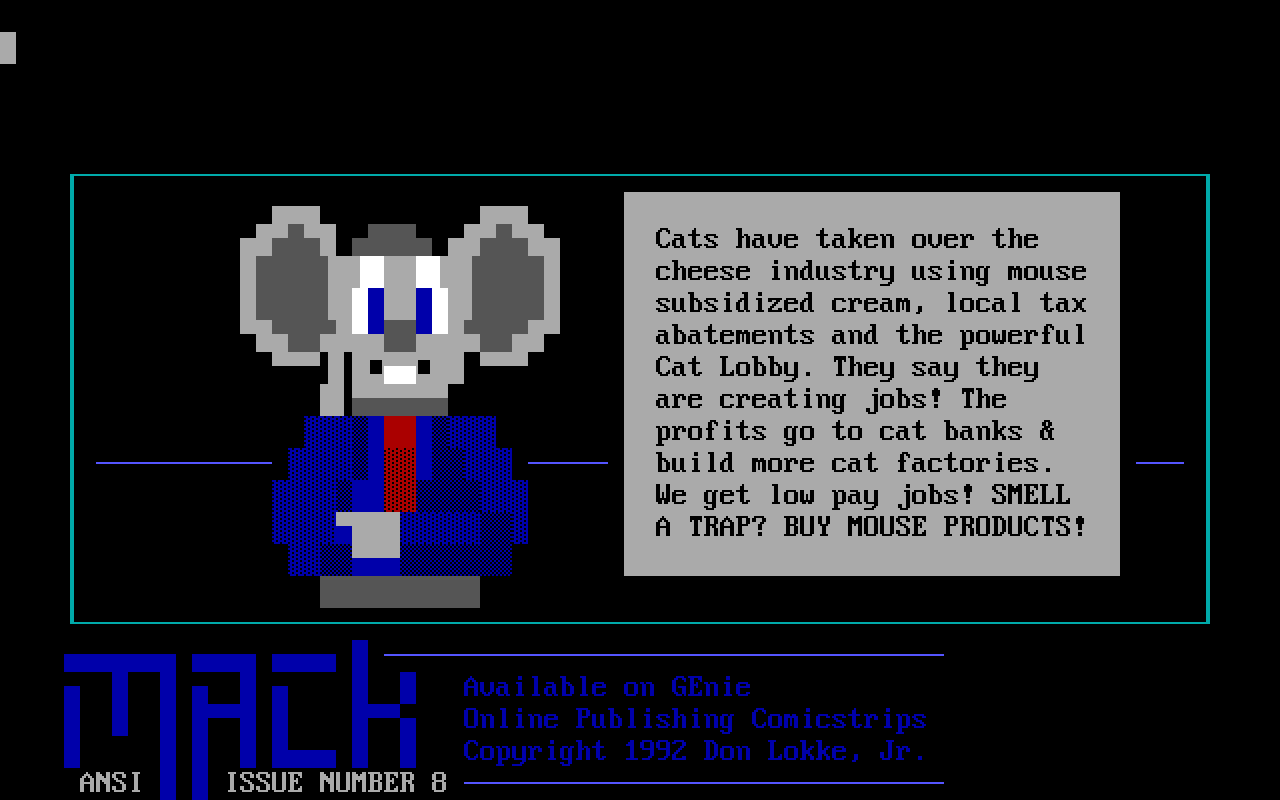
The cat-and-mouse analogy here is ambiguous enough to invite several interpretations, but to me “BUY MOUSE PRODUCTS!” sounds like the “Buy American!” rhetoric of that time. Mack is criticizing state and local governments for giving incentives to foreign “cat” firms, such as Japanese automakers, to build and operate factories in the U.S. Sure, they create jobs, he argues, but those jobs don’t pay well, and the profits end up overseas.
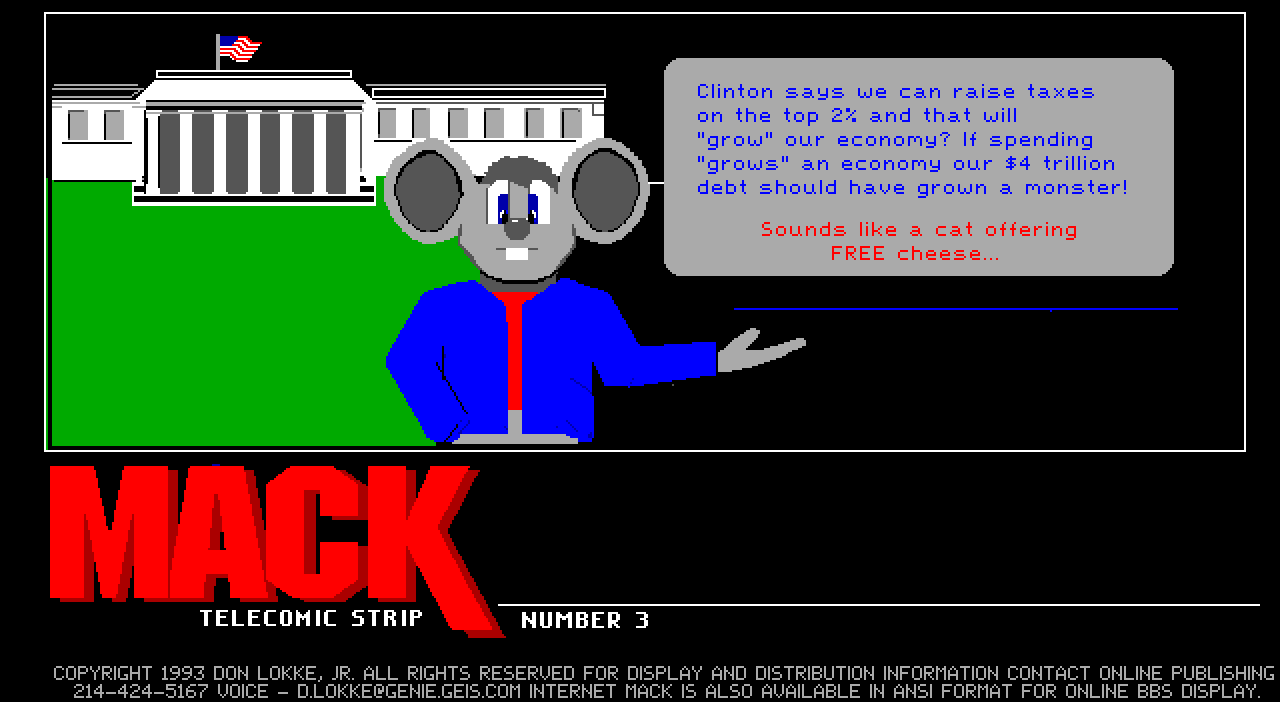
Still, a few early strips were specific and timely, referencing the end of the 1992 presidential race. Take Mack No. 3, for example:
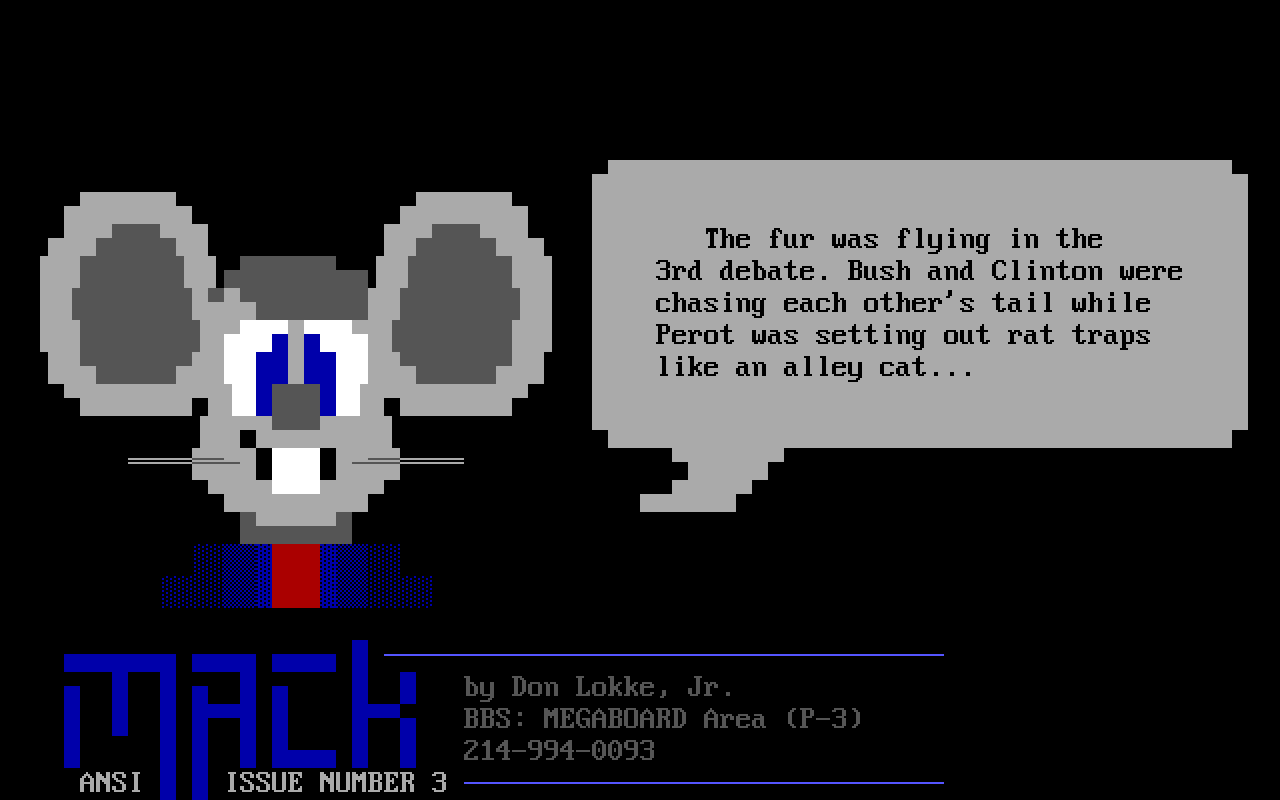
“The fur was flying” during the third presidential debate, Mack observes. “Bush and Clinton were chasing each other’s tails while Perot was setting out rat traps like an alley cat.”
Here he has again employed “cat” / “rat” language, but this time to describe individual candidates. He also flipped the analogy: in contrast to strip No. 2, where he described Clinton negatively as a “cat offering free cheese,” this time the “cat” is good. Ross Perot is a wily “alley cat” setting traps for the bad politician “rats,” Bush and Clinton.
Then, in an issue published just days before the election, he seemed to endorse Perot, the outsider.
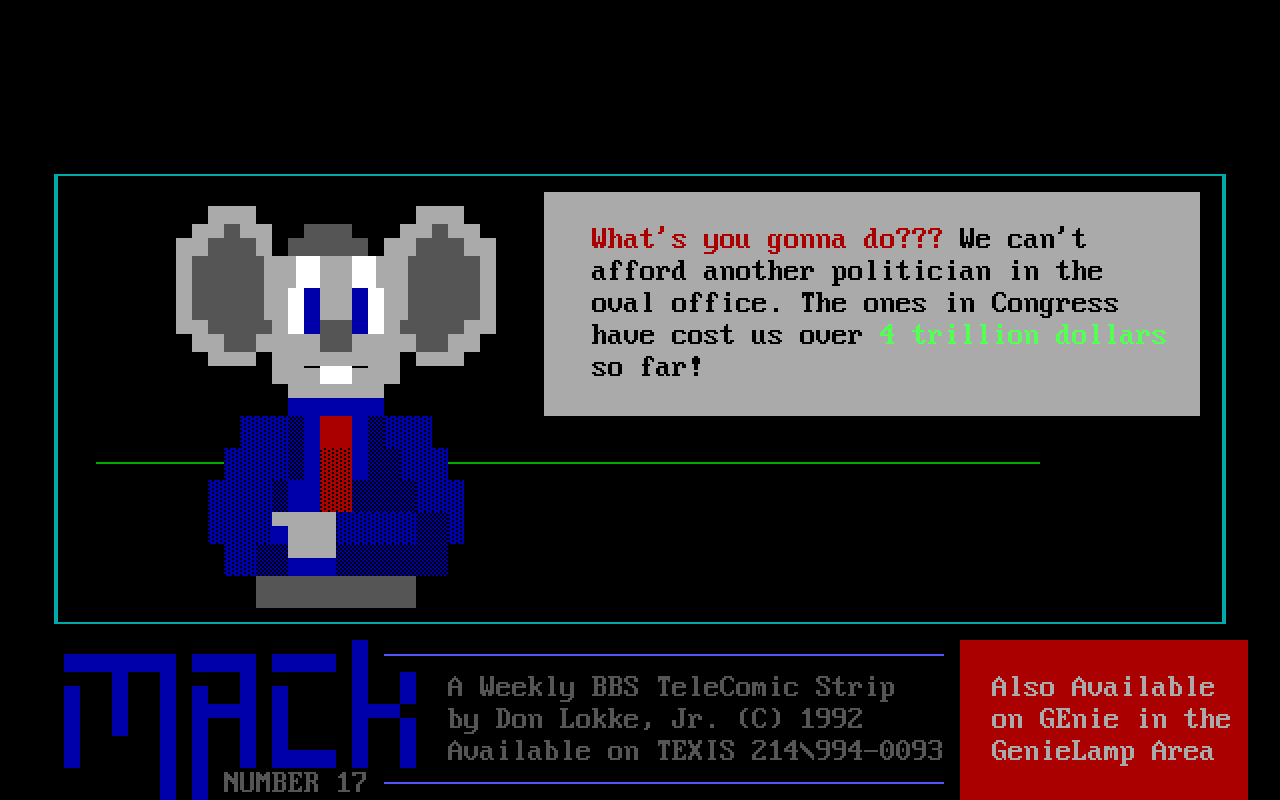
“What’s you gonna do?” Mack asks voters. “We can’t afford another politician in the Oval Office. The ones in Congress have cost us over $4 trillion so far!”
But a Perot presidency was not to be. He received 19% of the popular vote — the best showing by a third-party candidate in 80 years — but that was only good enough for third place.
Still, Perot’s campaign had a very real impact. He siphoned off conservative support from Bush, enabling Clinton to win with 43% of the popular vote. For the first time in 12 years, a Democrat would occupy the White House.
An increasingly conservative observer
By the time Clinton was inaugurated in early 1993, Lokke had built a library of nearly 50 issues of Mack the Mouse.
Lokke reacted with a notable shift in his political commentary. Instead of complaining about generic “rats” and “cats” in Washington, now Mack was more likely to critique specific issues or Clinton administration initiatives such as NAFTA or health care.
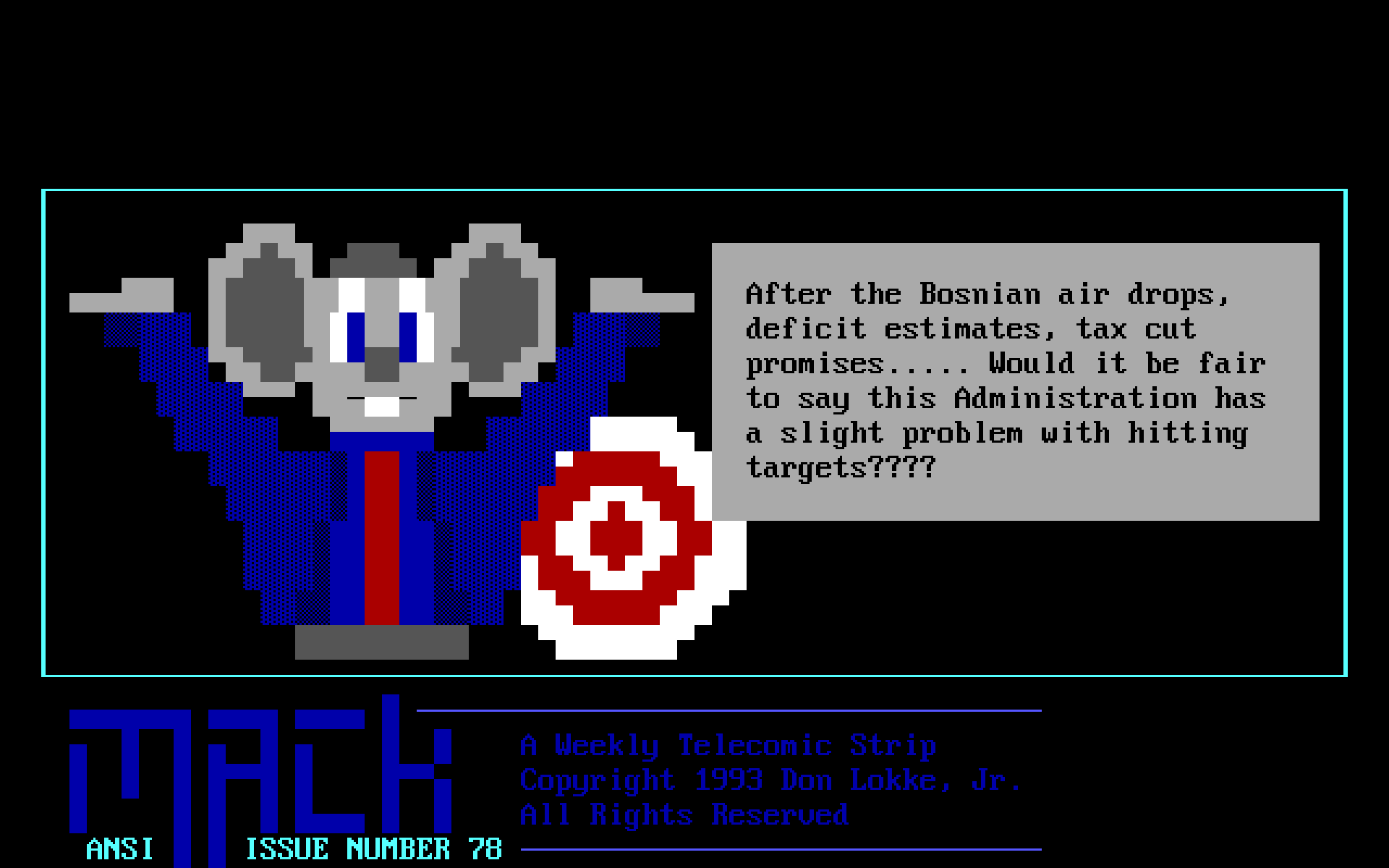
“After the Bosnian air drops, deficit estimates, and tax cut promises, would it be fair to say this administration has a slight problem with hitting targets?” Mack asks pointedly in No. 78, published in June.
Lokke acknowledged this change of tone in his marketing materials, revising his original neutral description of Mack from “political observer” to the overt “conservative observer.”
This change didn’t happen in a vacuum. The Clinton presidency was perhaps the best thing that could have happened for conservative commentators across the country. As Clinton tried to enact his agenda, their voices got louder in opposition.
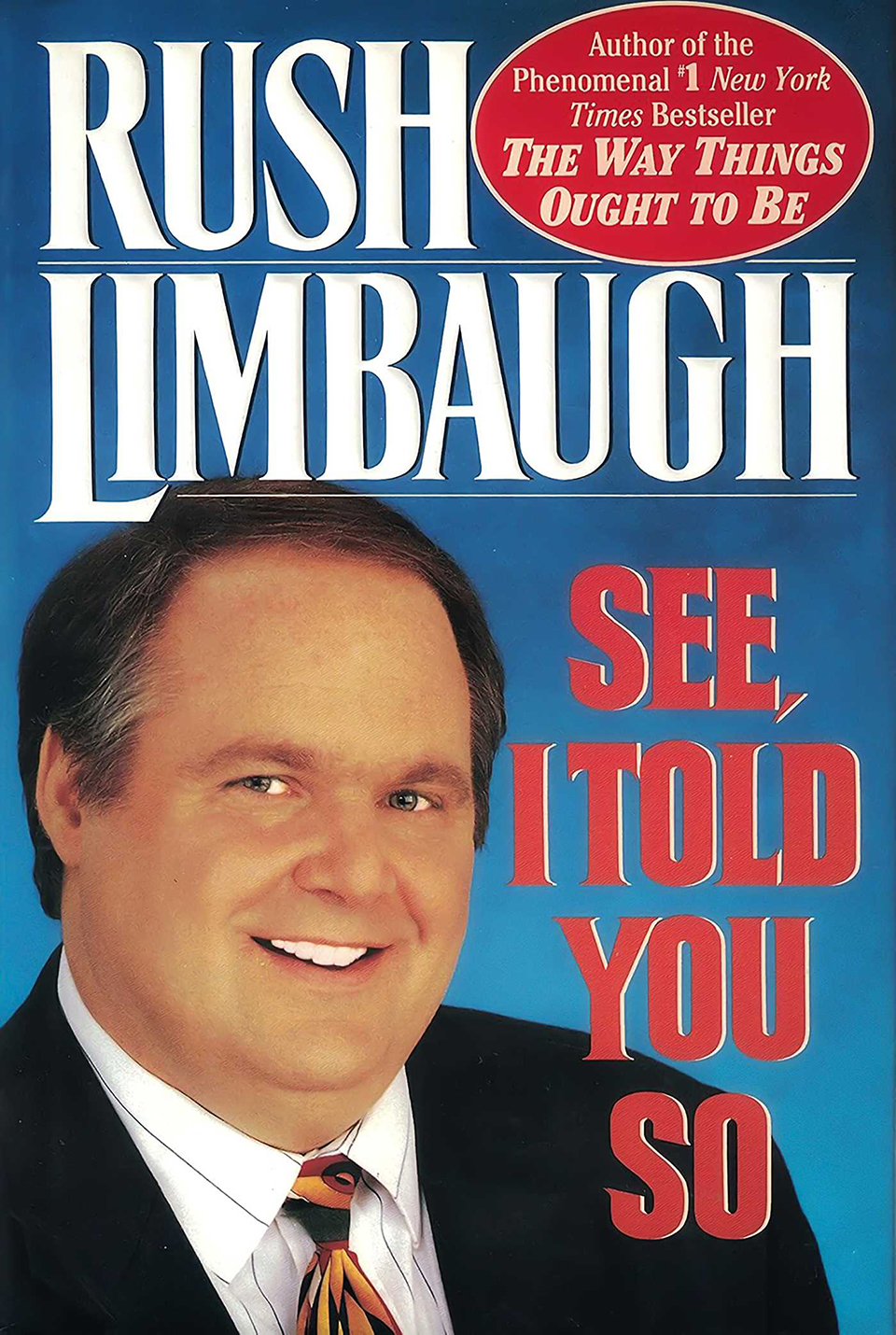
Radio talk show host Rush Limbaugh was perhaps the biggest beneficiary. Known for his brand of sharp attacks laced with humor, Limbaugh had launched a new TV show and published two New York Times bestselling books in 1992 and 1993.
Around that time, newspaper editors began seeking a conservative counterpoint to put on the comics pages opposite the popular liberal strip Doonesbury. Bruce Tinsley’s conservative anthropomorphic duck Mallard Fillmore fit the bill, so to speak, and was picked up for national syndication in 1994.
Compared to Limbaugh or Tinsley, Lokke’s writing is clumsier. His commentaries are often too long and not always funny. Lokke improved over time, but he never developed the smooth rhythm and pithy punchlines typical of comic strips like Mallard Fillmore.
But unlike Limbaugh, who often attacked people with epithets and slurs, Lokke never got so mean-spirited. A typical joke looked like this:
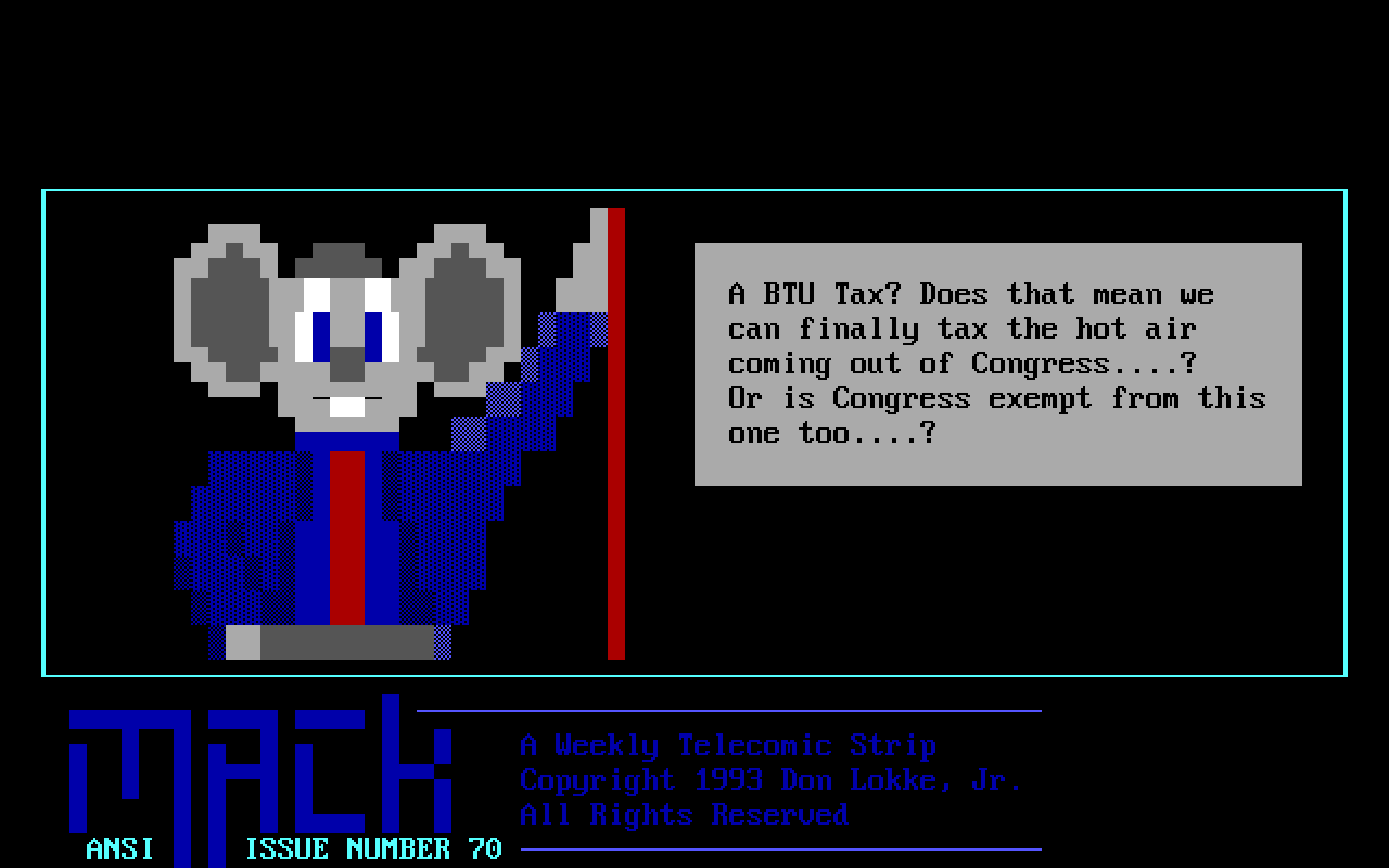
“A BTU tax? Does that mean we can finally tax the hot air coming out of Congress?” Mack asked in No. 70. “Or is Congress exempt from this one too?”
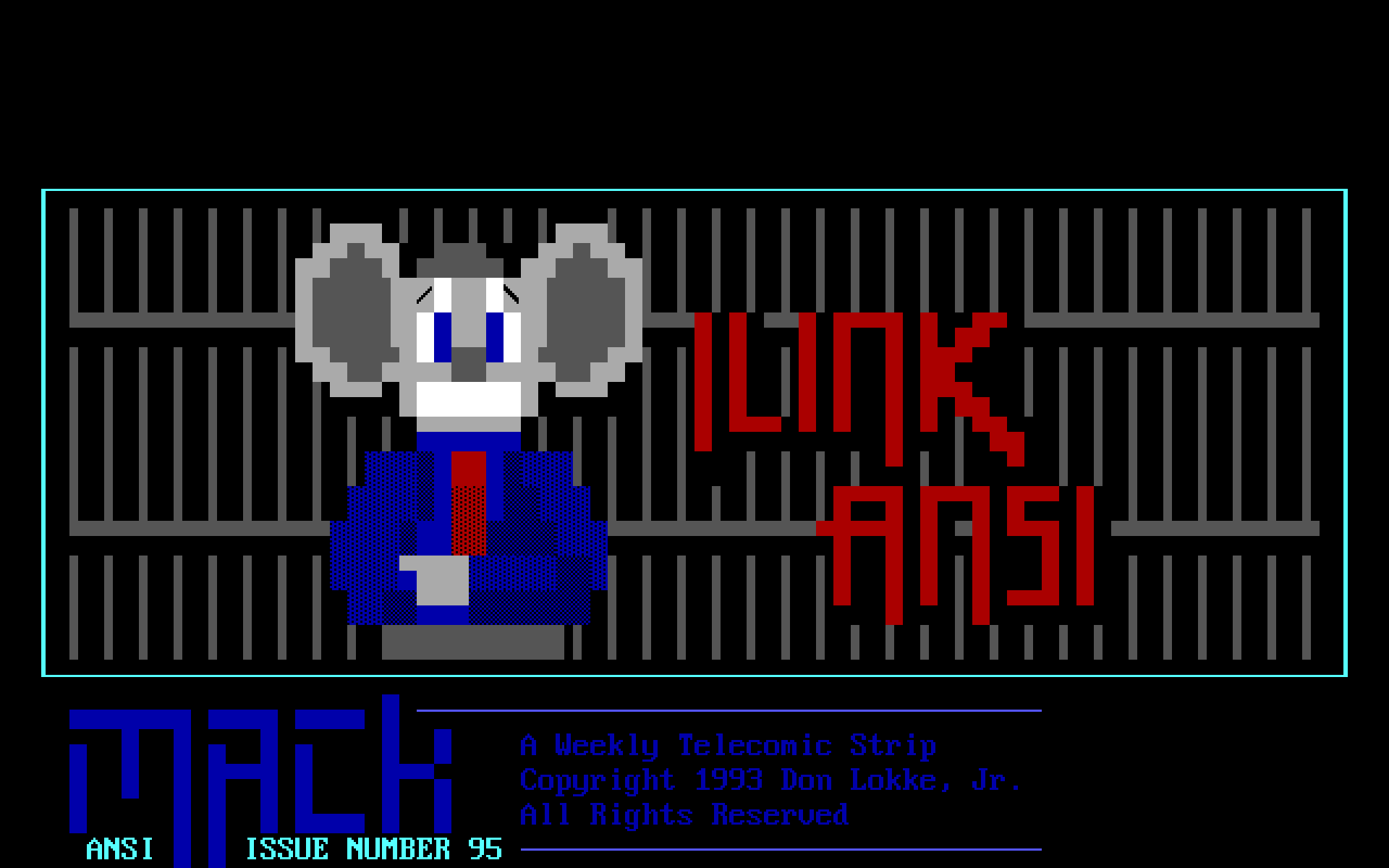
Still, there were some folks who didn’t want to see Mack the Mouse posted in ANSI art conferences. In June 1993, Lokke reported that Mack had been suspended from ILINK “for airing political views.” Lokke commemorated the development in No. 95 by drawing Mack behind bars with his mouth taped shut and no speech balloon.
One year after Mack’s debut, Lokke had drawn more than 130 strips, tackling favorite conservative targets of the time ranging from “political correctness” to “socialized medicine.”
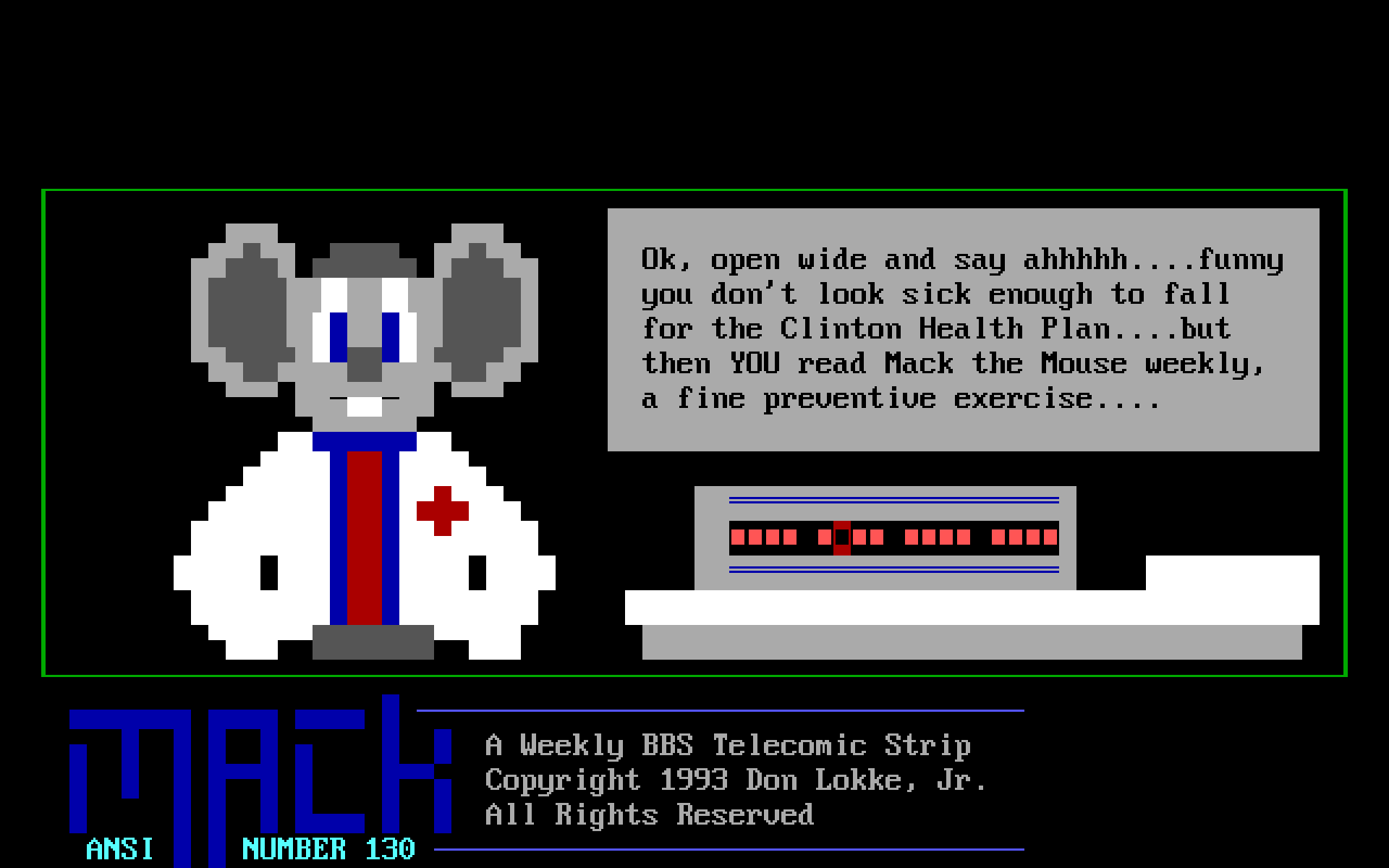
Over that time, his confidence had grown. He believed his commentary was common sense, a sort of preventive medicine for his readers.
“Funny, you don’t look sick enough to fall for the Clinton Health Plan,” Mack says in No. 130. “But then, you read ‘Mack the Mouse’ weekly.”
Meet Mack
Lokke settled on a horizontal format for his ANSI comics, roughly 72-76 characters wide and 15 rows tall. This tight canvas required him to keep the character designs simple and small. His series Mack the Mouse, Yellow Bird, and Talking Heads began as just, well, talking heads.
Let’s look at how these constraints shaped Mack the Mouse.
Lokke’s initial Mack design was cute and distinctive: a head-and-neck portrait of a grinning gray mouse with long whiskers and enormous ears.
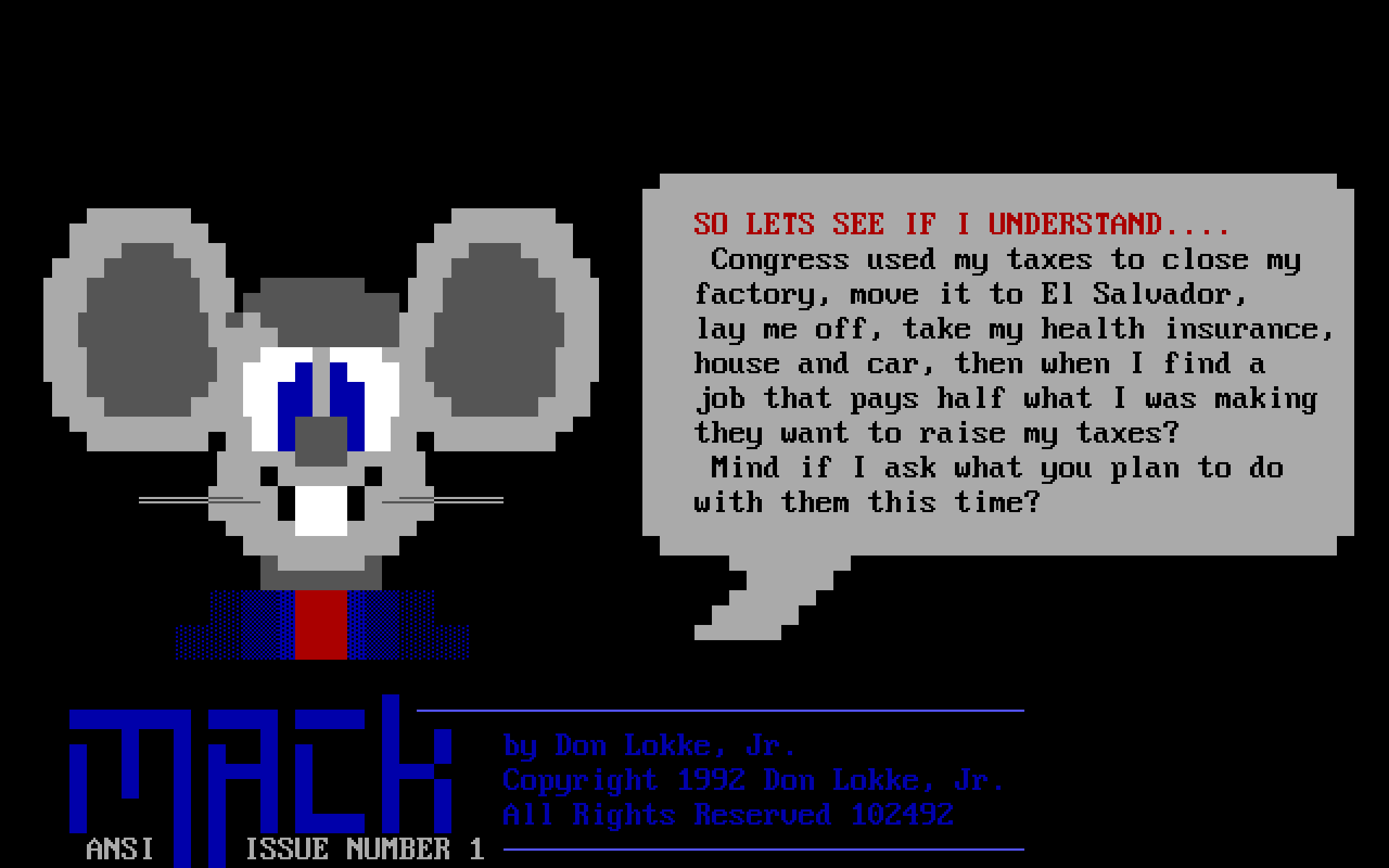
This version of Mack’s visage was clearly too big. His face and enormous ears took up nearly one-third of the canvas, leaving room for commentary, but little else.
Lokke redesigned Mack for the fourth issue, shrinking him considerably and simplifying his face. Mack lost his whiskers, kept his distinctive ears and buck teeth, and gained a torso and arms. Now it was possible for him to gesture.
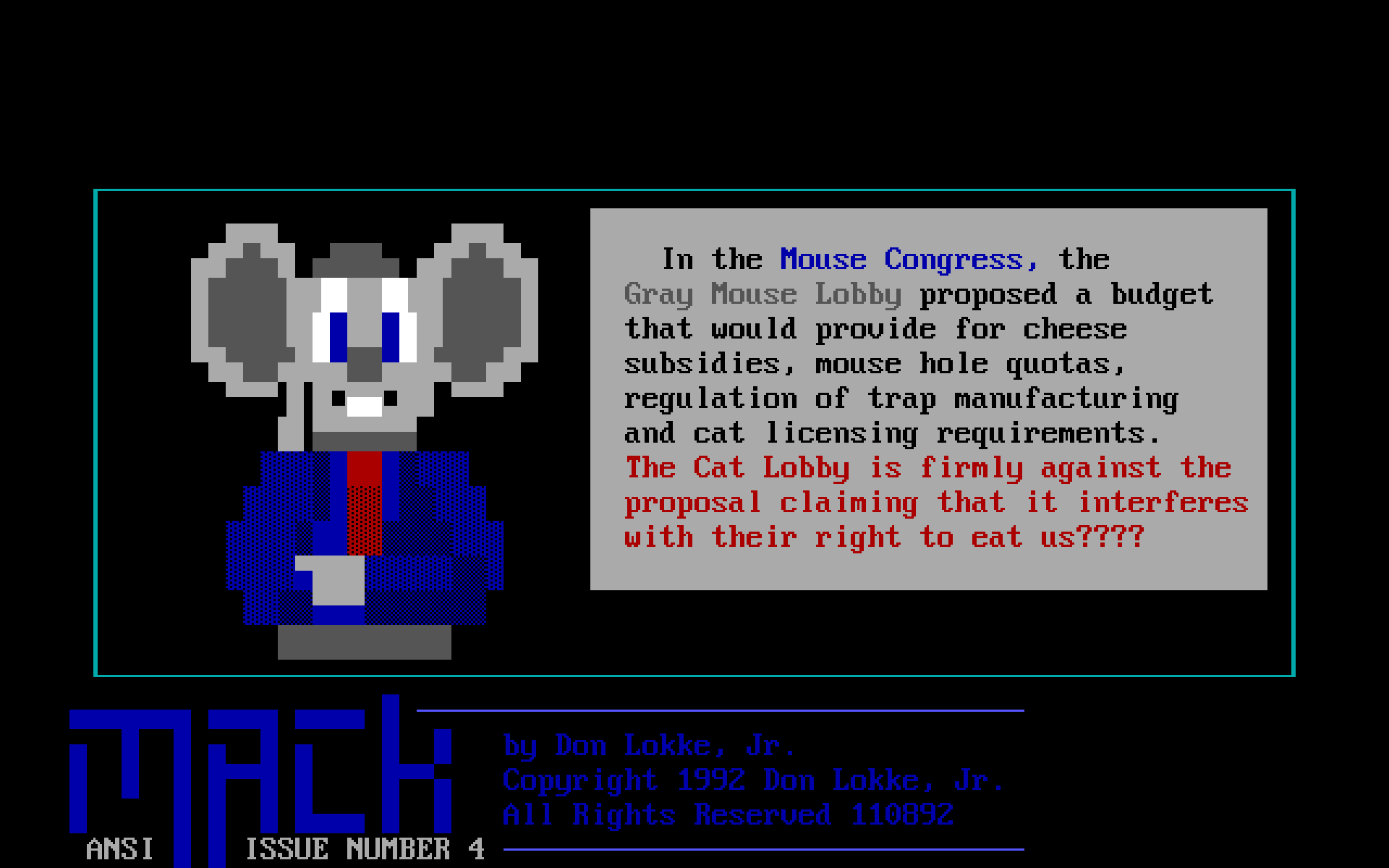
Still, the first two dozen Mack comics were visually boring, almost meme-like in their repetition: Mack holds the same pose, staring out at the reader with his arms folded. With one or two exceptions, the only thing that changes is the text.
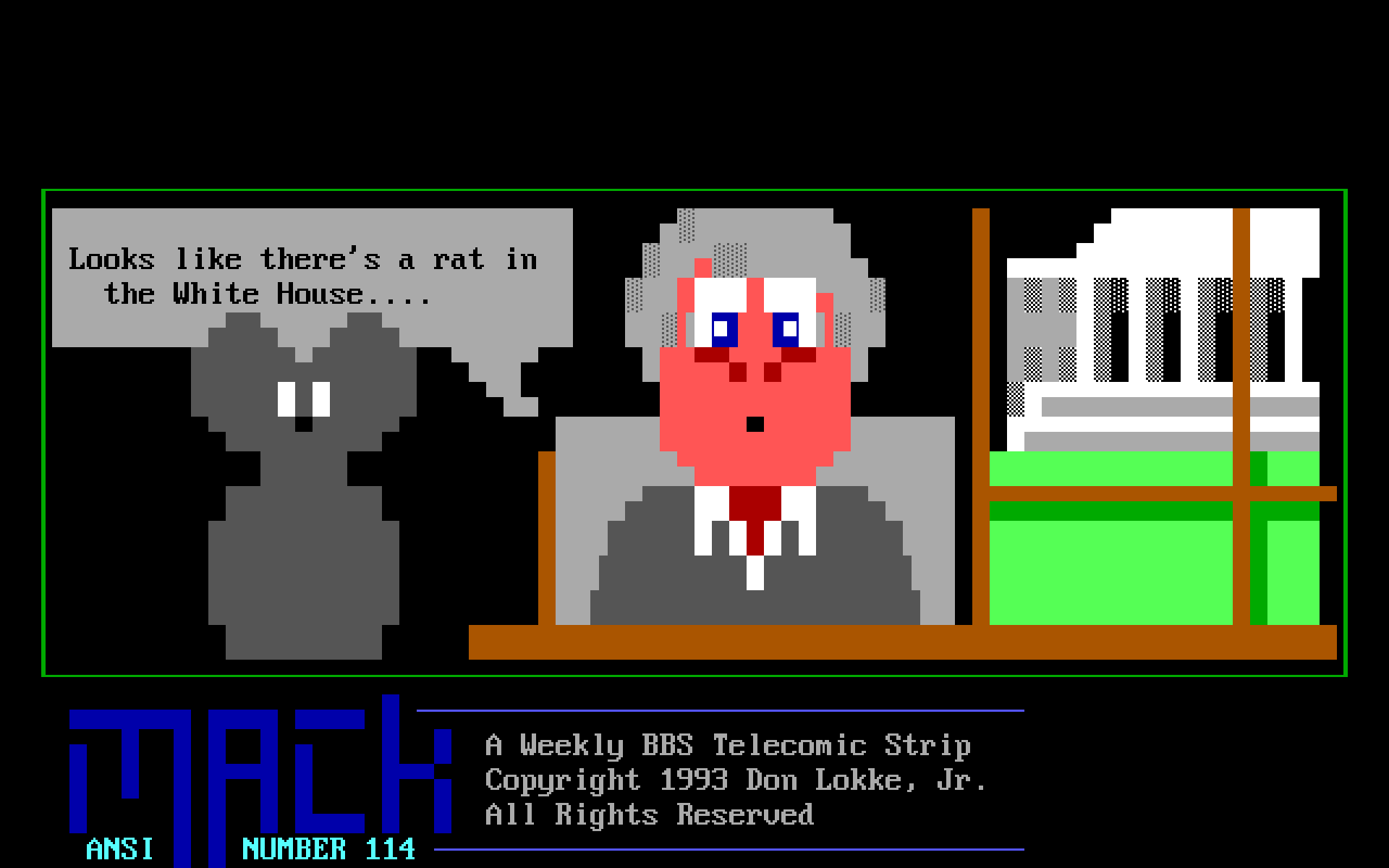
But eventually Lokke had built up his catalog enough to get some breathing room. He began to draw new expressions and poses for Mack, which he could remix and reuse. He added visual elements to reinforce his jokes and comments: a desk, a cave, the White House, Air Force One, jail bars.
By issue 99, Lokke was clearly getting comfortable with the format, and his drawings became noticeably more inventive. Now he was depicting Mack at a gas pump, or flipping a coin into a panhandler’s cup. He even replaced Mack entirely in one issue — with a small-scale portrait of Clinton.
The measure of success
Lokke found a voice and a style. But did he find an audience or financial success?
I believe he did find an audience, some of whom were enthusiastic. Sysop Andy Nachbaur, for example, added Lokke’s telecomics to his “Wild Bee’s BBS” and immediately began running ads promoting the availability of these new “conservative ANSI cartoon friends.”
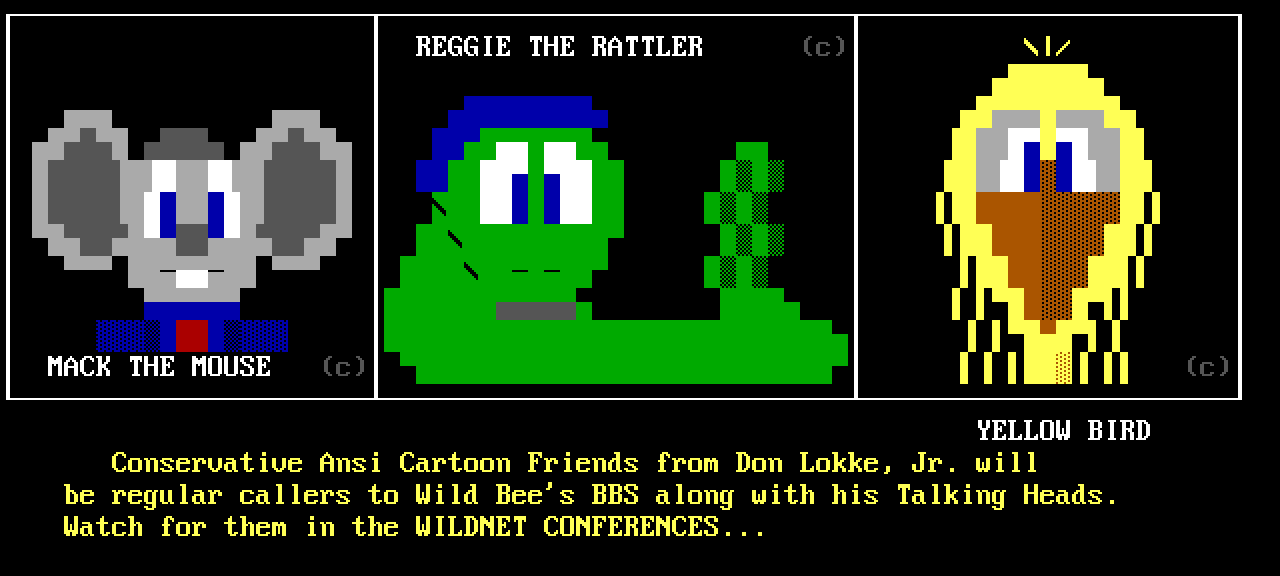
It’s impossible to measure the reach of Lokke’s telecomics, but contemporary records show that Lokke found many distribution outlets, ranging from BBS message networks like RIME or PlanoNet to big online services like GEnie and CompuServe.
Lokke was member of the Disktop Publishing Association (DPA), and he persuaded a few of his fellow publishers to carry Mack in their digital publications. Maryjane Choate ran dozens of Mack strips in the “Funny Pages” section of her A-Chat magazine from late 1992 until the magazine’s demise in April 1993.
Todd and Tamara Jacobs likewise ran Mack strips in their Electronic Review literary magazine from March 1993 until February 1994.
Then, in October 1993, they published a surprising headline: Lokke had been syndicated in print!
“Mack the Mouse is now a political cartoon for several traditional newspapers and magazines,” they wrote. “Way to go, Don!”
I tried but was unable to corroborate this claim. Still, it’s possible the strip may have run in small community newspapers or magazines which haven’t been archived and can’t be searched.
As far as subscription revenue, evidence suggests it was probably tough going.
Lokke floated numerous pricing plans and services: $5-per-month subscriptions for access to download and publish any of Lokke’s digital content, a $30-per-year delivery service where Lokke would call a sysop’s BBS to upload new telecomics issues, or $52-per-year subscriptions for individual telecomics series or “info screens” delivered weekly, just to name a few.
He may not have had many takers. The June 1993 edition of Lokke’s “Online Publishing” newsletter showed a total of 13 BBSes carrying Mack online or in ZIP archives. If they each paid $60 that year, Lokke would have earned less than $800.
Getting in on the ground floor
In this profile, we have focused on Lokke’s ANSI telecomics. But when Lokke set out to draw and sell artwork through his BBS in early 1992, he didn’t begin with ANSI.
As an experienced illustrator from the print world, he would have preferred to draw with a tool like CorelDraw and distribute his art in a high-resolution graphics format, rather than a crude all-text format like ANSI.
So when Lokke heard about a brand-new, high-resolution graphics standard for BBSes called “Blue Instant Graphics” (BIG) created by Larry Mears, he quickly became an early adopter — and enthusiastic cheerleader — of the format. In Mears he must have seen an innovator, a kindred spirit. They promoted each other’s work.
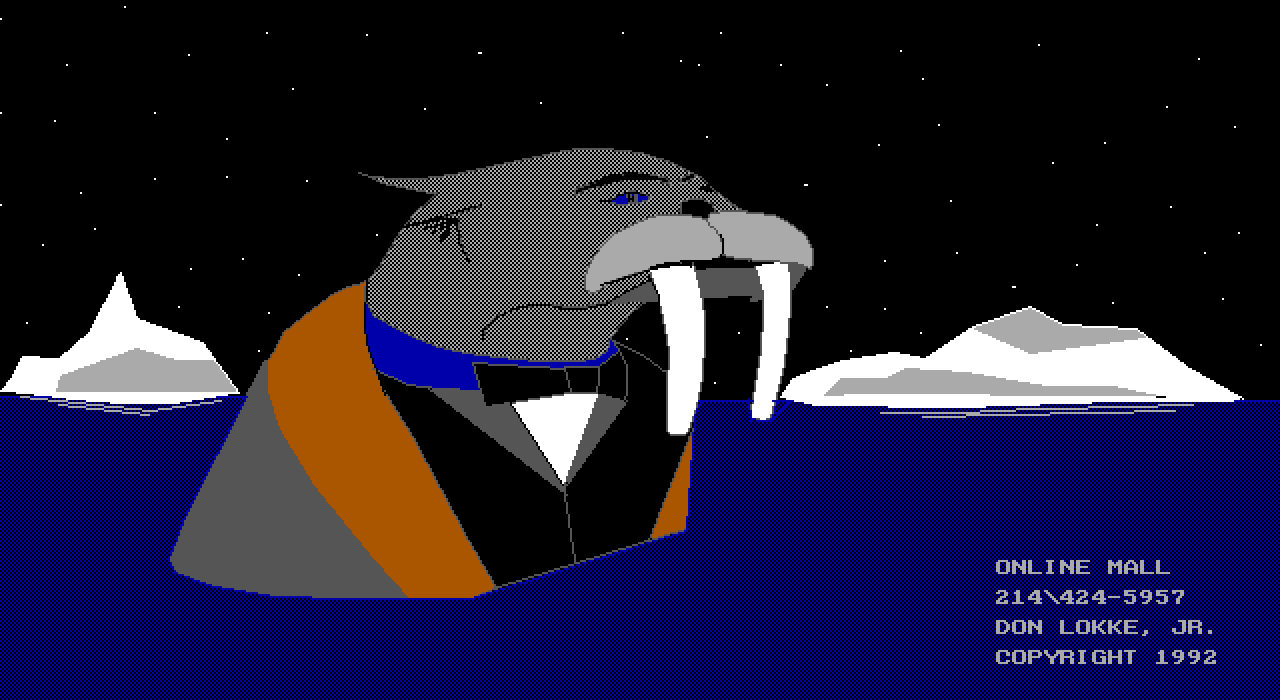
Lokke used BIG to drew several high-resolution animated issues of “Reggie the Rattler,” his first online political cartoon, which he later marketed as an “anti-Congress” series. He gave these away free, along with other BIG art, to entice sysops to pay $35 to subscribe to his “art support service,” which would give them access to “high quality EGA/VGA BIG illustrations, comic strips, cartoons, and online publications.”
But BIG never really caught on with sysops and users. To have any hope of selling content, Lokke had to go where the audience was. So later that year he pivoted to the ubiquitous ANSI format.
He proved prolific in that medium, creating around 275-300 ANSI telecomics. He drew at least 225 issues of Mack the Mouse by March 1995, plus at least 56 installments of his other series: Reggie the Rattler, Talking Heads, Yellow Bird, and Rainbow. (There is also evidence of a Lenny the Lizard strip, but no totals were given and no copies have survived)
Still, Lokke never gave up on high-resolution artwork. In 1993, he re-drew at least 7 issues of Mack at EGA resolution (640×350) — perhaps using Mears’ tools — and released them as GIFs.
And that summer, when Mears released another new graphical protocol for BBSes called “Condor,” Lokke wrote a glowing review for the GEnie Lamp online magazine.
“Condor has achieved what whole industries have failed to produce,” he enthused. “At last, digital publications can mix text and graphics on the same screen without special programming. ”
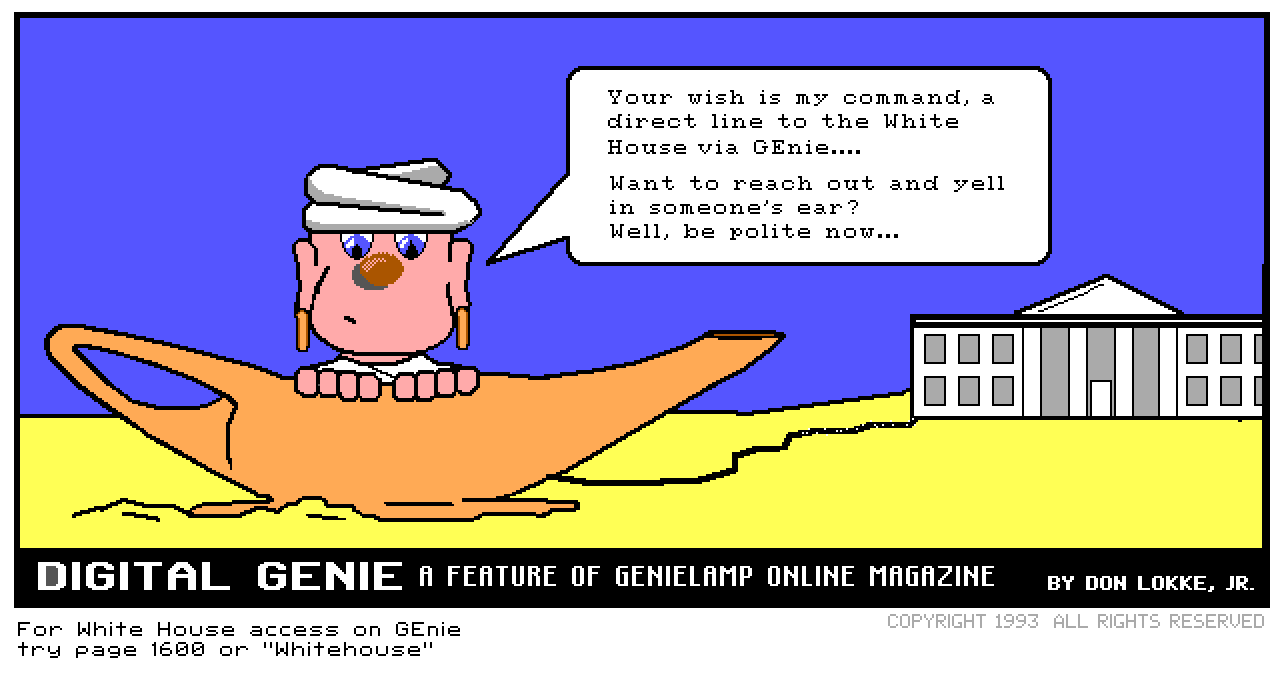
A few months later, he started Digital Genie, a new monthly cartoon for GEnie Lamp. Only his initial cartoon has survived, but Lokke’s name continued to be listed in the magazine’s staff box until March 1995.
Were Lokke’s “telecomics” comics?
This is probably a good place to consider the question we have been asking throughout this series: Can Lokke’s ANSI “telecomics” be considered comics?
After all, Lokke stuck to a single-panel format — but the widely accepted definitions of comics from Scott McCloud and Will Eisner require juxtaposed images “in a deliberate sequence,” as discussed in Part 2.
Under that strict definition, probably not. (Though Lokke did draw a couple multi-panel installments of Mack the Mouse)
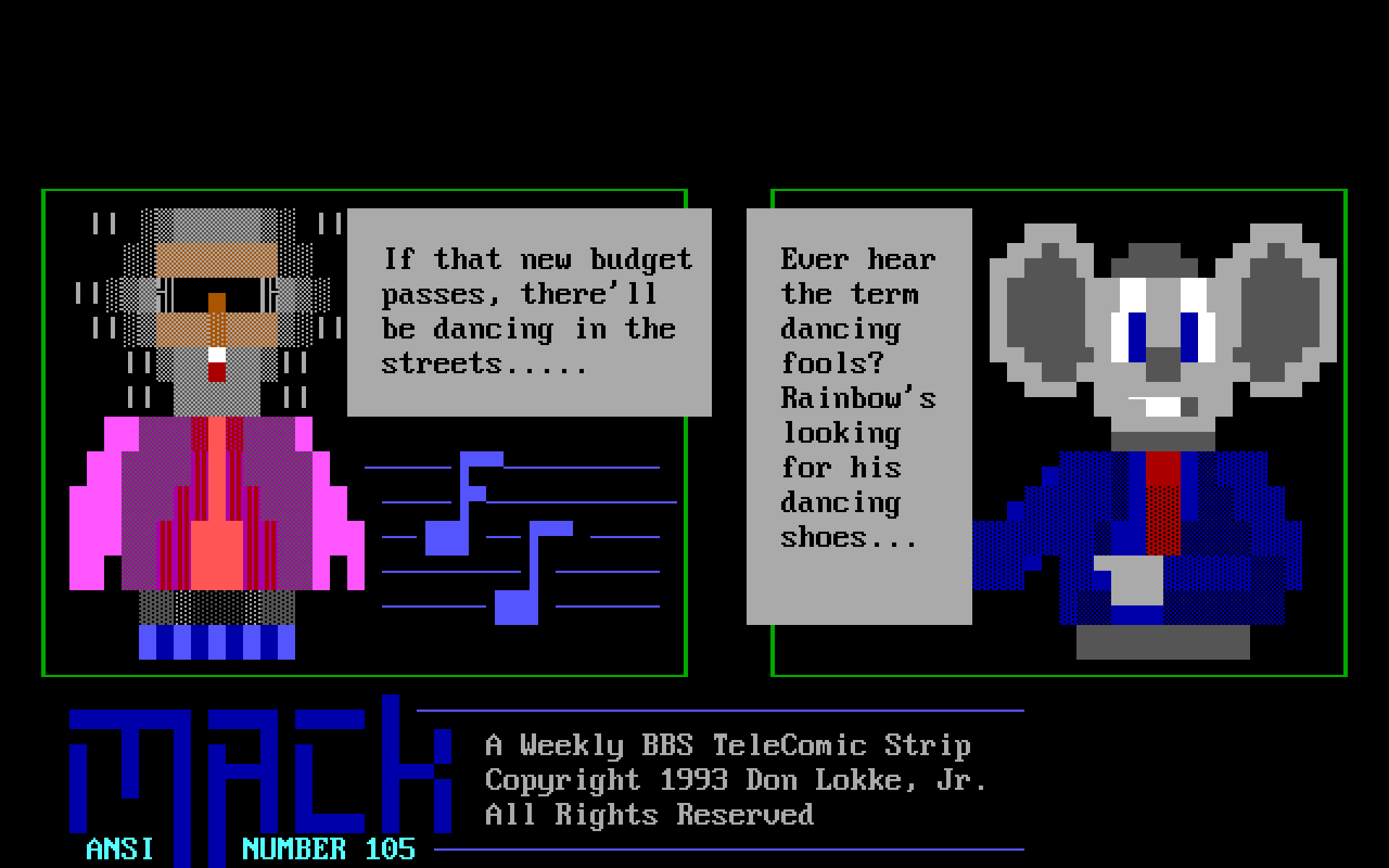
But some comics historians, such as the late R.C. Harvey, have disagreed with McCloud’s view.
“To McCloud, ‘sequence’ is at the heart of the functioning of comics,” Harvey once wrote. “To me, ‘blending’ verbal and visual content is.”
He identifies speech balloons — which Lokke uses extensively — as unique to the comics medium.
“Speech balloons breathe into comics their peculiar life,” Harvey wrote. “In all other graphic representations … characters are doomed to wordless posturing and pantomime. In comics, they speak.”
Harvey offered a competing description:
… comics consist of pictorial narratives or expositions in which words (often lettered into the picture area within speech balloons) usually contribute to the meaning of the pictures and vice versa.
This looser definition was intended to add single-panel “gag cartoons” to the fold, and it probably covers Lokke’s political telecomics, too.
End of the line
Like so many BBSers, Don Lokke was ultimately lured away by the siren song of the internet. As the World Wide Web became the dominant online medium, bulletin board services faded into obscurity.
In 1995, Lokke set up the “Texas Online Mall” website, the first of dozens — maybe hundreds — of advertising and marketing websites he would create over the subsequent decades.
His ANSI telecomics were eventually forgotten, and there’s no evidence they influenced the wave of webcomics that emerged later in the 1990s. They were an evolutionary dead-end in the history of digital comics, to borrow Eerie’s description from Part 3.
But Lokke wasn’t alone in his instincts about online publishing.
In 1996, he advised a marketer hoping to syndicate personalized interactive cartoons to website owners for $1,000 per month — essentially the subscription model Lokke had once offered to BBS sysops. Citing his experience as “the originator of Mack the Mouse cartoons,” he made a prediction:
“I believe there will be a lot of opportunity for syndicated content providers including columns, cartoons, news, reports and investigative white papers. Learning to market these web site add-ons will insure solid income, but you’re going to have to follow the established syndication format.”
That’s not quite how it worked out. In the early webcomics boom, most creators kept control of their work and monetized through merchandise, donations and advertising, rather than syndication.
Lokke misjudged the business model, but he was right about one thing: people wanted to read comics online.
In the text-only, pre-Web world, he tried to make that work.
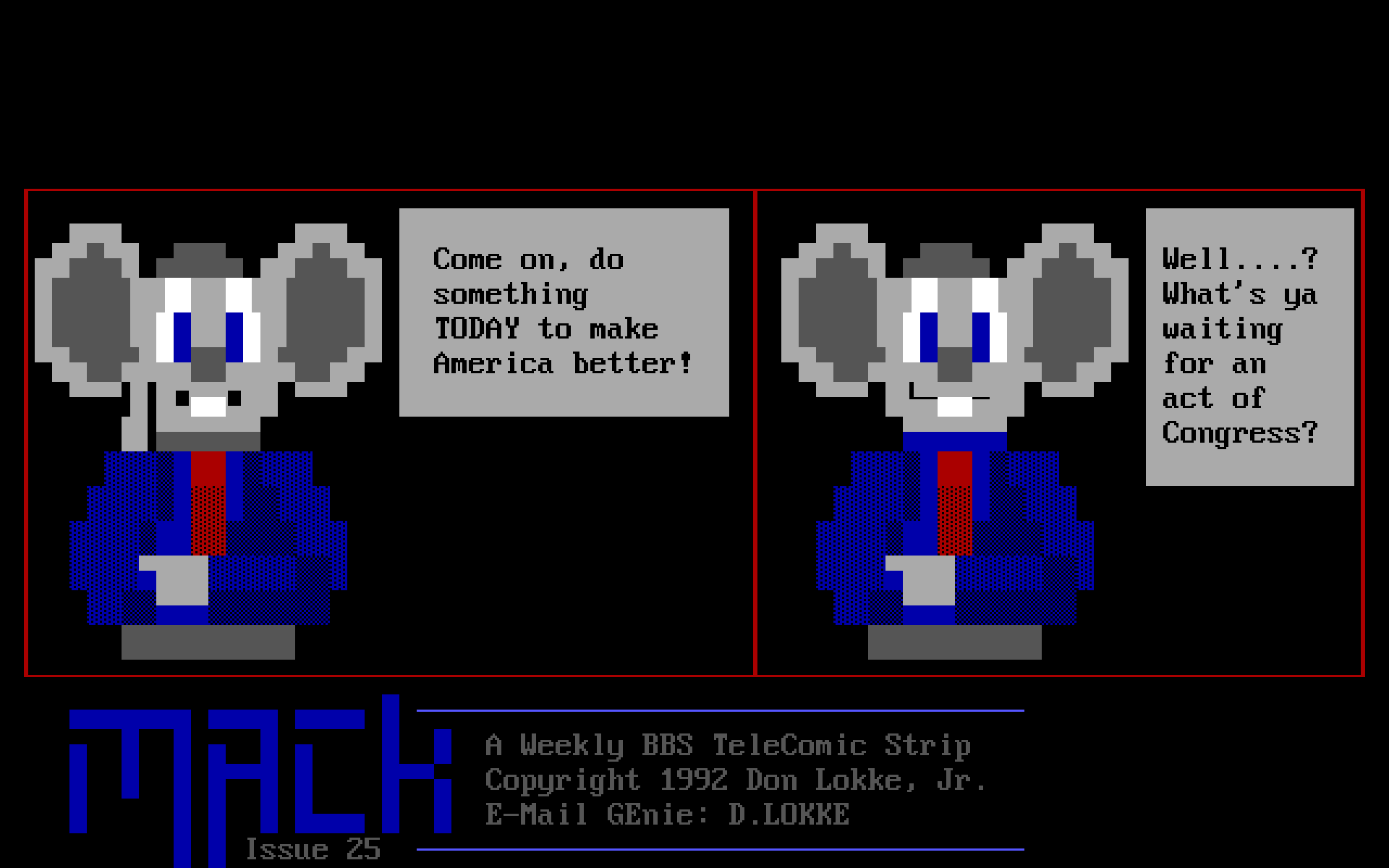
To close out this series, I’ll let Mack have the last word:
“Come on, do something TODAY to make America better!”
Share your thoughts!